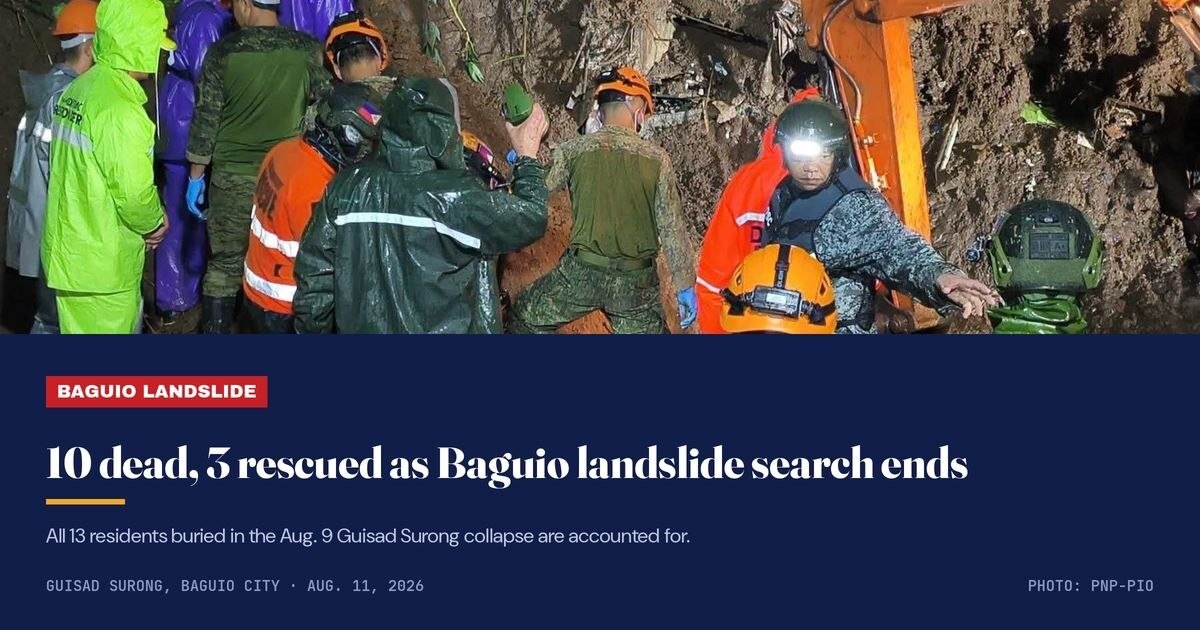
Authorities formally closed search and retrieval operations at the Guisad Surong landslide site in Baguio City just before dawn on Tuesday, August 12, after confirming that every one of the 13 residents buried by the August 9 collapse had been accounted for. Ten were confirmed dead; three were brought out alive. The Baguio City Police Office and the Incident Command Center made the announcement following nearly two days of non-stop work under dangerous conditions.
All ten bodies had been fully retrieved by 2:40 a.m. Tuesday, and the three survivors were receiving medical care at hospital, according to authorities — bringing to a close one of the most intense urban search operations Baguio City has seen in recent years.
Collapse Buried Three Houses and Five Families Along Guisad Road
The ground gave way along Guisad Road in Guisad Surong shortly past 7 p.m. on Sunday, August 9, sending earth and debris crashing into three residential structures occupied by five families, the Baguio City Public Information Office reported. The collapse happened without warning, trapping residents inside their homes.
Baguio City Mayor Benjamin Magalong confirmed that 13 individuals had been buried and that approximately 150 rescuers were mobilised to respond. The mayor described the terrain as steep and highly unstable, requiring crews to monitor the hillside continuously while heavy equipment — including a backhoe — and a K9 search dog were brought in to shift a massive concrete slab that had blocked access to buried victims.
Three people were pulled from the debris alive: a 27-year-old man, a 27-year-old woman, and a 77-year-old pastor. All three were transported to the Baguio General Hospital and Medical Center for treatment. Among the grim recoveries during Monday’s operations were the remains of a mother and her young child, found locked in an embrace.
Five of the Dead Were Students
The Department of Education confirmed Tuesday that five of the ten fatalities were young students. In its statement, the agency called on the education community to hold the victims’ families and the broader Cordillera region in their prayers. In response to the disaster, Baguio City suspended classes from preschool through Grade 12 in all public and private schools.
PNP, Volunteers, and Partner Agencies Worked Side by Side
The Philippine National Police, in a statement attributed to PNP Chief Police General Jose Melencio C. Nartatez Jr., said officers worked in coordination with local authorities and other responding agencies to locate victims, secure the perimeter, and assist those affected. The PNP said survivors were prioritised for hospital transport while retrieval work for the deceased continued in parallel, and that personnel remained deployed to support affected families long after the formal search phase ended.
Mayor Magalong extended his commendation to all rescue teams, first responders, civilian volunteers, and partner agencies who worked without rest through difficult and hazardous conditions. He also expressed gratitude toward community members who provided food, clothing, and essential supplies to both displaced families and rescue workers. At the same time, the city government warned the public that the landslide zone remains an active danger area. Magalong disclosed that 13 other landslide-prone sites across Baguio were being closely monitored as heavy rainfall continued to fall across the region.
Broader Cordillera Toll: 14 Dead, Roads Cut Off, Power Out
The Guisad Surong deaths were only part of a wider crisis unfolding across the Cordillera region. Authorities reported that at least 14 people had died in landslides across the region by August 11, with 13 others injured. Swollen rivers and repeated slope failures left at least 15 road sections impassable and cut electricity to 19 areas, isolating communities throughout the mountain provinces.
Beyond Baguio, two people were killed when a landslide crashed into a roadside eatery in Shilan, La Trinidad. In Paoay, Atok, two relatives lost their lives after being buried while clearing mud from near their home — a reminder of how secondary hazards in the aftermath of a slide can claim additional lives.
On the national level, the PNP deployed 800 personnel across affected areas and directed field units to maintain heightened alert status while intensifying preemptive evacuation efforts in vulnerable communities. The Office of Civil Defense said Tuesday it was verifying at least 19 deaths connected to Tropical Depressions Luis and Maymay and the southwest monsoon, with an estimated 2.2 million people affected across the country, according to the agency.
History Echoes: Guisad Surong Has Been Here Before
For longtime residents of the area, the August 9 collapse stirred painful memories of an older disaster. On October 18, 1967, at the height of Typhoon Trining — known internationally as Carla — a devastating landslide struck the same Guisad Surong community, killing dozens. Weather records show that Baguio received 1,216 millimetres of rainfall in the 24 hours spanning October 17 to 18 of that year.
More than half a century later, the community finds itself burying its dead again. The latest disaster has sharpened debate over the long-standing vulnerability of settlements built on Baguio’s steep, rain-saturated slopes — a structural risk that authorities acknowledge has never been fully resolved. With Baguio and Benguet continuing to absorb rainfall from successive weather systems, the threat of further slides remains very real.
By the Numbers
- 10 — fatalities confirmed and retrieved at Guisad Surong
- 3 — survivors rescued and hospitalised, including a 77-year-old pastor
- 13 — total residents initially buried; all accounted for as of August 11
- 5 — students among the dead, per the Department of Education
- 150 — rescuers deployed to the Guisad Surong site
- 14 — total Cordillera landslide deaths as of August 11
- 15 — road sections rendered impassable by flooding and slope failures
- 19 — areas left without electricity across the Cordillera
- 800 — PNP personnel deployed nationally in emergency response
- 2.2 million — people affected nationwide by Luis, Maymay, and the southwest monsoon, per the Office of Civil Defense
- 1,216 mm — rainfall recorded in Baguio over 24 hours during the October 1967 Typhoon Trining disaster
Why This Matters
The Guisad Surong landslide stands as the single deadliest incident in the ongoing wave of weather-related disasters battering the Cordillera region, with five of the ten confirmed dead identified as students — underscoring the human cost borne disproportionately by younger residents. The collapse of homes occupied by five families at once points to the persistent and well-documented danger facing communities settled across Baguio’s steep hillsides, a risk Mayor Magalong openly acknowledged remains unaddressed with 13 additional sites under active monitoring. At the national scale, the Office of Civil Defense’s count of at least 19 deaths and 2.2 million people affected signals that the monsoon emergency is still escalating, with no clear end to the weather systems driving it.
Source: Originally reported by Baguio City Public Information Office, Baguio City Police Office, and wire reports.