
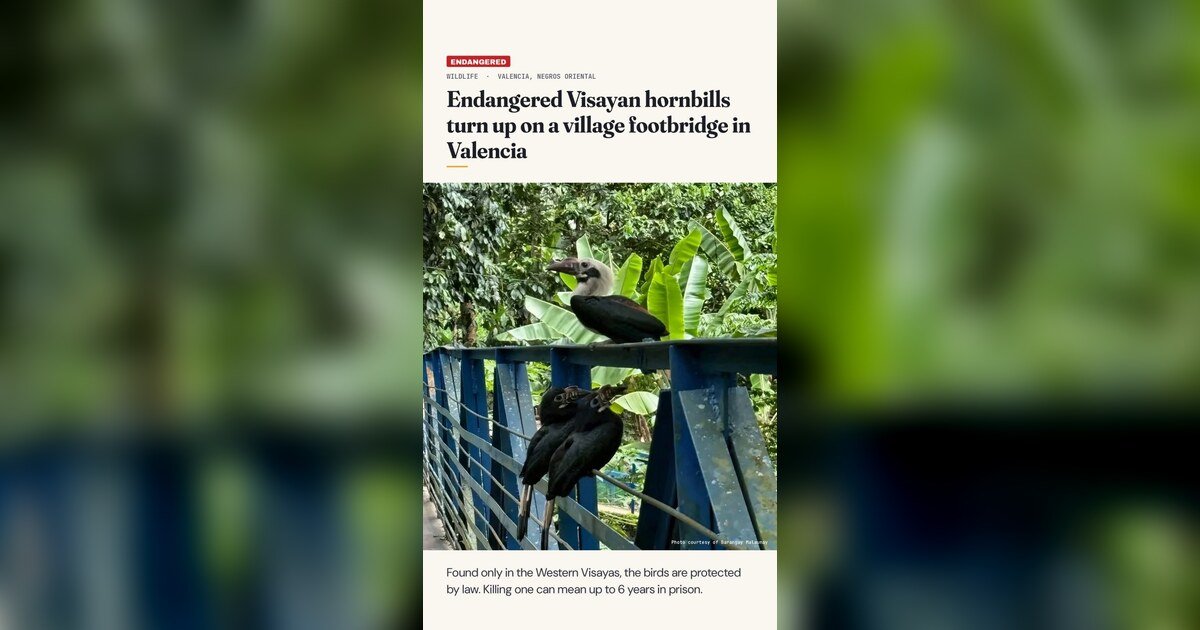
Four endangered Visayan tarictic hornbills were spotted perched on a footbridge in Barangay Malaunay, Valencia, Negros Oriental, prompting barangay officials to issue a public advisory urging residents and visitors to leave the birds undisturbed and to report any attempts to capture or harm them.
The Barangay Malaunay government posted the advisory on its official Facebook page after residents Amje S. Atoy and Engr. Amiel S. Atoy encountered the birds on a footbridge leading to their home. A photograph shared alongside the advisory shows three of the hornbills resting on the bridge’s blue steel railing, with banana plants and forest growth visible in the background.
Birds Identified as the Visayan Tarictic Hornbill
The barangay identified the birds as the Visayan tarictic hornbill (Penelopides panini), known locally as “tariktik.” The species is classified as Endangered by the International Union for Conservation of Nature (IUCN) and is found only in the tropical lowland forests of the Western Visayas — primarily on the islands of Panay and Negros.
The hornbills in the Malaunay photograph are visually consistent with the species’ known markings. Males have a creamy-white head and neck, while females are almost entirely black with blue bare skin around the eyes. According to the IUCN, the species once also occurred on Masbate and Ticao, but the Ticao subspecies is now believed to be extinct, with no recorded sightings since 1971.
A Barangay Set Against Upland Forest
Barangay Malaunay is an upland community of approximately 2,100 residents, based on the 2020 census, situated roughly 430 meters above sea level in the municipality of Valencia, west of Dumaguete City. Its forested surroundings and elevation make it suitable habitat for forest-dependent species such as the tarictic hornbill.
The hornbill feeds mainly on fruit — particularly figs and berries — and also eats insects, lizards, and other small animals. Its dependence on intact forest cover makes it especially vulnerable to habitat loss driven by logging, agricultural conversion, and mining.
Barangay Issues Protection Appeal
In its advisory, the Barangay Malaunay government called on all residents and visitors in the area not to touch, hurt, or kill the birds, and not to capture, take away, or sell them. The barangay also urged the wider community to actively help protect the species so that local bird life can continue to thrive in the area.
Residents who spot the hornbills — or who witness anyone attempting to catch or harm them — are encouraged to report it to the barangay hall or the nearest Department of Environment and Natural Resources (DENR) office, the advisory stated.
Wildlife Law Carries Stiff Penalties
The Barangay Malaunay advisory reminded the public of the penalties provided under Republic Act No. 9147, also known as the Wildlife Resources Conservation and Protection Act, which prohibits the hunting, capturing, or possession of endangered species such as the Visayan tarictic hornbill.
Under RA 9147, killing an endangered species is punishable by imprisonment of four years and one day to six years and a fine ranging from ₱50,000 to ₱500,000. Killing a critically endangered species carries a heavier penalty of six years and one day to 12 years in prison and a fine of ₱100,000 to ₱1,000,000.
Population Estimates Remain Contested
Estimates of how many Visayan tarictic hornbills remain in the wild vary significantly. A 2000 IUCN assessment placed the global wild population at approximately 1,200 birds. The Philippine Biodiversity Conservation Foundation has since counted 3,584 hornbills on Negros island alone, suggesting the earlier figure may have been conservative. Researchers note that additional surveys are still needed to arrive at a more definitive count.
The species faces ongoing threats from habitat destruction through logging, land conversion for agriculture, and mining activities, as well as from hunting and the illegal wildlife trade — pressures that have steadily reduced both its numbers and range over decades.
By the Numbers
- 4 — Visayan tarictic hornbills spotted on the Malaunay footbridge
- 1971 — Last recorded sighting of the Ticao subspecies, now believed extinct
- 1,200 — Estimated wild population in a 2000 IUCN assessment
- 3,584 — Hornbills counted on Negros island by the Philippine Biodiversity Conservation Foundation
- 2,100 — Approximate population of Barangay Malaunay (2020 census)
- 430 meters — Elevation of Barangay Malaunay above sea level
- ₱50,000–₱500,000 — Fine for killing an endangered species under RA 9147
- 4 years and 1 day to 6 years — Prison term for killing an endangered species under RA 9147
Why This Matters
The Visayan tarictic hornbill is an endangered species with a range restricted almost entirely to Panay and Negros, making every verified sighting significant to conservation efforts. The appearance of four birds in a residential barangay in Valencia underscores that intact upland forest habitats in Negros Oriental continue to support threatened wildlife — and that communities living alongside these areas play a direct role in whether the species survives. The barangay’s swift public advisory, backed by the legal penalties under RA 9147, reflects the front-line responsibility that local governments carry in protecting the country’s biodiversity.
Photo credit: Photo courtesy of Barangay Malaunay/Facebook