
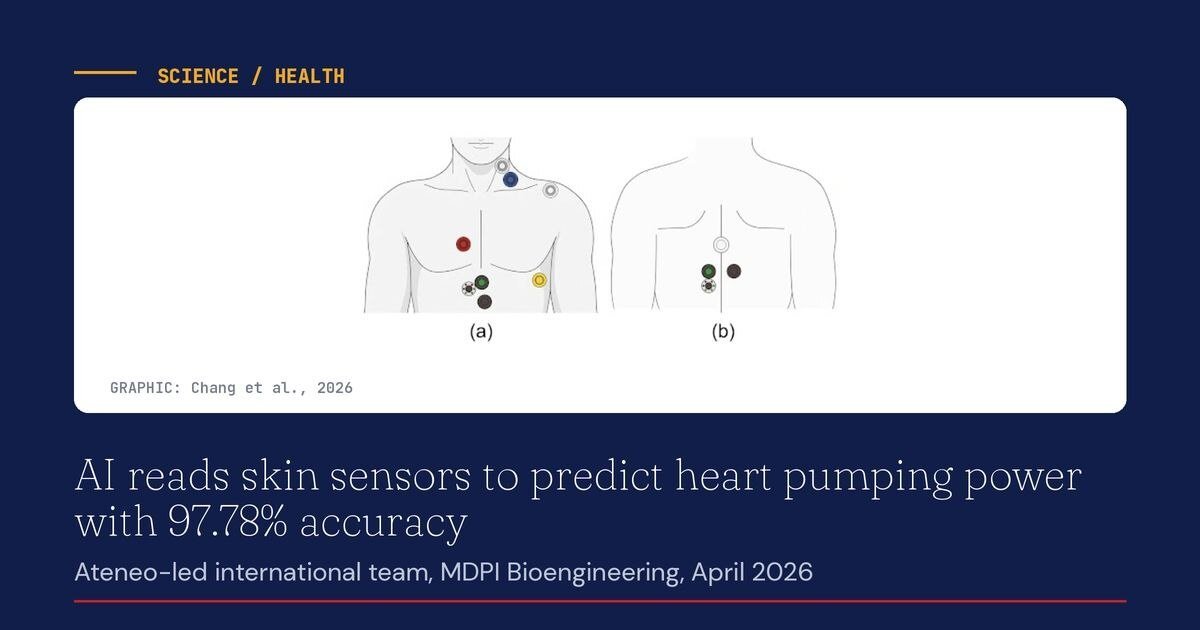
A research team spanning the Philippines, Taiwan, and China has produced an artificial intelligence model capable of assessing how efficiently the human heart pumps blood — and it does so without needles, catheters, or hospital-grade hemodynamic equipment. The model, which relies solely on readings gathered through adhesive sensor patches placed on a patient’s skin, achieved a classification accuracy of 97.78 percent, according to findings published in the April 2026 edition of Bioengineering, a peer-reviewed scientific journal.
Leading the Filipino side of the collaboration is Patricia Angela R. Abu of the Ateneo de Manila University’s Department of Information Systems and Computer Science. The paper, formally titled “Robust Non-Invasive Cardiac Index Prediction via Feature Integration and Data-Augmented Neural Networks,” brings together thirteen researchers from institutions in the Philippines, Taiwan, and China in what its authors describe as a meaningful advance toward broader access to cardiac diagnostics.
Understanding What the Cardiac Index Actually Measures
Before the significance of this research can be fully appreciated, it helps to understand what the cardiac index is. As a clinical measurement, the cardiac index quantifies how much blood the heart pumps in relation to a patient’s body surface area. Cardiologists rely on it alongside other physiological indicators — including heart rate, stroke volume index, and cardiac output — to evaluate heart performance and determine appropriate treatment courses.
The challenge, according to the published study, is that obtaining this measurement through standard methods demands a specialized hemodynamic analyzer, controlled clinical conditions, and staff with the training to interpret the results. That combination, the research team notes, is almost exclusively available within major hospitals in metropolitan areas, effectively putting the diagnostic out of reach for patients living in provincial towns and rural communities.
Skin Patches and a Neural Network: How the Model Works
Rather than relying on invasive procedures, the research team fed physiological data captured through three non-invasive Internet of Things sensing devices into an artificial neural network. The instruments used were the TERUMO ES-P2000 blood pressure monitor, the PhysioFlow PF07 Enduro cardiac hemodynamic analyzer, and the InBody 720 body composition analyzer. Sensor stickers placed directly on the skin collected the necessary readings — no injections or surgical access required.
With three physiological parameters as inputs, the neural network returned a classification accuracy of 97.78 percent — a figure the authors say substantially outperforms conventional diagnostic approaches. Notably, the model continued to perform well when the number of input parameters was reduced to two, indicating that the measurement burden on patients and health workers could potentially be reduced further without meaningfully compromising the model’s predictive power.
Ethical Clearance and the Full Research Team
The study received institutional review board approval under application number 202501987B0, confirming that the research met established ethical standards for handling clinical data. The complete list of authors includes Chih-Hao Chang, Mei-Ling Chan, Yu-Hung Fang, Po-Lin Huang, Tsung-Yi Chen, Tsun-Kuang Chi, I Elizabeth Cha, Tzong-Rong Ger, Kuo-Chen Li, Shih-Lun Chen, Liang-Hung Wang, Jia-Ching Wang, and Patricia Angela R. Abu.
A Global Health Backdrop: Cardiovascular Disease Among the Young
The World Health Organization has raised alarms about a rising incidence of cardiovascular disease among adults aged 20 to 29 — a trend driven by increasing rates of obesity, hypertension, hyperlipidemia, and diabetes in younger populations worldwide. The study frames its contribution within this wider public health context, arguing that accessible, early-stage cardiac assessment tools have become an urgent need rather than a long-term aspiration.
The study specifically notes that within the Philippines, sophisticated diagnostic capacity remains heavily concentrated in Metro Manila and a small number of regional medical hubs. For patients in rural provinces — where resident cardiologists may be scarce or entirely absent — detailed cardiac monitoring remains largely inaccessible regardless of medical need.
Moving Cardiac Assessment Closer to the Community
The research team argues that because this AI model requires only portable, non-invasive devices to generate its predictions, it could realistically be deployed at rural health units and community clinics that currently have neither hemodynamic analyzers nor cardiology staff. This would not substitute for cardiologist oversight, the authors emphasize, but it would enable frontline health workers to identify patients who require urgent referral to a specialist.
In practical terms, the research suggests that what currently requires a multi-thousand-peso specialist consultation at an urban hospital — beginning with advanced hemodynamic equipment — could eventually be initiated with an adhesive patch and a handheld sensor. For lower-resource clinical settings, that shift carries significant implications for community-level health screening and early intervention.
Broader Validation Remains the Next Hurdle
According to the published paper, the 97.78 percent accuracy figure reflects the model’s performance on its study cohort under controlled laboratory conditions. Before clinical deployment can be seriously considered, the model will need to be validated against real-world patient populations encompassing more varied demographic profiles. The research team has stated its intention to pursue exactly this kind of expanded validation, as well as to investigate whether the number of required measurements can be reduced further ahead of any broader clinical application.
By the Numbers
- 97.78% — classification accuracy achieved by the AI model using three physiological input parameters
- 3 — number of non-invasive sensing devices used (TERUMO ES-P2000, PhysioFlow PF07 Enduro, InBody 720)
- 2 — minimum parameter inputs under which the model remained reliably effective
- 13 — total authors listed on the published research paper
- 202501987B0 — institutional review board application number confirming ethical clearance
- 20 to 29 — age bracket identified by the World Health Organization as experiencing rising cardiovascular disease rates
Why This Matters
The study presents a technically credible pathway toward making advanced cardiac monitoring accessible far beyond major urban hospitals — a particularly consequential development in the Philippines, where hemodynamic diagnostics remain geographically and financially out of reach for large segments of the population outside Metro Manila. The World Health Organization’s documented rise in cardiovascular disease among young adults makes the case for earlier, more accessible detection tools increasingly urgent. Real-world clinical validation across diverse patient populations is the essential next step before this technology can move from the laboratory into community health settings.
Source: Bioengineering (MDPI), April 2026 issue; originally reported by wire reports