DUMAGUETE CITY — Draft loan contracts for Dumaguete City’s ₱2.185 billion market and City Hall borrowing contain repricing clauses that allow Land Bank of the Philippines and Development Bank of the Philippines to adjust the interest rate — contradicting the City Council’s understanding that the 4.5 percent rate was fixed for the full 15-year term.
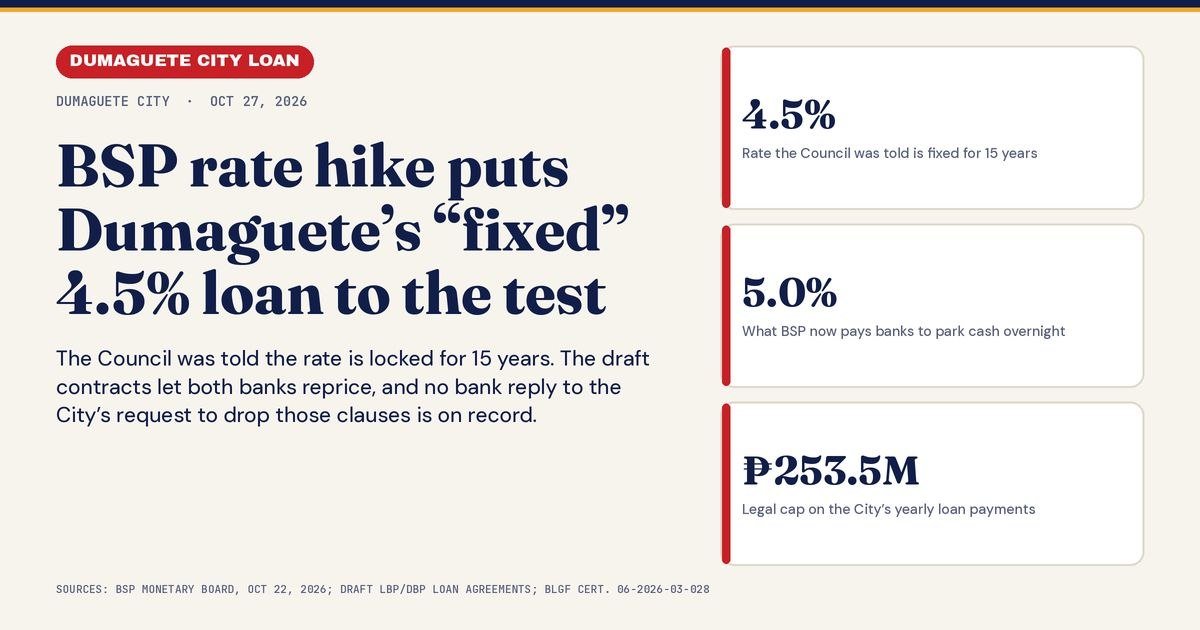
The discrepancy has sharpened since the Bangko Sentral ng Pilipinas raised its benchmark rate for the fourth time this year on October 22, bringing the policy rate to 5.5 percent. As of October 27, 2026, neither bank has replied on record to the City’s request to remove the repricing clauses.
What the Sangguniang Panlungsod Was Told
On September 8, the Sangguniang Panlungsod passed two borrowing ordinances on second and third reading. One authorises ₱1.211 billion from LBP for a new public market and a City Hall extension; the other authorises ₱974 million from DBP for the market.
In his August 27 letters requesting authority to sign, Mayor Manuel Sagarbarria described the rate as “fixed at 4.50% per annum,” provided the City maintains substantial deposits with each bank. The Local Finance Committee told councilors the fixed rate would make debt payments predictable over the life of the loan.
LBP and DBP Clauses That Allow Repricing
The draft loan agreements attached to those letters tell a different story. LBP’s draft allows the bank to adjust the interest rate — up or down — when changes in laws or regulations raise its cost of funds, on 30 days’ written notice.
DBP’s draft allows the bank to adjust the rate on notice. If the City rejects the new rate, it must repay the entire loan in full. If it neither accepts nor rejects, the new rate is “deemed accepted.” A separate clause allows either party to seek a new rate once the old one is “no longer reflective of the market.” The promissory note form included in the DBP package is titled “Form of Promissory Note (Variable Interest Rate).”
DBP’s June 3 term sheet had already quantified that risk, stating that if the City did not maintain at least ₱1 billion on deposit, the rate would switch to a three-month market benchmark plus a spread, or 5.5 percent — whichever was higher — repriced every quarter. That sentence was removed from DBP’s revised August term sheet, but the repricing clauses remained in the draft contract, and the required deposit amount was left blank.
City’s Request to Delete Clauses Went Unanswered
On September 4 — four days before the Council vote — the City Legal Office wrote both banks asking them to delete their repricing clauses “since the loan shall bear a fixed interest rate of 4.5% per annum for the entire term.” The City did not ask DBP to remove the clause allowing a new rate when the old rate no longer reflects the market.
The City Administrator later submitted a chronology of the loan process to the Council. It ends with those September 4 letters and contains no reply from either bank. The borrowing ordinances adopt the loan agreements “as amended.” On the record, those amendments remain only the City’s requests, not confirmed concessions from the lenders.
BSP Rate Now Above the Loan’s Offered Rate
LBP and DBP first offered Dumaguete 4.5 percent in January and February, when the BSP’s policy rate stood at 4.25 to 4.5 percent, according to BSP records. The October 22 Monetary Board decision brought the benchmark rate to 5.5 percent — meaning a bank now earns 5 percent simply by leaving money with the central bank overnight, compared to the 4.5 percent the City’s loan would pay over 15 years.
BSP Governor Eli Remolona Jr. said the central bank remains open to further increases. The Monetary Board is scheduled to meet again on December 17. The peso closed at a record 63.95 to the dollar on October 26 and touched 64 in trading on October 27 — its 32nd record low this year — according to GMA News and The Philippine Star. A weaker peso raises imported fuel and goods costs, adding to the inflation the BSP is working to contain.
Repayment Schedule Already Exceeded the Legal Debt Ceiling at 4.5%
The Bureau of Local Government Finance set Dumaguete’s net debt service ceiling — the legal limit on annual loan payments — at ₱253.5 million. Based on the feasibility study’s repayment schedules, BNNO computed combined payments to both banks at approximately ₱266.4 million in 2029 and ₱259.6 million in 2030, both figures above the BLGF ceiling even at the stated 4.5 percent rate.
Each additional percentage point added to the rate would cost roughly ₱21 million more per year during those peak years. At 5.5 percent, 2029 payments would reach approximately ₱287 million — ₱34 million above the ceiling. At 6.5 percent, they would reach approximately ₱308 million, or ₱55 million over the limit. Across the full 15-year term, each extra percentage point adds an estimated ₱190 million to ₱220 million in total interest.
The loans provide two years of interest-only payments, followed by 52 quarterly principal payments. The BLGF ceiling is recomputed annually against actual income, so the City stays within it only if revenue grows as projected.
Reviewers Questioned Revenue Assumptions Behind the Plan
The feasibility study assumes the City’s national tax allotment will grow 11 percent a year, compounded, for 15 years. Dumaguete’s actual NTA dropped from ₱860.5 million in 2022 to ₱736.3 million in 2023, and stood at ₱782.5 million in 2024. Pinnacle Accounting & Consultancy Services, the financial reviewer, called the 2022 and 2023 figures probable outliers and recommended using a 10-year basis instead.
The study expects the new public market to generate approximately ₱80.6 million in annual revenue — about 37 percent of total debt repayment. The old market’s gross revenue has peaked at ₱30 million to ₱35 million, and it ran an operating deficit in seven of the last eight years.
Much of the remaining repayment falls on the City’s 20 percent development fund. In Year 3 of repayment, the debt draw of ₱83.1 million would consume roughly half of the fund’s projected ₱161.6 million — money otherwise allocated to flood control, health programmes, and barangay assistance.
Atty. Golda Benjamin, the legal member of the independent review panel, noted that the feasibility study contains no computation for a repriced loan and did not recommend approval of the borrowing.
City Study Panel Disputed the Reviewers’ Findings
The City’s feasibility study committee responded to the reviewers on August 25, stating there is “no scenario in which the revenue model collapses” and describing the loan as fixed for the full term with no repricing.
A draft Council resolution filed in September recommends that the City review “financing requirements, funding sources, financial sustainability and long-term fiscal implications” before “major project commitments.” The borrowing ordinances were passed before that review was completed.
Consequences if Rate Terms Change
The BLGF certificate on Dumaguete’s borrowing capacity, issued March 12, is valid for one year and is revoked if loan terms change — meaning the City may need a new certificate if the rate or other conditions are renegotiated.
Because the ordinances name 4.5 percent, new terms would arguably require the matter to return to the Council. The contracts’ prescribed remedy for a higher rate is full repayment of the loan. DBP charges a 3 percent penalty if another bank refinances its portion, plus what it terms breakage costs. Veterans Bank, whose February offer the City set aside, informed City Hall in July that rates had already risen since that offer. LBP’s own summary of terms states its offer is “subject to market conditions at the time of availment.” No loan proceeds have been released.
The DBP draft also requires the City to certify, each time it draws on the loan, that total loan payments remain within 20 percent of regular income. An incorrect certification constitutes a default. Both banks’ draft contracts set default charges at 24 percent per year; DBP’s version compounds those charges quarterly on top of the regular rate.
Photo credit: Photo from Breaking News Negros Oriental
Related stories