Military Mobilizes Full HADR Response Across Three Mindanao Areas
Within hours of assessing the damage caused by a recent earthquake, the Philippine Army activated its Humanitarian Assistance and Disaster Response (HADR) machinery on Wednesday, June 11, 2026 — sending specialized teams into General Santos City, Sarangani province, and Davao Occidental to deliver relief goods, restore road access, and address the urgent need for safe drinking water among affected communities.
The coordinated military response was officially announced by Col. Louie G. Dema-ala, Chief Public Affairs of the Philippine Army at Fort Bonifacio, Taguig City. According to Col. Dema-ala’s statement, all operations are being carried out in close partnership with local government units and national government agencies, consistent with established disaster response protocols under the National Disaster Risk Reduction and Management Council framework.
Four Barangays in General Santos City Reached by Army Response Teams
In General Santos City, the Philippine Army’s Emergency Response Company (ERC) linked up with the City Disaster Risk Reduction and Management Office (CDRRMO) to jointly carry out relief activities across four of the worst-hit communities. The barangays covered by Army HADR teams were Labangal, Calumpang, Apopong, and Fatima — all identified as heavily impacted by the seismic event.
Troops on the ground assisted residents with immediate relief requirements while participating in coordinated damage assessment activities alongside city officials. The integration of Army personnel with civilian disaster management offices reflects standard military protocol during large-scale emergencies, ensuring that military resources complement rather than duplicate civilian-led response efforts.
Mobile Water Purification Unit Serves Hospital, Then Shifts to Residential Area
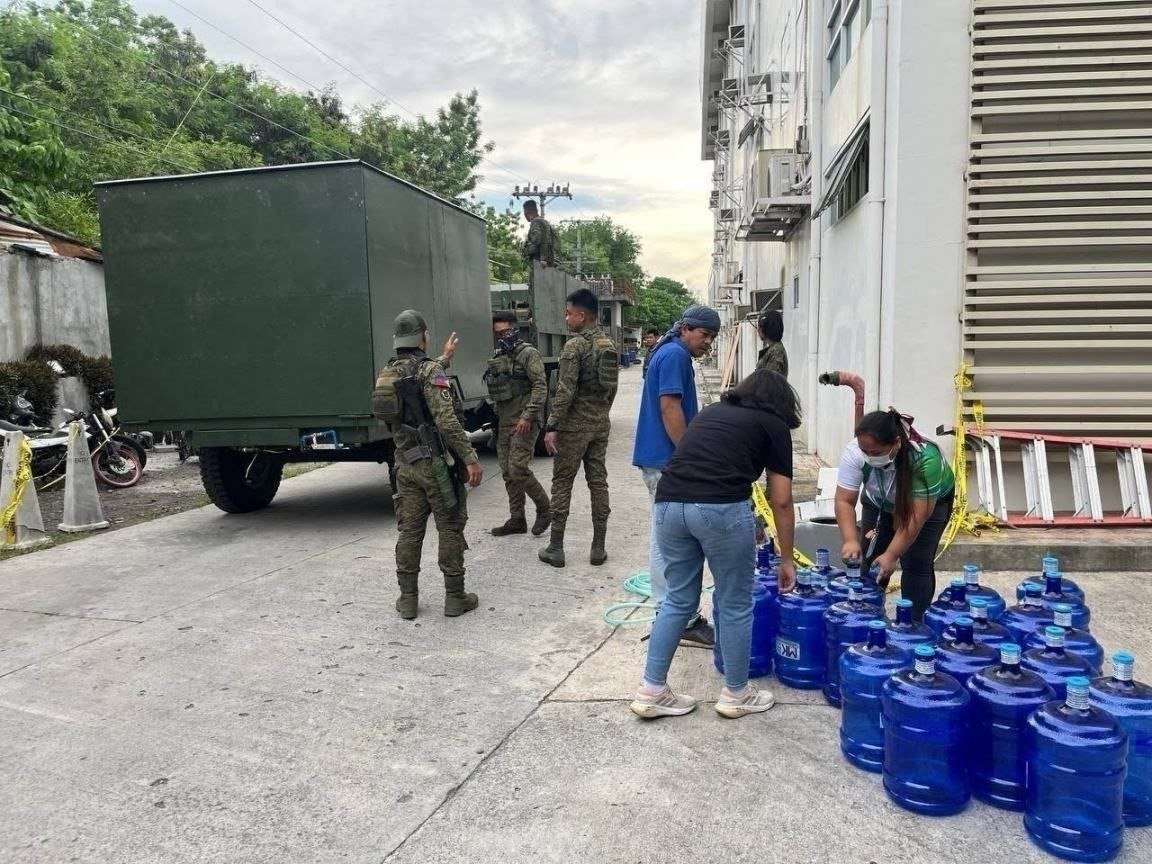
Among the most vital interventions recorded on June 11 was the installation of a mobile water purification system at the General Santos Medical Center. A Philippine Army sustainment team deployed the unit to supply potable water to patients, their companions, and hospital staff after the facility’s regular water supply was disrupted by earthquake damage.
Once the hospital’s most critical water needs were addressed, the purification system was repositioned to Purok Filomena in Barangay Calumpang, General Santos City, where it continues to serve community members who lost access to safe drinking water. Relief agencies consistently classify potable water provision as a top priority in post-disaster environments, given that damaged water infrastructure sharply raises the risk of waterborne disease among displaced or otherwise vulnerable populations. The Army’s mobile purification capability allows it to respond to this need rapidly, independent of fixed utility infrastructure.
603rd Infantry Brigade Covers Nine Municipalities in Sarangani Region
Outside of General Santos City, HADR teams drawn from the 603rd Infantry Brigade fanned out across a broad swath of territory in Sarangani province and the wider SOCCSKSARGEN region. Col. Dema-ala confirmed that Brigade teams are actively assisting local authorities in Kiamba, Maitum, Maasim, Lake Sebu, T’boli, Lebak, Kalamansig, and Palimbang.
Operations in these municipalities include damage assessment, ground-truthing of early destruction and casualty reports, and logistical coordination with both municipal and provincial government offices. Accurate validation of field reports is an essential component of any organized disaster response, ensuring that limited resources are directed toward areas with the greatest verified need rather than based on preliminary or unconfirmed data.
The scale of the 603rd Infantry Brigade’s deployment — stretching across multiple municipalities in two administrative regions — is a direct reflection of the earthquake’s wide geographic footprint and the proportional commitment the Philippine Army has made to the humanitarian response.
USAR Teams Launch Search, Rescue, and Retrieval Operations in Davao Occidental
Two Urban Search and Rescue (USAR) teams from the 525th Combat Engineer Battalion are currently conducting Search, Rescue, and Retrieval (SRR) operations in Davao Occidental. These specialized units are trained to navigate complex rescue environments that commonly result from significant earthquake events, including partially or fully collapsed structures requiring technical intervention.
As of the Philippine Army’s June 11 statement, no further information was disclosed regarding the specific municipalities where USAR teams are operating in Davao Occidental, nor were figures released on the number of individuals rescued or retrieved thus far. The Army indicated that additional updates would follow as operations progressed.
The deployment of combat engineer battalions in a search-and-rescue capacity highlights the versatility of these units, which bring structural assessment expertise, heavy equipment, and specialized technical rescue skills that extend well beyond the capabilities of standard infantry formations.
Road Clearing Prioritized to Restore Access for Isolated Communities
One of the earliest priorities identified by the Army HADR deployment was clearing earthquake-related debris and landslide material blocking road networks. According to the Philippine Army’s official statement released by Col. Dema-ala, clearing operations were conducted to reopen access routes to communities that had been cut off by the disaster.
Reestablishing road connectivity is widely recognized as a foundational step in post-earthquake response. Without passable roads, relief convoys cannot reach affected residents, medical teams cannot deploy to injury sites, and critically injured individuals cannot be transported to hospitals or health facilities. In rural and mountainous areas of Mindanao, blocked roads following seismic events can leave communities isolated for prolonged periods if clearing operations are delayed.
The Philippine Army did not identify specific road segments cleared or quantify the volume of debris removed in its June 11 statement, though photographs taken by multiple Army major units were cited as documentation of the ongoing clearing operations.
Interagency Coordination Central to Military’s Response Framework
The Philippine Army’s official statement stressed that HADR teams operating across General Santos City, Sarangani, and Davao Occidental are working in close coordination with both national government agencies and local government units. This whole-of-government approach aligns with the NDRRMC framework, which assigns specific responsibilities to civilian and military bodies during declared disaster situations.
While the Army’s public affairs release did not name the specific national agencies participating alongside military units, it confirmed that the overarching objective is timely, organized, and well-coordinated humanitarian response across all earthquake-affected zones. Col. Dema-ala accompanied the June 11 announcement with documentary photographs sourced from various Philippine Army major units to support transparency and public accountability in the ongoing relief effort.
All Operations Remain Active; Residents Urged to Coordinate with Local DRRMO Offices
As of the Philippine Army’s most recent June 11 update, all HADR operations across the affected regions remain active with no announced end date. Military disaster response operations of this scope typically continue until comprehensive damage assessments are completed, key infrastructure is restored to functional status, and displaced residents have either returned to their homes or been transitioned into longer-term shelter and recovery programs.
Earthquake-affected residents in General Santos City, Sarangani province, and Davao Occidental are encouraged to reach out to their respective barangay offices or city and municipal Disaster Risk Reduction and Management Offices to register damage, access available relief assistance, and obtain current information on water supply and road restoration efforts.
The scope and speed of the Philippine Army’s response illustrate the increasingly central role the military plays as a first-responder institution during major natural disasters, with HADR capabilities now embedded as a standard operational function within infantry brigades and combat engineer units throughout the country.
Originally reported by: Philippine Army Public Affairs Office via wire reports
Related stories