
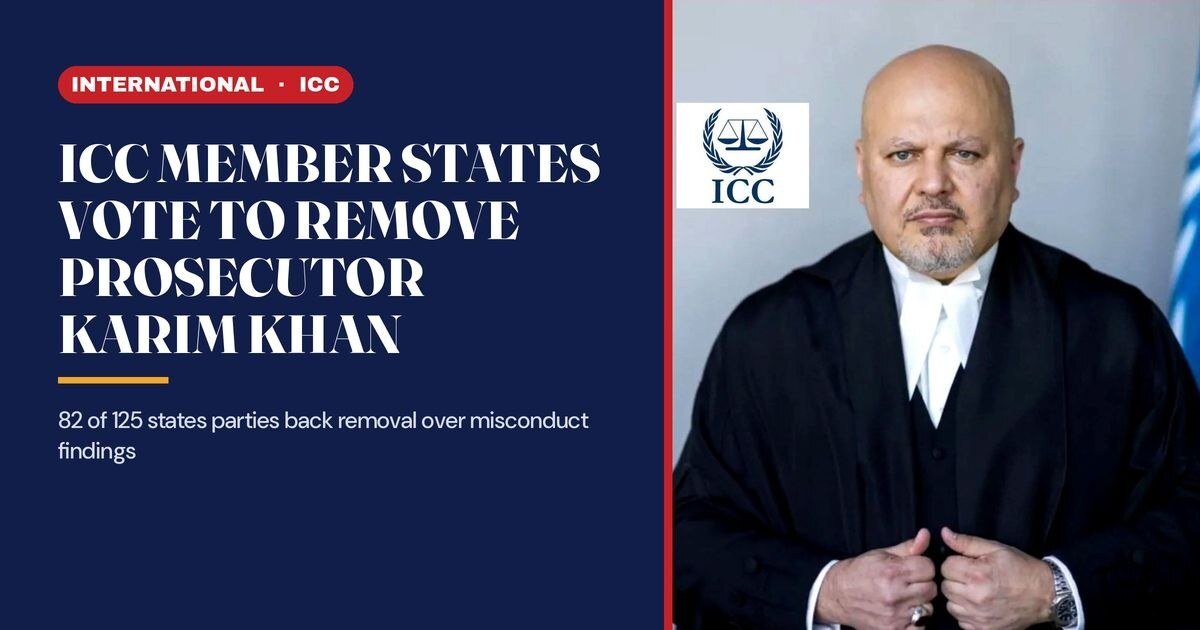
In an unprecedented move that rewrote the history of international justice, the International Criminal Court’s assembly of member states formally removed Chief Prosecutor Karim Khan from office on Friday, July 25, finding him guilty of serious misconduct and a serious breach of his duties. Despite the seismic nature of that decision, legal proceedings against former Philippine President Rodrigo Duterte are proceeding without disruption.
A Secret Ballot That Made History
The extraordinary session took place at United Nations headquarters in New York, where delegates cast secret ballots during a special convening of the Assembly of States Parties. Assembly President Päivi Kaukoranta announced the result: 82 of the court’s 125 member states voted in favour of removal — well above the absolute majority threshold of 63 required under ICC rules. Thirteen member states voted to retain Khan, while 15 abstained and another 15 took no part in the ballot, according to the Assembly.
Kaukoranta stated that the 82 voting states had concluded Khan engaged in prohibited conduct toward a subordinate staff member, conduct that rose to the level of serious misconduct and a serious breach of duty. The dismissal is the first of its kind in the ICC’s 24-year operational history.
How the Case Against Khan Began
The misconduct allegations trace back to a formal complaint lodged by a Malaysian lawyer who had served as Khan’s direct personal assistant. Legal news outlet JURIST identified the complainant only by her first name. The Assembly’s oversight body commissioned the UN Office of Internal Oversight Services to lead a full investigation — one that stretched for more than a year — and focused on the former aide’s account of non-consensual sexual acts.
According to Inquirer.net, Khan stepped away from his duties on a leave of absence in May 2025 once the inquiry was formally launched. He was subsequently suspended by the Assembly’s executive committee on June 8, 2026, pending the outcome of Friday’s vote. In the days immediately before the ballot, the complainant appeared in a televised interview to recount her allegations publicly and, as reported by MSN, denied that she had been acting as a representative or instrument of any state. Khan has maintained throughout the process that he did nothing wrong.
Khan’s Legal Team Vows to Fight On
Tayab Ali of Bindmans LLP, acting as Khan’s lawyer, said his client intends to challenge the Assembly’s decision. According to Al Jazeera, Ali pointed out that a judicial panel had unanimously ruled that the OIOS findings did not establish misconduct or a breach of duty within the applicable legal framework, and argued that the Assembly’s vote therefore contradicts both the evidence and that judicial finding.
Ali further contended, as reported by Fox News, that Khan and his legal representatives were barred from making formal submissions to the Assembly ahead of the vote. He characterised the entire process as politically motivated and procedurally unjust, noting that over 180 non-governmental organisations and senior international legal experts had publicly raised due process objections — objections he says the Assembly chose to disregard.
Assembly President Kaukoranta firmly rejected those claims. According to JURIST, Kaukoranta maintained that Khan’s due process rights were fully respected throughout the proceedings and that the investigation did yield evidence sufficient to support the allegations against him.
Duterte Trial Moves Forward Under Deputy Prosecutor Niang
Khan’s ouster carries no practical consequence for the Philippine case. He had already been disqualified from involvement in the Duterte proceedings back in October 2025, when ICC judges determined there was a reasonable appearance of bias — stemming from Khan’s earlier legal work representing victims of alleged extrajudicial killings in the Philippines before he assumed the role of chief prosecutor, according to Philstar.com.
Since that disqualification, the ICC’s Office of the Prosecutor has been managing the Philippine situation under the leadership of Deputy Prosecutor Mame Mandiaye Niang. The court has confirmed that Khan’s earlier disqualification had no bearing on the case, and following Friday’s vote, the ICC released a statement acknowledging the Assembly’s decision while affirming that its institutional work would continue uninterrupted, citing the professionalism of its staff, according to Inquirer.net.
According to VERA Files, Duterte’s trial is formally scheduled to open on November 30 in The Hague, where he faces three counts of crimes against humanity connected to the bloody anti-drug campaign he oversaw during his presidency. Duterte has been held in ICC custody since March 2025.
Washington and Jerusalem Respond
The United States — which is not a member of the ICC — offered no sympathy for the ousted prosecutor. State Department spokesman Tommy Pigott described Khan as a “quintessential example of the ICC’s corruption and abuse of its supposed authority,” while making clear that the vote would have no effect on Washington’s existing campaign to weaken or dismantle the court, according to Israel National News.
Secretary of State Marco Rubio had announced the week prior that the United States was launching a broad offensive against what he characterised as the ICC’s threat to American sovereignty, according to Euronews. That campaign includes pressure on member states to withdraw from the court, sanctions targeting organisations that cooperate with ICC proceedings, and entry denials for court personnel. Washington has already sanctioned 11 ICC judges and prosecutors, including Khan himself.
Israeli Foreign Minister Gideon Sa’ar welcomed the removal, calling it long overdue, while renewing his country’s demand that the 2024 arrest warrants against Prime Minister Benjamin Netanyahu and former Defence Minister Yoav Gallant be revoked, according to The Times of Israel. Legal experts note, however, that those warrants fall exclusively under the authority of ICC judges and are entirely unaffected by Khan’s departure.
Search for New Prosecutor Begins; Venezuela Exits
Khan’s dismissal automatically sets in motion the process of selecting a new chief prosecutor, though Al Jazeera reported that an election is not expected to take place before sometime next year. In a development that compounded the turbulent day for the court, Venezuela announced — within hours of the ballot result — that it would be withdrawing its membership from the ICC, according to The Times of Israel.
By the Numbers
- 125 — total ICC member states eligible to vote
- 82 — member states that voted to remove Khan, surpassing the required threshold
- 63 — the absolute majority threshold required under ICC rules for removal
- 13 — member states that voted against Khan’s removal
- 15 — member states that abstained from the vote
- 15 — member states that did not participate at all
- 24 years — the ICC’s operational lifespan; Khan’s ouster is the first removal in that history
- 180+ — NGOs and international legal experts who publicly raised due process concerns before the vote
- 11 — ICC judges and prosecutors sanctioned by the United States, including Khan
- 3 — counts of crimes against humanity Duterte faces at trial
- November 30 — scheduled date for the opening of Duterte’s trial in The Hague
- March 2025 — month Duterte was taken into ICC custody
Why This Matters
The forced removal of Karim Khan is a watershed event for international justice: in 24 years of operation, the ICC has never before expelled a sitting chief prosecutor, and the vote exposes the court’s vulnerability to political pressures from powerful states including the United States and Israel. For the Philippines specifically, the leadership change at the top of the Office of the Prosecutor is legally inconsequential — Deputy Prosecutor Mame Mandiaye Niang has been directing the case since Khan’s disqualification in October 2025, and Duterte’s trial on three counts of crimes against humanity is firmly scheduled to open November 30 in The Hague. The simultaneous announcement of Venezuela’s withdrawal and Washington’s openly declared campaign to undermine the court’s authority signal a period of intensifying institutional pressure on the ICC at one of the most consequential moments in its history.
Source: Inquirer.net, Philstar.com, VERA Files, Al Jazeera, JURIST, MSN, Fox News, Euronews, Israel National News, The Times of Israel
Related stories