
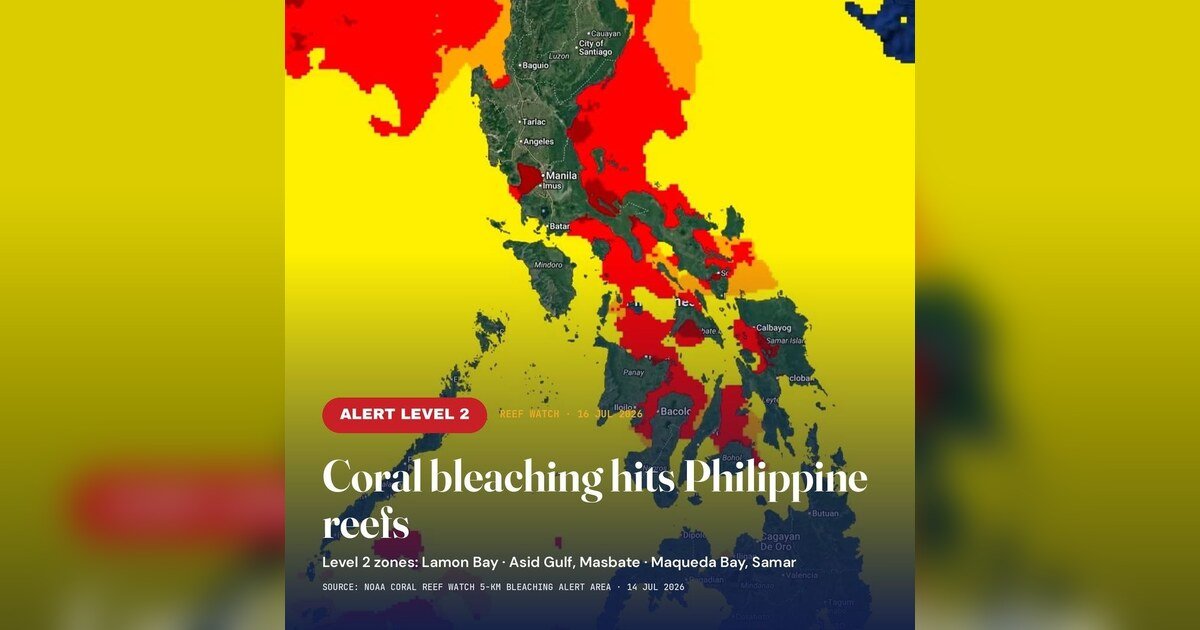
Some of the most ecologically sensitive reef systems in the eastern Philippines are now under the highest tier of coral bleaching alerts, with scientists warning that significant coral death is likely in at least three identified zones, according to a July 16 advisory drawing on NOAA Coral Reef Watch satellite data mapped for July 14, 2026.
The advisory, issued by reef monitoring organizations tracking thermal stress across Philippine waters, identifies Lamon Bay, the Asid Gulf near Masbate, and Maqueda Bay near Catbalogan in Samar as the areas bearing the most severe conditions — all classified under Alert Level 2, the highest designation on NOAA’s bleaching alert scale.
What Alert Level 2 Means for Corals
According to NOAA Coral Reef Watch, whose satellite-based monitoring system underpins the alert classifications, an Alert Level 2 designation means that accumulated heat stress has reached a threshold where significant coral bleaching is expected to occur — and where heat-sensitive coral species face a real risk of dying. This is not a predictive warning; it reflects thermal stress that has already built up in those waters.
NOAA’s bleaching alert scale operates in four tiers. At the base level, a Watch designation (marked in yellow) signals low thermal stress with conditions that could worsen if sea surface temperatures remain elevated. A Warning (orange) indicates that thermal stress is actively accumulating and that bleaching may already be occurring in some reef locations. Alert Level 1 (red) confirms that bleaching is expected and is likely already underway. Alert Level 2 (dark red) represents the most critical stage — significant bleaching is expected, and coral mortality is considered likely.
Widespread Alerts Across the Country
The July 14 data mapped by NOAA Coral Reef Watch shows that the three Level 2 zones are not isolated incidents. Alert Level 1 conditions — where bleaching is expected and probably already in progress — span a considerably wider band of Philippine reef areas. The advisory identifies parts of Calabarzon, the Bicol region, Tayabas Bay, portions of Lamon Bay outside the most critical zone, Masbate, northern Panay Island, western Samar, and select reefs north of Tawi-Tawi as falling under Level 1 status.
Beyond those, Warning-level conditions are present across several other reef areas, indicating heat stress is building. A Watch designation — the lowest tier — remains widespread across much of the country, suggesting that large portions of Philippine reef systems are not yet in the clear and remain vulnerable if ocean temperatures continue to stay elevated.
Understanding Coral Bleaching
Coral bleaching is a physiological stress response that occurs when corals are exposed to elevated water temperatures, disease, pollution, sedimentation, or other environmental disturbances. When stressed, corals expel the symbiotic microalgae called zooxanthellae that live within their tissues. These algae are responsible for providing corals with up to 90 percent of their energy through photosynthesis and give corals much of their visible color. Once expelled, the coral turns white or pale — hence the term “bleaching.”
If the stressful conditions that triggered the bleaching persist for an extended period, the coral is unable to recover and will die. Reef systems that succumb to bleaching events lose not only their structural complexity but also the biodiversity they support — including fish species, invertebrates, and other marine life that depend on the reef for habitat and food.
Reef Monitors Called to Document Conditions
In response to the escalating alerts, the advisory issued a call to action for reef monitors and patrollers with direct access to affected reef areas. According to the advisory, those on the ground are being asked to document underwater conditions — recording both bleached corals and areas that remain healthy.
Monitoring groups are currently transitioning to a new reporting platform, and the advisory directs those with photographic documentation to submit their reports for validation through a dedicated online form at tinyurl.com/phcoralreefreport. Individuals who have already submitted earlier reports from previously affected reefs are urged to continue their observation and to document any signs of recovery or further deterioration.
The advisory states that field data collected through these reports will serve multiple conservation purposes: helping map the full geographic extent of the bleaching event, identifying reefs that have recovered or proven more resilient, and locating potential “reefs of hope” — reef sites that could serve as anchors for long-term conservation and restoration strategies against future marine heatwaves.
By the Numbers
- 3 reef zones classified under the highest Alert Level 2 designation (Lamon Bay, Asid Gulf, Maqueda Bay)
- 4 tiers in NOAA’s bleaching alert scale: Watch, Warning, Alert Level 1, Alert Level 2
- 5 kilometers — the resolution of the NOAA Coral Reef Watch Bleaching Alert Area satellite product used for the map
- July 14, 2026 — the date of the satellite data on which the alert map is based
- July 16, 2026 — the date the advisory was issued
Why This Matters
The presence of Alert Level 2 conditions across three distinct reef zones in eastern Philippine waters signals that coral mortality is not merely a risk but an expected outcome if thermal stress persists — a consequence that would cause lasting damage to marine ecosystems that support fisheries and coastal biodiversity. The simultaneous spread of Level 1 and Warning alerts across multiple regions, from Calabarzon to Tawi-Tawi, indicates this is a broad-scale event affecting reef systems throughout the Philippine archipelago. Timely documentation by reef monitors, as called for in the advisory, is critical to understanding the full scope of the bleaching event and identifying which reefs may be resilient enough to support future conservation efforts.
Source: NOAA Coral Reef Watch / July 16, 2026 advisory