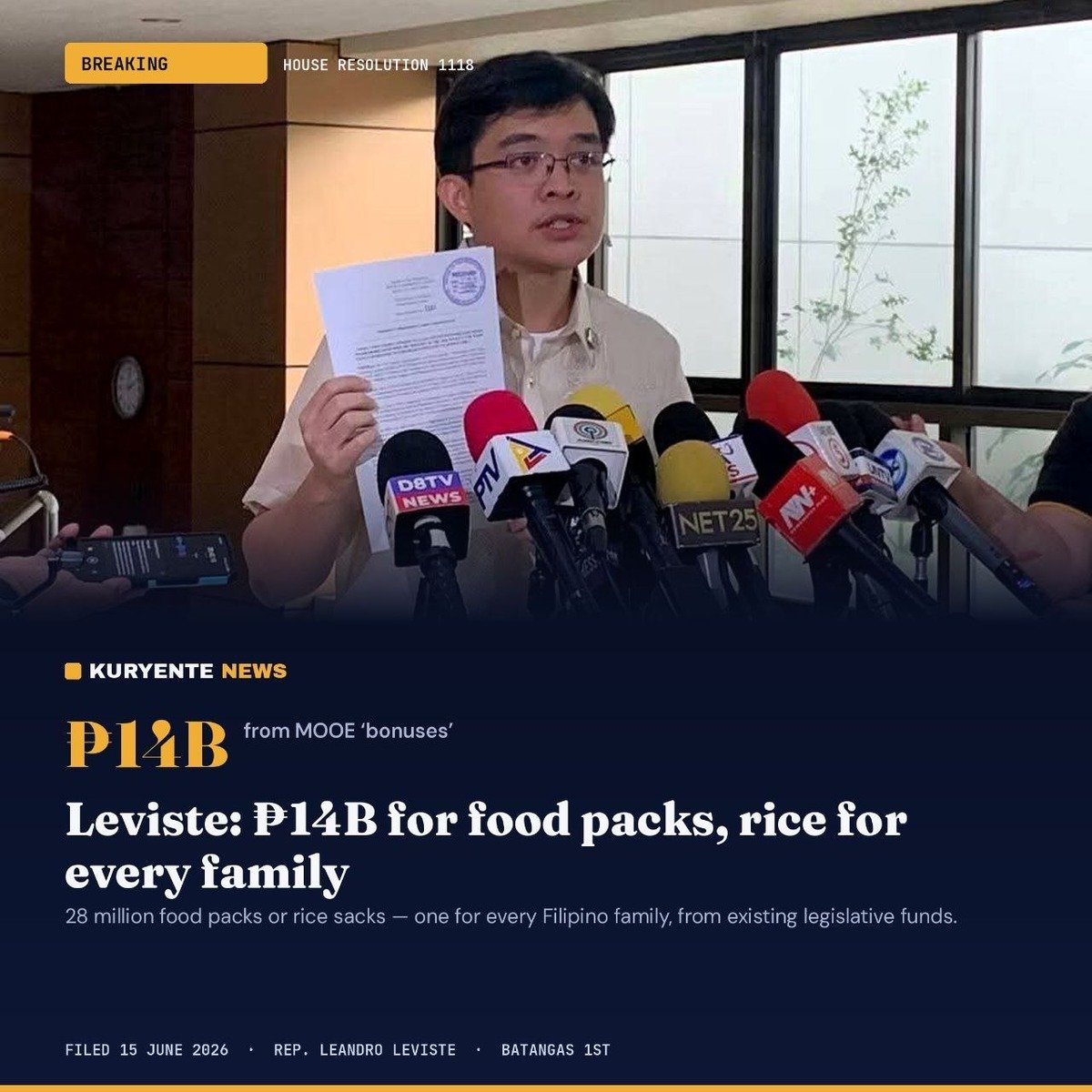
A Batangas lawmaker has filed a formal resolution calling on both chambers of Congress to cut a combined ₱14 billion from their Maintenance and Other Operating Expenses (MOOE) and channel the savings into tangible food assistance — either disaster relief packs or a 10-kilogram sack of rice for every Filipino household.
House Resolution No. 1118, filed by First District Representative Leandro Legarda Leviste on June 15, 2026, during the Second Regular Session of the 20th Congress, proposes realigning existing funds within the already-approved 2026 national budget rather than appropriating new money. Leviste introduced the measure at a press briefing held at the House of Representatives, where he displayed sample cheques to illustrate how much individual members currently receive from MOOE allocations.
One Bag of Rice Per Filipino Household
Under the congressman’s proposal, the combined MOOE of the House and Senate — which HR 1118 places at roughly ₱23.89 billion — could be trimmed to approximately ₱10 billion, a figure Leviste said is consistent with historical congressional spending levels. The ₱14 billion that would be freed up from this reduction, he argued, is enough to reach every Filipino family in a meaningful way.
According to Leviste, ₱14 billion at ₱500 per unit — the approximate cost of a Department of Social Welfare and Development (DSWD) family food pack or a 10-kilogram sack of rice under the Bawat Bayan Makikinabang program — translates to as many as 28 million individual aid packages. That number, he pointed out, corresponds roughly to the total number of Filipino families nationwide.
Congressional MOOE Has Ballooned 228% Since 2017
As detailed in HR 1118, the 2026 General Appropriations Act allocates ₱18.58 billion in MOOE to the House of Representatives, ₱4.12 billion to the Senate, and ₱1.19 billion to the Commission on Appointments and the electoral tribunals — totaling ₱23.89 billion across the legislative branch. The resolution notes this figure represents a 228.61-percent increase from the ₱7.27 billion budgeted for congressional MOOE in 2017, reflecting a compounded annual growth rate of 14.13 percent over nine years.
Even with a ₱14-billion reduction, HR 1118 notes that Congress would still retain ₱9.89 billion in MOOE — enough, according to the resolution, to sustain legitimate operational needs. Based on consultations with the House Committee on Accounts, the resolution further states that at least ₱10 billion of the House’s MOOE allocation goes toward what it describes as “unidentified uses.”
After excluding ₱3.31 billion earmarked for utilities, supplies, and maintenance, HR 1118 pegs the remaining 2026 House MOOE at ₱15.27 billion — averaging out to about ₱48 million per member across the chamber’s 318 members.
Members Reportedly Receive Up to ₱1M Monthly for Office Costs
Leviste said that House members receive an average of approximately ₱1 million per month in basic office MOOE — a figure that adds up to ₱3.82 billion across all 318 members over a full year. These funds are intended to cover travel, communication, representation, and other legitimate office expenditures, the resolution acknowledges.
Beyond that, some members reportedly receive additional “break bonuses” of ₱2 million per legislative recess period. Leviste also flagged that a portion of MOOE is “liquidated by certification,” a mechanism that allows disbursements without the submission of official receipts. HR 1118 argues that while lawmakers do have legitimate constituent-related expenses, there is no justification for disbursing such funds through certification-liquidated cheques with no accompanying documentation.
Distributing funds “equitably and with transparency,” the resolution contends, would eliminate the perception that these disbursements function as informal bonuses and would significantly strengthen public accountability over how legislative money is spent.
Mindanao Earthquake and Inflation Drive Urgency of Proposal
Leviste pointed to a series of recent disasters and economic pressures as evidence that emergency food assistance is urgently needed. A magnitude 7.8 earthquake struck southern Mindanao on June 8, 2026 — just one week before the resolution was filed — displacing thousands of families and placing heavy demand on government relief operations.
HR 1118 also cites the United Nations’ World Risk Report, which identifies the Philippines as the most disaster-prone country on earth, as well as a domestic inflation rate of 7.2 percent recorded in April 2026 amid an ongoing oil crisis. According to the resolution, this inflationary environment has substantially eroded the purchasing power of ordinary Filipino households, making direct food assistance all the more critical.
The resolution further notes that House members had previously made voluntary salary deductions to support victims of the 2026 Mindanao earthquake, as well as survivors of Typhoons Tino and Uwan and the 2025 Cebu earthquake — a pattern that, in Leviste’s view, reflects persistent demand for legislative-backed relief efforts.
Resolution Seeks MOOE Audit and Public Disclosure
In addition to the ₱14-billion reallocation proposal, HR 1118 calls on the accounts committees of both the House and Senate to publish a detailed breakdown of how MOOE funds are spent and how much each member receives. The resolution also urges both chambers to hold public hearings on legislative fund utilization and to adopt an allocation system that distributes MOOE proportionally based on the size of each member’s constituency.
According to the resolution, the findings from such hearings and audits should directly shape budget reforms for both fiscal year 2026 and the upcoming 2027 budget cycle. The resolution also acknowledges that the House already reserves a portion of its budget for relief and social assistance purposes.
Leviste Has Consistently Challenged Congress’ Internal Spending
Leviste, a son of Senator Loren Legarda and former Batangas Governor Antonio Leviste, has established himself as one of the House’s more vocal critics of legislative self-appropriation. He had previously questioned a ₱10.5-billion increase in Congress’ internal budget and publicly raised allegations about year-end cash disbursements tied to MOOE liquidation, which he characterized as “bonuses.”
A number of his fellow legislators have pushed back on that framing, maintaining that the disbursements comply with existing rules and are properly audited. HR 1118, however, represents the most fully developed and data-driven effort Leviste has made to date to quantify the excess and propose a specific alternative use for the redirected funds.
Resolution Awaits Committee Referral and Action
As of the filing date of June 15, 2026, neither House leadership nor the Senate had issued any formal response to HR 1118, according to available reports. The resolution has been filed and is expected to be referred to the appropriate House committee for deliberation.
It is important to note that a House resolution does not carry the force of law on its own. Any actual budget realignment would require coordinated action by the House Committee on Accounts and its Senate counterpart, along with the concurrence of leadership in both chambers, before any funds could be redirected within the 2026 appropriations cycle.
Originally reported by: House of Representatives of the Philippines / wire reports