
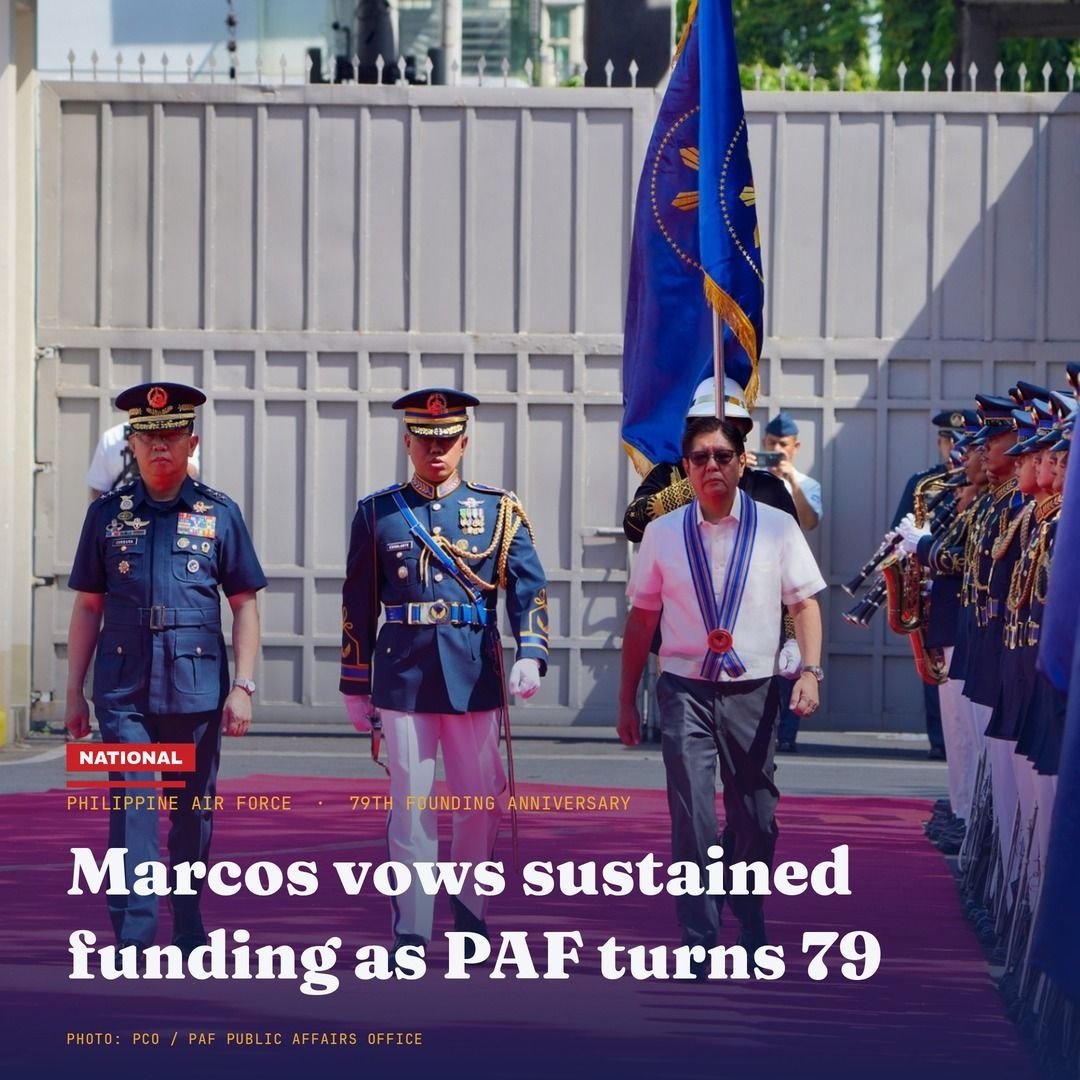
Amid a ceremonial formation of airmen and airwomen at Colonel Jesus Villamor Air Base in Pasay City, President Ferdinand R. Marcos Jr. on July 1, 2026, used the Philippine Air Force’s 79th founding anniversary to renew his administration’s pledge of uninterrupted financial support for the military branch’s ongoing modernization drive.
The event drew high-ranking officials including Defense Secretary Gilberto Teodoro Jr., who joined the Commander-in-Chief in presiding over the milestone celebration. Marcos, whose role as Commander-in-Chief of the Armed Forces of the Philippines places him at the apex of military command, addressed PAF personnel directly and set the tone for the institution’s priorities in the years ahead.
President Underscores Long-Term Capability Investment
In his address before assembled air force personnel, President Marcos framed continued government investment as a direct response to an increasingly complicated security environment. “As modern challenges grow increasingly complex, requiring sustained investments in your capabilities so that you can perform your duties more safely and more effectively,” Marcos said, according to reports from the anniversary ceremony.
The President traced the PAF’s institutional journey — from its origins as a modest post-war aviation unit formally constituted as a separate major service in 1947 — to its current form as what he characterized as a mission-oriented, capability-driven, and values-based organization. That evolution, Marcos argued, justifies the sustained funding his administration is committing to provide.
Marcos further pointed to the expanding scope of the PAF’s responsibilities — spanning national security, humanitarian assistance, disaster response, and territorial defense — as core reasons why investment cannot be allowed to lapse.
Flight Safety Standards Affirmed as Absolute Priority
The President did not limit his remarks to funding pledges. He also reinforced a standing directive on aircraft readiness and the protection of military aviation personnel. The PAF must “ensure the airworthiness of all these aircraft and to uphold rigorously safety protocols in mission and training activities,” Marcos said, making clear that the safety of every airman and airwoman is a non-negotiable standard.
The directive, as reported at the ceremony, reflects sustained executive attention to flight safety practices within military aviation — a concern that runs parallel to the broader modernization agenda rather than being subordinate to it.
PAF Chief Lays Out Acquisition and Basing Plans
PAF Commanding General Lieutenant General Arthur M. Cordura delivered a detailed overview of the service’s modernization roadmap, describing a force being repositioned for greater agility, interoperability, and multi-domain operational capability.
Cordura noted that the nature of modern warfare is shifting rapidly, and that the PAF must evolve in step with those changes. Among the specific capability additions he outlined are long-range patrol aircraft, additional Black Hawk and Bell 412 EPX helicopters, advanced surveillance radar systems, and flight simulators — a package of acquisitions designed to broaden the force’s reach and effectiveness, according to the Commanding General’s remarks.
Cordura also highlighted plans for strategic basing expansions at two locations: Pag-asa Island and Santa Ana in Cagayan. These expansions, he explained, are intended to extend the PAF’s operational presence in geographically significant areas, in direct support of the government’s Comprehensive Archipelagic Defense Concept — the strategic framework underpinning the Philippines’ territorial defense posture.
Anniversary Theme Captures Institutional Direction
The 2026 celebration was conducted under the theme: “PAF@79: Forging a Credible, Agile, and Multi-Domain Air Force through Mission Readiness, Capability Development, and Values-Based Service.”
According to the PAF, the theme encapsulates the institution’s priorities going forward — aligning technological and operational development with ethical standards and a values-based culture of service. It is intended not merely as a ceremonial slogan, but as a guiding framework for the force’s growth through its next decade.
Awards Presented for Operational Excellence
The anniversary program also featured the presentation of awards to PAF units and individual personnel distinguished by their operational performance and dedication. Defense Secretary Teodoro joined President Marcos in conferring the recognitions during the ceremony.
The PAF reported that over the preceding year, the service accumulated close to 50,000 flying hours across its defense operations, pilot training, unit training, and aircraft maintenance activities. The PAF cited that figure as a concrete indicator of the high operational tempo the force has sustained — and as further justification for both continued funding and strict adherence to airworthiness protocols.
Nearly Eight Decades of Philippine Air Power
The Philippine Air Force was formally established as a distinct and separate major service of the Armed Forces of the Philippines in 1947, growing out of military aviation activities that began in the immediate post-war period. Over the nearly eight decades since, the PAF has expanded its mandate significantly — taking on responsibilities that now include air sovereignty patrols, close air support for ground operations, inter-island logistics, and disaster response missions across the breadth of the Philippine archipelago.
Guided by this year’s anniversary theme, the PAF said it remains focused on advancing Philippine air power, deepening operational readiness, and maintaining the institutional values of excellence, integrity, and innovation as it carries out its mandate to defend the nation and serve the Filipino people.
By the Numbers
- 79 — Founding anniversary years being marked by the PAF in 2026
- 1947 — Year the Philippine Air Force was formally constituted as a separate major service
- ~50,000 — Flying hours logged by the PAF over the past year across defense, training, and maintenance operations
- 2 — New strategic basing sites announced: Pag-asa Island and Santa Ana, Cagayan
- 5 — Major capability acquisitions outlined by Commanding General Cordura: long-range patrol aircraft, Black Hawk helicopters, Bell 412 EPX helicopters, advanced surveillance radar systems, and flight simulators
Why This Matters
President Marcos’s public reaffirmation of sustained PAF funding at the 79th anniversary carries direct strategic significance: the air force is simultaneously pursuing major equipment acquisitions and expanding its basing footprint at locations critical to the Philippines’ territorial claims and maritime security posture. The Comprehensive Archipelagic Defense Concept, to which PAF’s basing expansions are explicitly tied, represents the country’s formal framework for defending its sovereign territory — making funding continuity a matter of national security policy, not simply military budgeting. With the PAF having logged nearly 50,000 flying hours in a single year, the operational load on personnel and equipment also makes the President’s parallel emphasis on airworthiness and safety protocols an equally pressing institutional concern.
Source: Breaking News Negros Oriental / wire reports