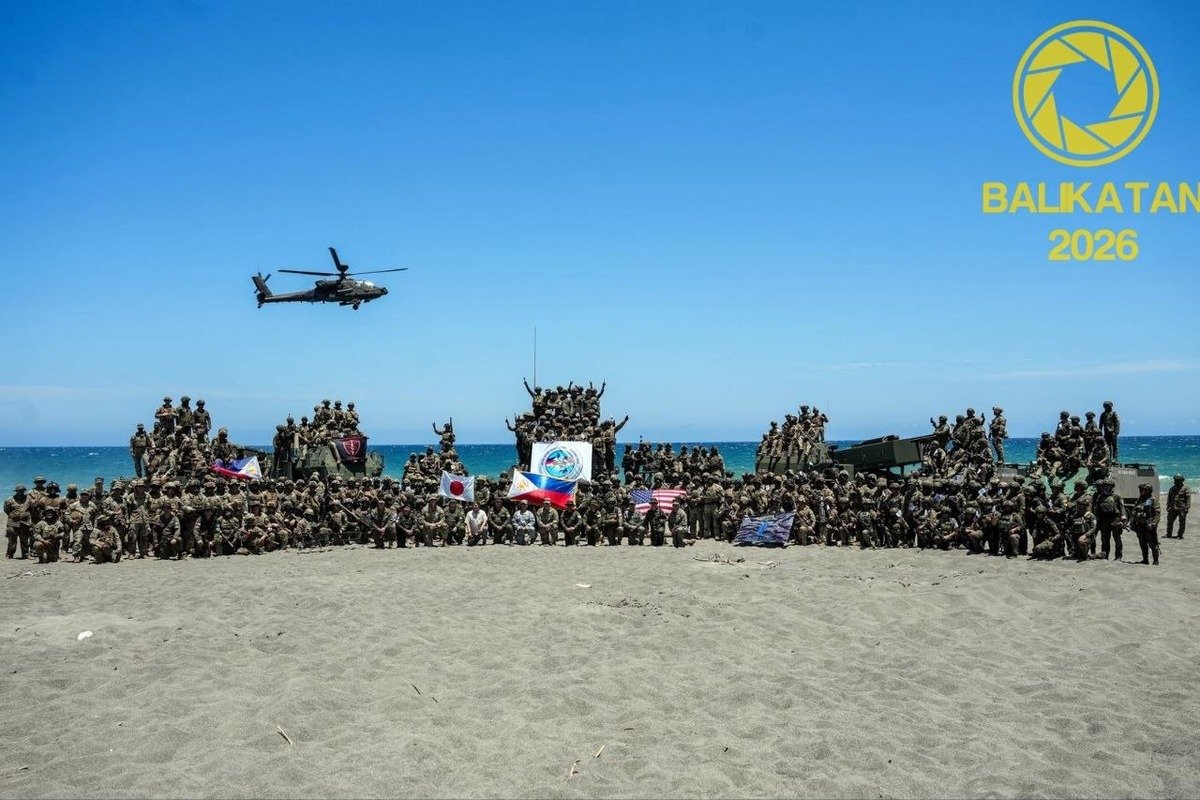
Four allied nations converged on the coastline of Ilocos Norte on May 4, 2026, staging one of the most complex live fire drills in recent memory as part of Exercise Balikatan 41-2026. The Armed Forces of the Philippines (AFP), together with military contingents from the United States, Japan, and Canada, carried out the Counter-Landing Live Fire Exercise North — known as CLLFX-North — at the iconic La Paz Sand Dunes in Laoag, putting their combined coastal defense capabilities to a rigorous test.
The drill was designed to simulate a realistic threat scenario: a hostile amphibious task group attempting to force its way onto Philippine shores. The combined forces responded with a swift, coordinated, multi-domain defense meant to stop the simulated enemy before it could gain any foothold on Philippine territory. The exercise forms a core component of the larger Balikatan 41-2026 framework, which supports the Philippines’ Comprehensive Archipelagic Defense Concept.
What the Exercise Was Designed to Prove
Major Al Anthony B. Pueblas, Chief of the Civil-Military Information Bureau, described the drill as a demonstration of “precision, speed, and unified resolve” among the participating nations. The goal, according to the official statement, was to show that allied forces could deny any simulated threat from establishing operational presence along the Philippine coastline — a scenario that grows more strategically relevant given current regional tensions.
Colonel Dennis Hernandez PN(M), the official spokesperson for Exercise Balikatan 41-2026, underscored the significance of the multi-layered approach employed during the drill. “This Counter-Landing Live Fire Exercise demonstrates our growing capability to defend our shores through a multi-layered, joint and combined approach — integrating land, sea, and air assets to decisively destroy threats before they reach our coastline,” Hernandez said.
Philippine Military Assets on Display
The AFP fielded an impressive array of ground and air assets for the exercise. On the ground, forces deployed Sabrah light tanks, ASCOD Command Post Vehicles equipped with 25mm gun systems, Armored Mortar Carriers with 120mm capability, fire support vehicles, and 105mm artillery batteries. These ground systems were reinforced by air assets including A-29 Super Tucano fixed-wing aircraft, AW109 Augusta helicopters, and Hermes unmanned aerial systems — the last of which provided critical surveillance and targeting support throughout the operation.
US Forces Bring Heavy Firepower
American forces substantially bolstered the exercise’s overall firepower. The US military deployed High Mobility Artillery Rocket Systems (HIMARS), AH-64 Apache attack helicopters, F-16 multi-role fighter jets, and P-8A Poseidon maritime patrol aircraft. The breadth of US assets committed to the drill reflected the depth of the longstanding security alliance between Manila and Washington, and illustrated the kind of combined-arms capability the two countries can bring to bear in a real defense scenario.
Japan’s Expanding Role in Regional Security
The Japan Self-Defense Force (JSDF) also participated in the exercise, an involvement that officials described as emblematic of the growing network of defense partnerships across the Indo-Pacific. Japan’s inclusion signals that regional security arrangements are broadening beyond the traditional Philippines-US bilateral framework, with Tokyo increasingly willing to engage in multilateral security activities alongside longtime American allies in Southeast Asia.
Canada Conducts Defensive Operations at Culili Point
Canadian Armed Forces (CAF) contributed meaningfully to the drill through several distinct components. A platoon from the 3rd Battalion, Princess Patricia’s Canadian Light Infantry, was deployed to Culili Point in Ilocos Norte, where they conducted defensive operations employing heavy machine guns, small arms, and rocket systems. Canadian forces also supported the Mass Casualty Exercise segment of the broader drill, adding a humanitarian and medical response dimension to the live fire activities.
Canada’s participation marked a notable expansion of the Balikatan format, which has traditionally been a bilateral Philippines-US affair. The CAF’s presence alongside Japanese forces signals that Balikatan is evolving into a genuinely multilateral platform for regional defense cooperation.
A Multi-Domain Approach to Shore Defense
What made CLLFX-North particularly notable was the seamless integration of assets across land, sea, and air domains from four different national militaries. The exercise tested not just individual equipment capabilities but the ability of multinational forces to coordinate in real time — sharing communications, synchronizing fires, and executing a unified operational plan against a common simulated threat.
Military officials emphasized that this kind of multi-domain integration is at the heart of modern coalition warfare doctrine. Successfully blending traditional tube artillery, precision rocket systems, advanced combat aircraft, unmanned surveillance platforms, and infantry defensive operations — all from different national inventories — requires standardized procedures and communication protocols that can only be built through repeated joint training.
Why La Paz Sand Dunes in Ilocos Norte
The choice of La Paz Sand Dunes in Laoag as the exercise site was deliberate. The coastal terrain offers a realistic training environment for counter-amphibious scenarios, with varied landscape features that allow defending forces to practice layered defensive positioning. Ilocos Norte’s location along the northern Luzon coastline also holds broader strategic significance, as the area commands approaches to central Luzon and the national capital region.
By conducting the exercise here, the AFP and its allies demonstrated that the Philippines is committed to defending the full extent of its coastline — not merely the most visible or traditionally prioritized strategic points.
Balikatan: Three Decades of Alliance-Building
Exercise Balikatan traces its roots back to 1991, making it the longest continuously running military exercise between the Philippines and the United States. Over more than three decades, the annual drill has expanded in scope and complexity — from early emphases on humanitarian assistance and disaster response to increasingly sophisticated combat training and now genuine multinational participation.
Colonel Hernandez described Balikatan as “a testament to the enduring Philippines–United States alliance, strengthening interoperability and ensuring forces remain ready to protect national sovereignty and uphold peace in the Indo-Pacific.” The 41st iteration of the exercise continues through the rest of May 2026, with additional training components planned across multiple locations throughout the Philippines.
Broader Context: Regional Security Pressures
The timing and scale of CLLFX-North cannot be separated from the broader security environment in the Indo-Pacific. Ongoing tensions in the South China Sea, disputes over territorial waters and aerial space, and concerns about freedom of navigation have sharpened the focus of regional allies on practical defense cooperation.
Defense analysts observe that exercises like Balikatan serve a dual function: on one level, they build genuine tactical coordination and interoperability among allied forces. On another, they project a collective signal of deterrence — demonstrating to potential adversaries that the Philippines does not stand alone in defending its sovereign territory, and that any hostile action would face a coordinated, multi-national response backed by advanced military capability.
The successful execution of CLLFX-North, with four nations operating in concert across multiple domains on short notice, reinforces that message clearly.
Photo credit: Photo by Cpl Esteban PN(M), A1C Castro PAF, PFC Carmelotes PN(M) / PAOAFP