
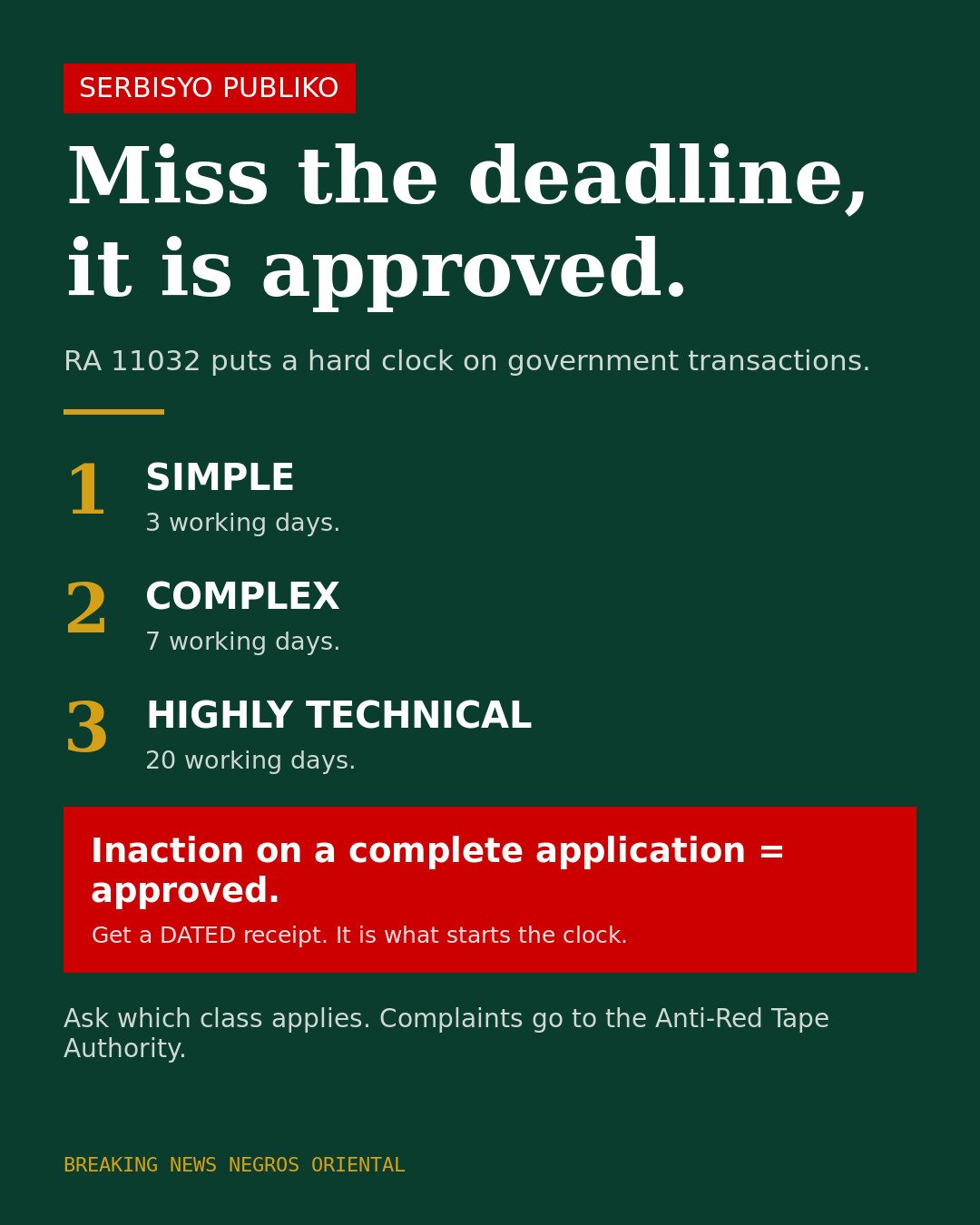
Standfirst: Republic Act 11032 sets a hard clock on government transactions — 3, 7 or 20 working days depending on complexity — and provides that an office which fails to act within it has approved your application by default. Most people queue without knowing the clock exists.
This explains the national rule and how to invoke it. Local implementation varies; the timeframes and the automatic-approval provision come from the law itself.
The three deadlines
Under Republic Act 11032, the Ease of Doing Business and Efficient Government Service Delivery Act of 2018, every government transaction is classified, and each class has a maximum processing time:
- Simple transactions — 3 working days
- Complex transactions — 7 working days
- Highly technical transactions — 20 working days
These cover business permits, licences and clearances, and non-business transactions alike. The office must classify each of its services and publish the classification.
The provision almost nobody invokes
If a local government unit, agency or government-owned corporation fails to act within the prescribed period, the application or request is deemed automatically approved.
That is the part worth knowing. The deadline is not advisory and the remedy is not merely a complaint — the law provides that inaction itself produces approval.
What this means in a queue
The clock starts when your application is complete. An office may not restart the count because a requirement was raised late; this is why the law also requires a published, complete checklist of requirements.
Ask which class your transaction is. “Is this simple, complex or highly technical under RA 11032?” is a precise question with only three possible answers, and it establishes the deadline in front of a witness.
Get proof of filing with a date. Without a dated receipt or acknowledgement, you cannot show when the clock started. That single piece of paper is what makes the rule usable.
The Citizen’s Charter
Every office is required to publish a Citizen’s Charter setting out its services, the requirements for each, the fees, the processing time, and the officer responsible. It is meant to be posted where the public can see it.
If the charter is not displayed, or the processing time is not stated, that is a compliance failure in itself — and it is the document you would otherwise use to establish which deadline applies.
Where to raise it
The law created the Anti-Red Tape Authority (ARTA) to oversee implementation and compliance. Complaints about missed timeframes, unpublished charters, or requirements demanded outside the published checklist go there.
Before escalating, it is usually worth putting the question in writing to the office itself, citing RA 11032 and asking which classification applies and what date the clock started. In many cases that is enough, because the officer is accountable for the answer.
What this is not
It is not a way to force approval of something you are not entitled to. The automatic-approval provision addresses inaction on a complete application, not applications that fail on the merits. An office that denies your application within the period has acted.
Sources: Republic Act 11032, the Ease of Doing Business and Efficient Government Service Delivery Act of 2018, and its Implementing Rules and Regulations (CSC–ARTA–DTI Joint Memorandum Circular No. 2019-001), covering the 3/7/20 working-day processing standards, the automatic-approval provision for inaction, Citizen’s Charter requirements, and the creation of the Anti-Red Tape Authority.