
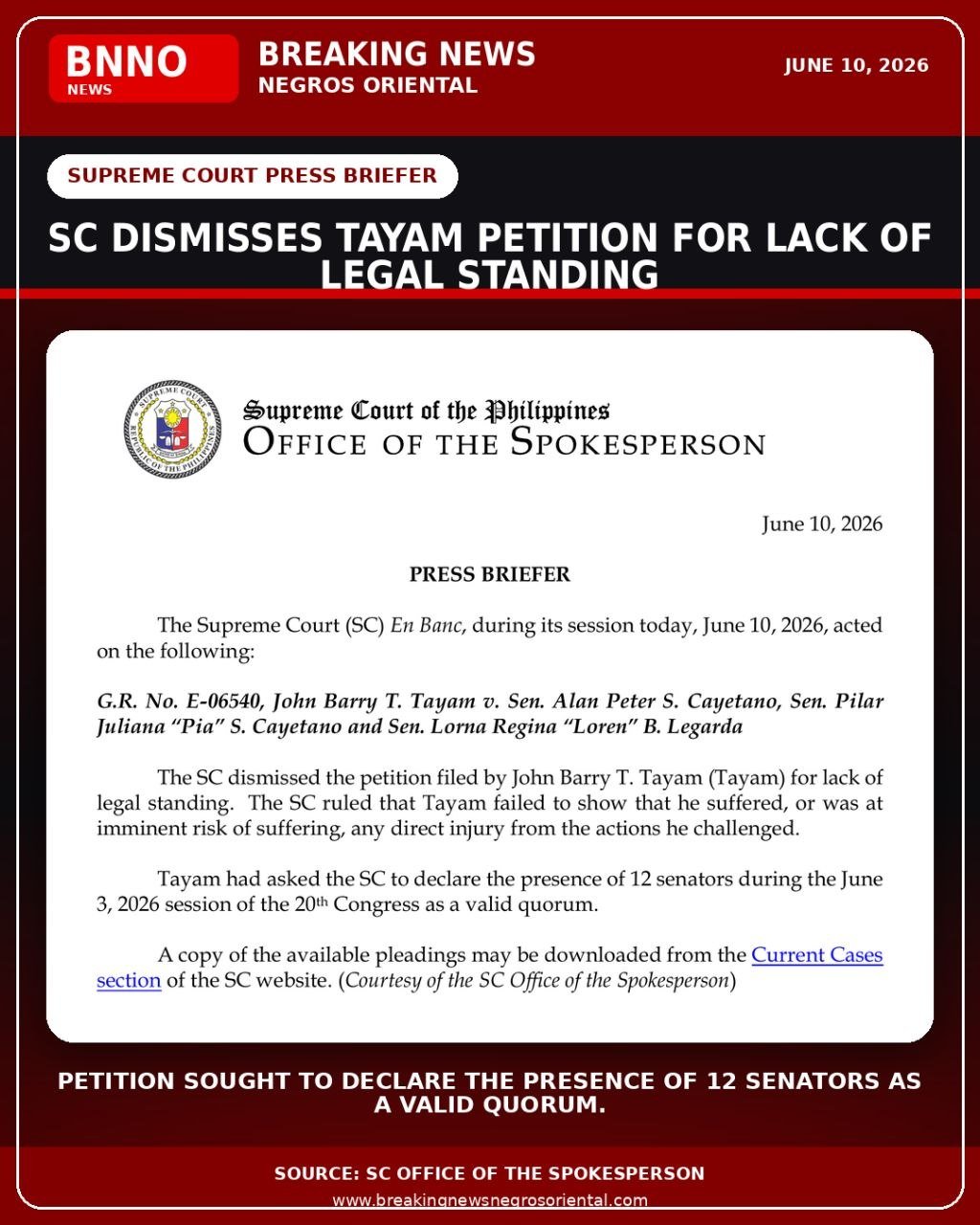
A private citizen’s bid to have the Supreme Court weigh in on whether a thin Senate attendance constituted a legally valid quorum has ended in dismissal — not on the substance of the constitutional question raised, but because the petitioner could not demonstrate he had sufficient legal standing to bring the case in the first place. The Supreme Court, sitting as a full En Banc court, issued the ruling on Wednesday, June 10, 2026.
The case in question, docketed as G.R. No. E-06540, was titled John Barry T. Tayam v. Sen. Alan Peter S. Cayetano, Sen. Pilar Juliana “Pia” S. Cayetano and Sen. Lorna Regina “Loren” B. Legarda. The Supreme Court Office of the Spokesperson confirmed the dismissal through an official press briefer released the same day the decision was handed down.
What the Petition Was About
Petitioner John Barry T. Tayam filed the case seeking a judicial declaration on whether 12 senators — the number reportedly present during a Senate session of the 20th Congress held on June 3, 2026 — satisfied the constitutional requirement for a quorum. The three senators named as respondents were Senator Alan Peter S. Cayetano, Senator Pilar Juliana “Pia” S. Cayetano, and Senator Lorna Regina “Loren” B. Legarda.
In essence, Tayam was asking the country’s highest court to step in and rule on a procedural legislative question: was the June 3, 2026 Senate session validly conducted given the number of senators present that day? The petition appeared to frame the matter as a constitutional issue touching on the integrity of legislative proceedings and the legitimacy of any business transacted with only 12 members in attendance.
Under the Philippine Constitution, a majority of all the members of each chamber of Congress is required to constitute a quorum for purposes of conducting legislative business. The Senate is composed of 24 members, meaning that a quorum would ordinarily require at least 13 senators — one more than the 12 who were allegedly present on June 3. This arithmetic alone gave the quorum question potential constitutional weight, according to legal observers familiar with parliamentary procedure.
Court Rules Tayam Had No Legal Standing
Despite the apparent constitutional dimension of the quorum question, the Supreme Court did not proceed to examine the merits of Tayam’s arguments. The En Banc dismissed the petition at the threshold stage, finding that Tayam had failed to establish locus standi — the legally recognized standing to initiate the case before the Court.
According to the Supreme Court’s Office of the Spokesperson, “the SC ruled that Tayam failed to show that he suffered, or was at imminent risk of suffering, any direct injury from the actions he challenged.” This statement, contained in the official press briefer, formed the core basis of the dismissal.
Legal standing is a procedural prerequisite deeply embedded in Philippine constitutional litigation. As established through decades of jurisprudence, a party seeking relief from the Supreme Court must demonstrate a concrete and personal stake in the outcome of the dispute — meaning the challenged government act must have caused, or must imminently threaten to cause, direct harm to the petitioner. A generalized interest in lawful governance or abstract civic concern, the Court has consistently held, does not by itself satisfy this requirement.
The Supreme Court’s En Banc evidently found that whatever concern motivated Tayam to file the petition, it did not rise to the level of a direct, personal, and substantial injury needed to confer standing. The dismissal, as a result, left the underlying constitutional question — whether 12 senators validly formed a quorum on June 3, 2026 — technically unanswered by judicial precedent from this case.
The Three Respondent Senators
The petition named three well-known figures in Philippine national politics as respondents. Senator Alan Peter S. Cayetano is a former Speaker of the House of Representatives who has remained an influential voice in the legislature. His sister, Senator Pilar Juliana “Pia” S. Cayetano, is a veteran lawmaker recognized particularly for her legislative contributions on public health and gender equality. Senator Lorna Regina “Loren” B. Legarda is among the Philippines’ most experienced legislators, having served multiple terms in both the Senate and the House.
As of the date of the Supreme Court’s press briefer, none of the three respondent senators had issued recorded public statements in reaction to the dismissal order, based on available information from the Court’s official release. The dismissal effectively closes the case as to all named respondents without any ruling on the underlying legislative controversy on its merits.
Background: The Disputed June 3 Senate Session
Tayam’s petition arose from what appears to have been a contentious Senate session held on June 3, 2026 — during the early period of the 20th Congress, which convened following the 2025 midterm elections. The session attracted enough scrutiny, at least in Tayam’s view, to warrant bringing the matter before the Supreme Court.
The 20th Congress has been operating under considerable public and political attention since it began. Legislative sessions with notably thin attendance — particularly when controversial measures are on the agenda — have historically invited questions about their procedural validity. While the Supreme Court’s press briefer did not elaborate on what specific business was transacted during the June 3 session, the filing of a judicial petition by a private citizen signals the degree of public concern over the regularity of that particular proceeding.
Full Court Deliberation and Access to Case Records
The ruling was issued by the Supreme Court sitting En Banc, meaning the full complement of the Court’s justices participated in deliberating and deciding the matter — as opposed to a smaller division handling it. En Banc decisions carry the full institutional authority of the Supreme Court and are generally reserved for constitutional questions or matters deemed to be of significant public interest.
The Supreme Court’s Office of the Spokesperson noted in its June 10, 2026 press briefer that the available pleadings filed in G.R. No. E-06540 may be accessed and downloaded through the Current Cases section of the Supreme Court’s official website at sc.judiciary.gov.ph. The briefer was issued in line with the Court’s standard practice of publicly disclosing significant actions taken during En Banc sessions, subject to the Supreme Court Public Information Office’s Credit Attribution Policy.
Legal Effect of a Standing-Based Dismissal
From a legal standpoint, a dismissal grounded on lack of standing is fundamentally different from a dismissal on the merits. Because the En Banc did not rule on whether 12 senators actually formed a constitutionally valid quorum, that substantive question remains judicially open — at least insofar as this case is concerned. No binding precedent was established on the quorum issue itself.
This distinction matters: another individual or entity — one who can demonstrate a sufficiently direct and personal injury traceable to the disputed June 3, 2026 Senate session — could theoretically bring a similar petition in the future. Philippine courts recognize certain exceptions to strict standing requirements, such as the doctrine of transcendental importance, which allows the Court to take up cases of overwhelming public concern even when the petitioner’s direct injury is not clearly established. However, the Supreme Court’s En Banc did not find that exception applicable in Tayam’s case, court records show.
Philippine jurisprudence has long maintained a strict approach to standing in constitutional litigation, viewing it as a safeguard against the courts being turned into forums for abstract policy debates untethered from concrete legal disputes. The dismissal of G.R. No. E-06540 reflects that principle in action, closing this particular judicial challenge to the June 3, 2026 Senate session without resolving the constitutional question at its heart.
Source: Supreme Court of the Philippines – Office of the Spokesperson, official press briefer dated June 10, 2026