Standfirst: This is a summary of what the independent review of Dumaguete City’s ₱1.948-billion public market project recommends, as recorded in the documents filed with the Sangguniang Panlungsod.
Who conducted the review
The Sangguniang Panlungsod’s independent review was produced in two components.
The legal and policy component is an Independent Review dated 14 August 2026, headed by Atty. Golda S. Benjamin, as the document is signed.
The financial and accounting component is an Evaluation Report by Pinnacle Accounting & Consultancy Services Co., dated 3 August 2026, signed by Patrick P. Templado, Ramil D. Repe and Frederick C. Roda, all certified public accountants. It was prepared for the Office of the Sanggunian through Vice-Mayor Estanislao V. Alviola and Councillor Jose Victor V. Imbo, chairman of the Committee on Finance and Appropriation and Ways and Means.
Both components addressed the ₱1.948-billion public market. The city’s total borrowing package is ₱2.185 billion, the balance being a ₱237-million City Hall extension with parking area. Neither component examined that component.
The threshold recommendation
Both components recommend that the feasibility study be revised before the Council decides.
The legal component states the study “lacks several critical verification data and must be revised to answer several key gaps in information before further decision on the project should be made.”
The accounting component recommends the study “be revised to incorporate the foregoing refinements — given their materiality to the project’s overall financial viability metrics — prior to final presentation to the Sangguniang Panlungsod.”
Four measures the legal component asks the Council to enact
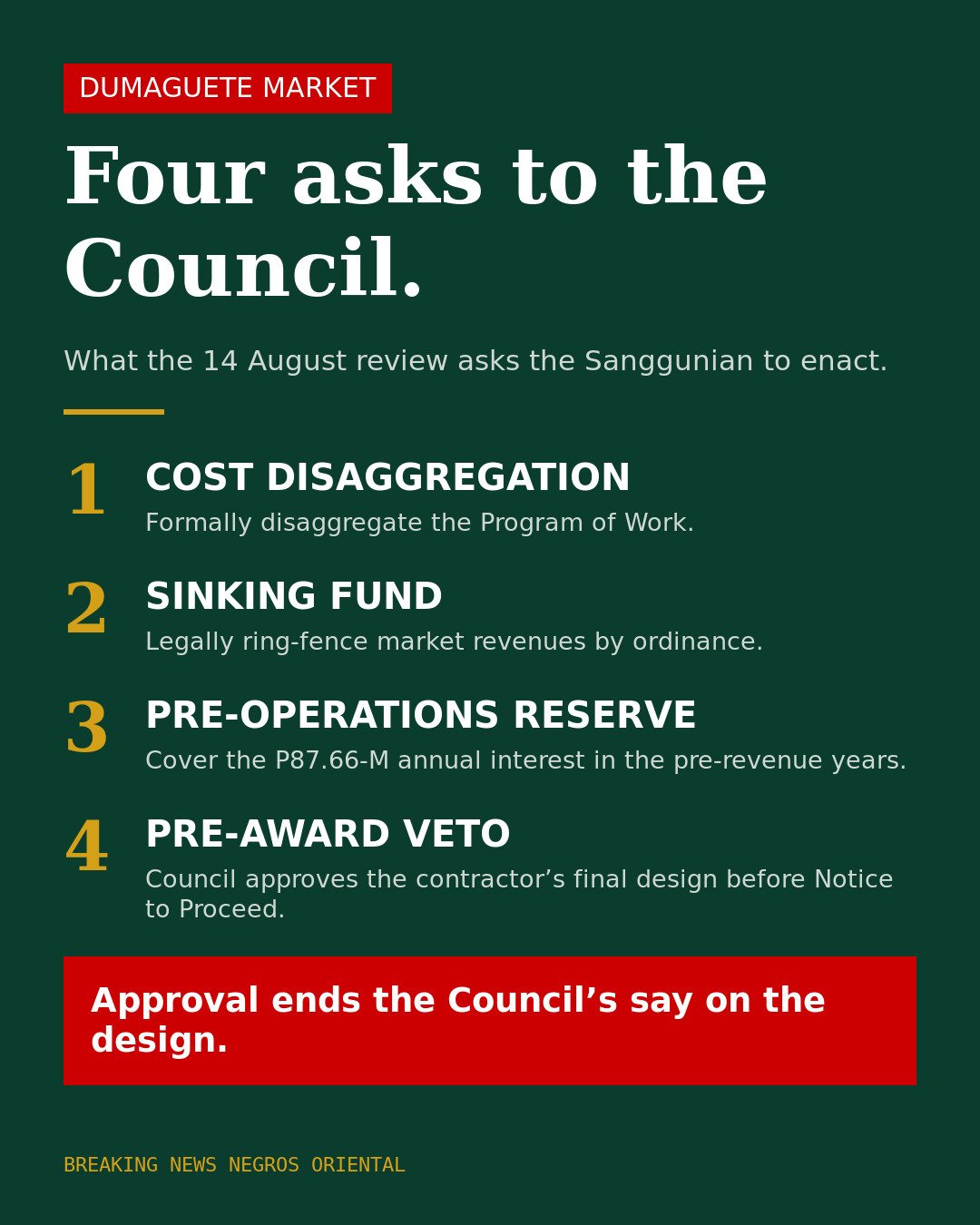
A cost-disaggregation ordinance. Directing formal disaggregation of the Program of Work. The review states this “protects signing officials from Joint Liability and COA disallowances.”
A sinking fund ordinance. To legally ring-fence market revenues. The heading in the document reads “LEE Sinking Fund.”
A pre-operations reserve. Pre-funded by surpluses from other high-performing local economic enterprises, to cover the ₱87.66-million annual interest falling due in the pre-revenue years “without starving regular local services.”
A pre-award veto resolution. Requiring the winning contractor’s final Detailed Engineering Design to be presented to and approved by the Council before the Notice to Proceed is issued. The review notes that “the Council can no longer question the design of the contractor once the loan is approved.”
Six verification benchmarks before final loan authorisation
The legal component lists six items it says should appear in the feasibility study before the loan is finally authorised, stating that each “protects signing officials, public funds, and the project’s credibility”:
- An itemised Bill of Quantities
- Geotechnical soil boring logs
- A relocation masterplan
- A traffic and transit study
- Technical sub-metering
- Draft revised Market Codes
Procurement and site readiness
The review recommends an independent quantity-surveyor market-scoping audit under Section 10.4.1 of the RA 12009 implementing rules, to “remove any perception of an inflated Approved Budget for the Contract.” It states the feasibility study “cites no regional DPWH guideline, historical bid record, or cost index” to support the ₱42,000–₱45,000 per square metre rate applied to 35,800 square metres of gross floor area.
It calls for independent multi-point geotechnical core tests commissioned before bidding, stating that deferring them to the contractor “invites post-award Variation Orders up to the 10% statutory limit — ₱194.8 Million” under Section 71.2 of the same rules.
It states that Sections 12.5 and 8.1.1 require verified site availability and permits to enter before award, and that no award should proceed without them.
Consultations the review says the city should obtain
- The Commission on Audit, on the loan structure.
- Land Bank, the Development Bank of the Philippines and other banks, on whether they will approve a loan bundling permanent physical assets and temporary operational subsidies into a single lot, and whether 4.5 percent fixed for a full 15-year period is available — which the review notes is “not an ordinary practice based on other LGU loans.”
- BLGF certification of the Net Debt Service Ceiling and Borrowing Capacity.
Recommendations affecting vendors and fees
The review recommends the 7 percent compounding fee escalation from Year 6 be codified as a step-by-step rent schedule in a Market Ordinance subject to public hearings, and “not locked in as a non-negotiable bank covenant.” It finds the escalation would “nearly double rental overheads for all 859 stallholders by Year 15.”
On the flat ₱400 water fee, the accounting component recommends five years of billing records be obtained from Metro Dumaguete Water and analysed by stall category. The legal component describes the flat rate as inequitable between dry-goods vendors and the fish and meat sections.
The review also recommends an ordinance barring corporate chains from the project’s anchor store spaces, so they cannot undercut local micro-vendors, noting the study states no supermarket is proposed while designing nine anchor stores.
Recommendations on the financial assumptions
The accounting component recommends expanding the computation basis for National Tax Allotment growth to ten years, flagging CY2022 and CY2023 as outliers. The legal component describes the study’s 11 percent compounding NTA growth assumption as “out of the usual practice for conservative government borrowing.”
The accounting component also records that the study’s treatment of market income as non-taxable no longer holds under Revenue Memorandum Circular No. 89-2024, and that the omission “currently overstates the study’s projected net surplus and payback metrics by an estimated ₱909.2 million through Year 2055.”
What the review does not say
Neither component states that the Sangguniang Panlungsod has enough information to vote.
The accounting component records its mandate as limited to “the feasibility study’s financial assumptions and viability,” and not procurement compliance, site readiness, Local Development Fund eligibility, or exposure under RA 7160 and RA 12009. Its conclusion that the project “remains a financially viable and strategically sound investment” is conditioned on the revisions it says must be made before final presentation to the Sanggunian.
Our earlier reporting on this borrowing
- Review tells Council: revise the study before deciding on the ₱1.948-billion market — 24 August 2026
- Dumaguete’s ₱2.185-billion loan faces public scrutiny over pricing — 25 August 2026
- Dumaguete council approves ₱2.185-B market and City Hall projects — 8 July 2026
- Dumaguete official raises concerns over the ₱2.185-billion loan — 22 May 2026
- Public hearings on the ₱2.185-billion loan — 18 May 2026
- ₱2.185-B borrowing plan hits 3.20× the city’s own NTA — 10 May 2026
- ₱1.948-B market loan dwarfs similar LGU projects nationwide — 9 May 2026
- Record ₱2.185-B borrowing gets swift CDC nod in a 27-minute meeting — 1 May 2026
Recommendations are quoted from the Independent Review dated 14 August 2026 and the Evaluation Report dated 3 August 2026, both filed with the Sangguniang Panlungsod. Breaking News Negros Oriental reported the review’s findings on 24 August 2026.
Correction, 30 August 2026: an earlier version of this article described the head of the review’s legal component as a member of the Silliman University College of Law faculty. We could not confirm that identification and have removed it. The review’s recommendations, quoted throughout, are unaffected.