This article never announces class suspensions. It explains who decides and how to
check. For whether classes are suspended on a particular day, go to the sources listed
at the bottom — never to an explainer, and never to a screenshot.
Standfirst: Every storm brings the same two problems: a suspension nobody heard about, and a “walang pasok” post that was never true. The rules are clearer than most people think, and one change in 2026 means a suspension in one town — or even one school — no longer tells you anything about the next one.
Rules current as at 30 August 2026. The automatic thresholds below are those of DepEd Order No. 14 (s. 2026), which updates the older Executive Order No. 66 (s. 2012). If you are working from the 2012 rules you will get Signal No. 2 wrong.
Some suspensions are automatic. Nobody has to announce them.
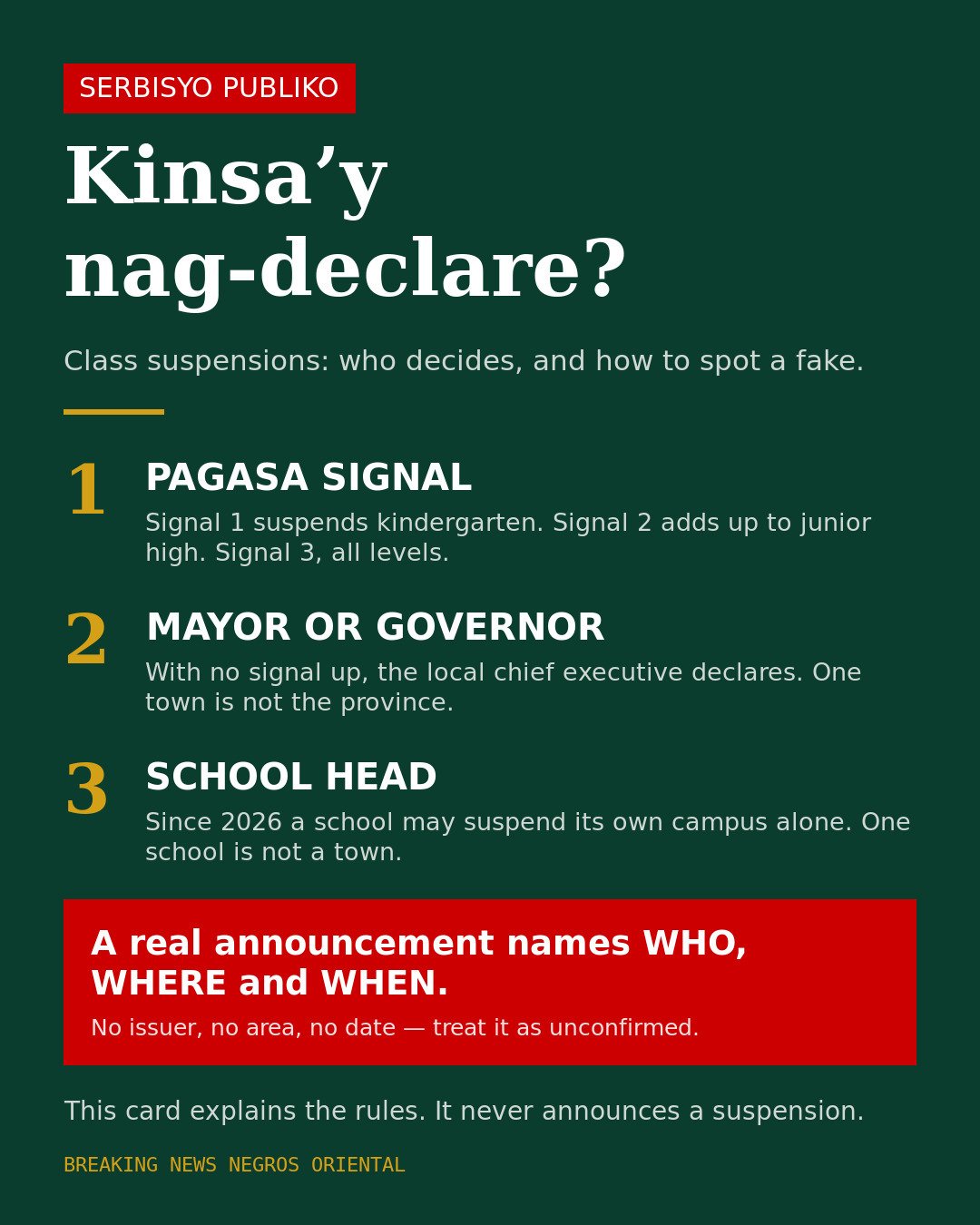
When PAGASA raises a tropical cyclone wind signal, suspension follows by rule, not by anyone’s decision. Under DepEd Order No. 14 (s. 2026):
- Signal No. 1 — in-person kindergarten classes are automatically suspended in the affected area.
- Signal No. 2 — kindergarten through junior high school.
- Signal No. 3 — the alternative learning system and all levels.
The Signal No. 2 line is where people go wrong. Under the older 2012 rules it was read as covering secondary school outright. The 2026 order sets the automatic threshold at junior high, so senior high school is not automatically suspended at Signal No. 2 — it may still be suspended, but by a local chief executive or a school head deciding, not by the signal alone.
“In the affected area” is the other part that gets missed. A signal raised over one part of the province does not suspend classes in a part it does not cover.
When there is no signal, a person decides
Most of our suspensions are this kind — heavy rain, flooding, ashfall, an earthquake — where no wind signal is up.
In that situation the local chief executive may declare a localized suspension, acting as chairperson of the local disaster risk reduction and management council. In practice:
- The PDRRMO assesses conditions and recommends.
- The mayor declares for a city or municipality; the governor may declare for the province.
- Schools follow.
This is why Bayawan can be suspended while Dumaguete is not. It is not an inconsistency — it is two different local chief executives reading two different sets of conditions.
What changed in 2026: suspensions are now much more granular
Under DepEd Order No. 14, s. 2026, school heads may implement suspensions targeted at the actual situation of their own community, coordinating with the Schools Division Superintendent and the LGU, rather than applying blanket cancellations across a whole division.
One school in your town may suspend when the school next to it does not. The order also introduces a four-level learning continuity framework — Hayo (continue), Hinay (ease in), Hinga (check in) and Hinto (stop) — so “suspended” is no longer a single state. Classes may continue in another mode rather than stop outright.
The practical consequence for parents is blunt: a suspension announcement is only about the unit that issued it. Your neighbour’s school is not evidence about your child’s.
When announcements are supposed to come
For weather-driven suspensions, the guidance sets two windows: not later than 10:00 p.m. the night before, and 4:30 a.m. on the day itself.
Those two times are when to check. Before 10 p.m. there may be nothing to find; between 10 p.m. and 4:30 a.m., a decision may still change.
How to tell a real announcement from a fake one
Fake “walang pasok” posts circulate every storm, and they are usually recognisable:
A real announcement names its issuer. A mayor, a governor, a school head, a division office. A post that says only “walang pasok bukas” without naming who declared it is not an announcement.
A real announcement names its scope. Which city or municipality, which levels, which date. “Negros Oriental” alone is a warning sign — the province rarely suspends as one unit.
A real announcement carries a date. Old suspension posts recirculate every storm season. Check the date in the notice itself, not the date it appeared in your feed.
A screenshot is not a source. Anyone can edit an image. Find the original post on the issuing office’s own page.
Where to check
- Your city or municipal government’s official page — the declaring authority for a localized suspension.
- Your child’s school or its division office — for a school-level suspension under the 2026 order.
- PAGASA — for whether a signal is raised over your area at all.
- Office of Civil Defense – Negros Island Region (OCD-NIR) — regional hazard alerts, including Kanlaon.
If you cannot find it on one of those, treat it as unconfirmed. Sending a child to a school that is open is inconvenient. Keeping a child home on a rumour, or sending one into a storm because a real suspension was missed, is not.
Sources: DepEd Order No. 14, s. 2026 (which updates Executive Order No. 66, s. 2012) and DepEd’s 2026 learning continuity framework; Executive Order No. 66, s. 2012; PAGASA tropical cyclone wind signal bulletins; Office of Civil Defense–Negros Island Region advisories.
Related stories