Standfirst: Most interruptions in the city are announced in advance, and a large share of them are not really about water at all — they are a knock-on effect of a power cut. Here is who to follow, and the free text service most people do not know exists.
*Contact details verified against Metro Dumaguete Water’s own contact page on 30 August
- Barangay lists are deliberately omitted: they are set per advisory, and the only
reliable source for whether your area is affected is the advisory itself.*
Who actually supplies your water
The utility is Metro Dumaguete Water (MDW), a joint venture between the Dumaguete City Water District and Metro Pacific Water, which took over operations in February 2021.
This matters when you go looking for advisories: the water district still exists as the JV partner, so searches surface both names and some older material predates the handover. For a current interruption notice, MDW is the operator to follow.
Sign up for the text advisory — this is the single most useful step
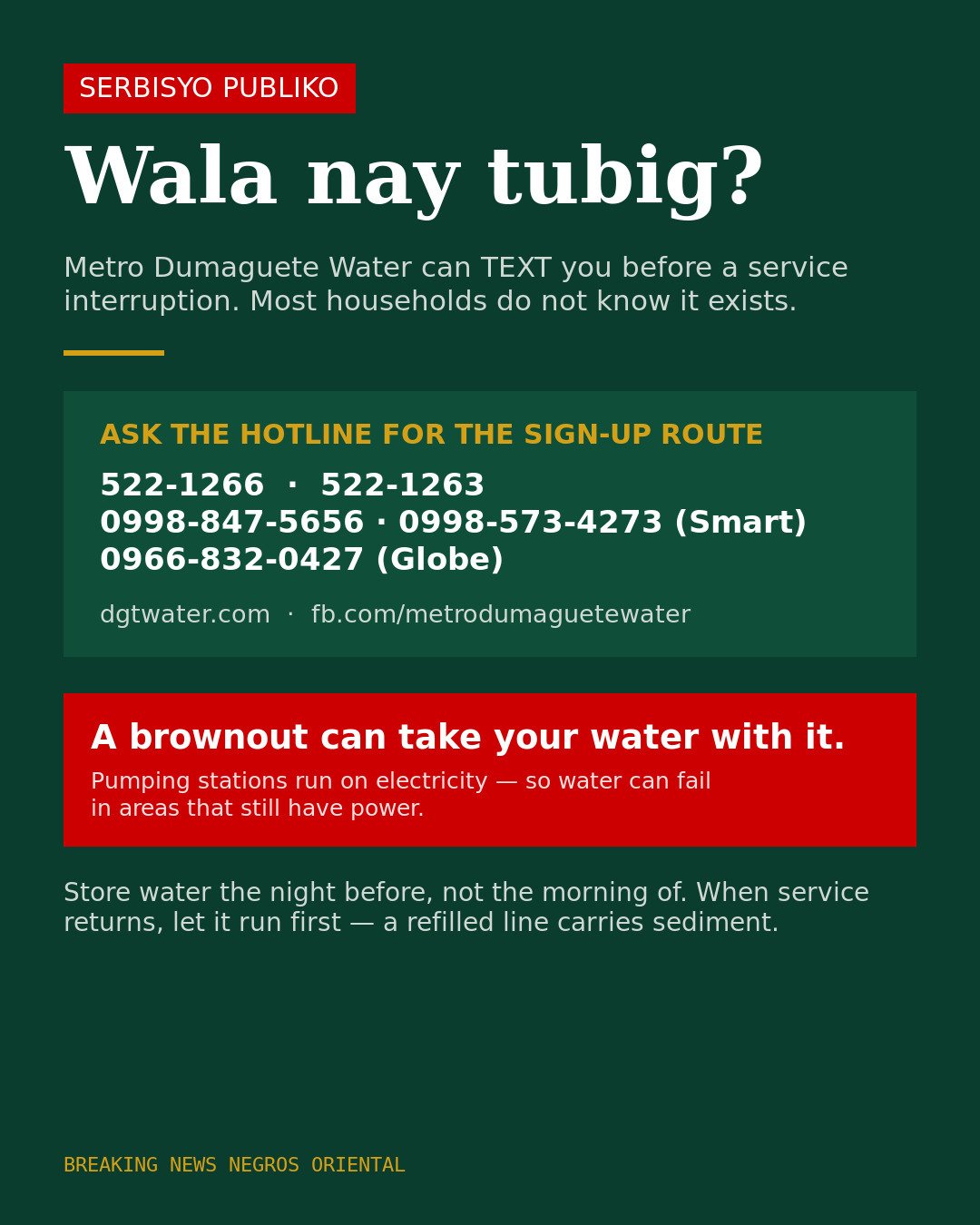
MDW promotes a Pahibalo Text Advisory, an SMS service that notifies subscribers of water service interruptions. It solves the problem better than any article can: the notice reaches you before you turn the tap, rather than after.
It is referenced in MDW’s own FAQs but not on its contact page, so ask the hotline for the current sign-up route rather than assuming a web form exists.
How to reach Metro Dumaguete Water
- Landlines: 522-1266 and 522-1263
- Mobile: 0998-847-5656 and 0998-573-4273 (Smart), 0966-832-0427 (Globe)
- Email: info@dgtwater.com
- Facebook: facebook.com/metrodumaguetewater — where advisories are posted
- Office: DCWD Building, Diego dela Viña Road, Barangay Daro, Dumaguete City
Two different kinds of interruption
Scheduled maintenance. Announced ahead with a date, a window and a list of affected barangays. These are the ones the text advisory catches.
Power-driven interruption. The one nobody anticipates. Water has to be pumped, and pumping stations run on electricity. When power goes out — including during rotational load dropping — water can fail in areas that still have power, because the affected pump serves a different area than the outage.
If you lose water on a day with a published brownout schedule, the two are very likely connected. Our guide to Manual Load Dropping explains how those schedules work, and why following NORECO’s page is also, indirectly, a way to see water interruptions coming.
Before an announced interruption
Store water the night before, not on the morning of.
Fill for the uses hardest to improvise: flushing, washing, cooking. Drinking water is the easiest to buy at short notice; the rest is not.
When service comes back
Let the water run before you use it. A system that has been emptied and refilled can carry sediment disturbed by the refill, and the first flow clears the line. Do not judge water quality from the first few seconds.
When there is no announcement
An unannounced loss of supply is usually one of three things: a power interruption affecting a pumping station, a main line failure, or work upstream of your barangay.
The fastest diagnostic is to ask whether neighbours on a different line are also out. If they have water and you do not, the problem is local — and worth reporting to the hotline rather than waiting.
Sources: Metro Dumaguete Water (dgtwater.com) — company background, FAQs, and contact details verified 30 August 2026; Philippine News Agency reporting on Dumaguete power and water interruptions; NGCP load-dropping advisories.
Related stories