Anti-Money Laundering Council officials announced Friday that they have successfully obtained a Court of Appeals freeze order affecting financial assets and properties connected to Leyte Representative and former House Speaker Martin Romualdez amid ongoing investigations into flood control project irregularities.
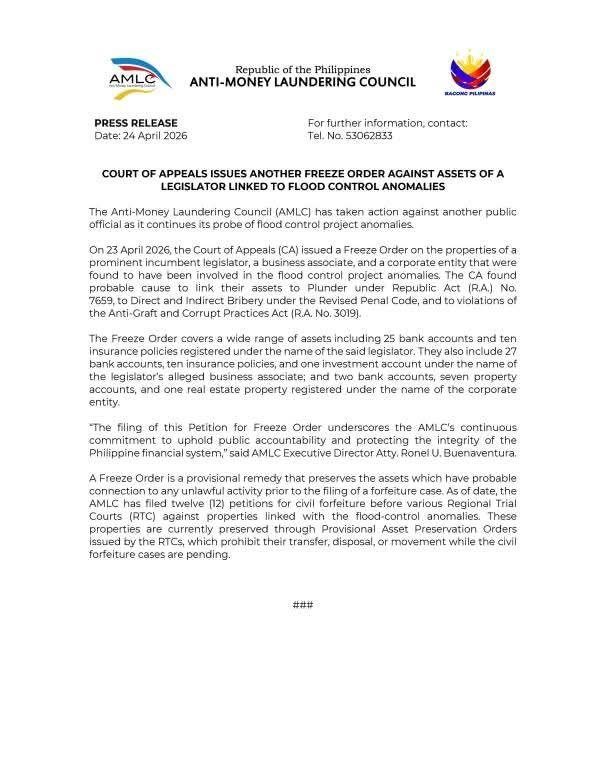
The freeze order, secured on April 23, 2026, targets what the AMLC described as a “prominent incumbent legislator,” with sources confirming the action specifically involves Romualdez alongside an identified business associate and related corporate entity under investigation.
Court documents reveal the Appeals Court found probable cause connecting the targeted assets to potential violations including Republic Act No. 7659 covering Plunder offenses, Direct and Indirect Bribery provisions under the Revised Penal Code, and Anti-Graft and Corrupt Practices Act (Republic Act No. 3019) violations.
Comprehensive Financial Holdings Targeted
Documentation obtained by media outlets reveals the freeze order affects an extensive range of financial instruments and real estate holdings distributed across several entities. Romualdez’s personal holdings subject to the order include 25 banking accounts and 10 insurance policies currently under restriction.
Jose Raulito Paras, identified as Romualdez’s alleged business partner and Upsilon fraternity associate, also faces asset restrictions affecting 27 banking accounts, 10 insurance policies, and one investment account registered in his name.
The court order further encompasses holdings registered to Golden Pheasant Holding Corp., specifically targeting two banking accounts, seven property-related accounts, and one real estate holding. Senator Panfilo “Ping” Lacson previously connected Paras to alleged Makati property acquisitions reportedly linked to Romualdez.
AMLC Leadership Stresses Institutional Commitment
AMLC Executive Director Attorney Ronel U. Buenaventura emphasized the agency’s dedication to transparency in an official statement, declaring: “The filing of this Petition for Freeze Order underscores the AMLC’s continuous commitment to uphold public accountability and protecting the integrity of the Philippine financial system.”
The provisional remedy aims to safeguard assets demonstrating probable connections to illegal activities while authorities prepare potential forfeiture cases. This legal tool effectively prevents asset transfers, sales, or relocations during active investigations and court proceedings.
Multi-Faceted Flood Control Investigation Expands
Friday’s freeze order represents one component of an extensive investigation examining flood control project anomalies that has generated numerous legal proceedings. The AMLC reports filing 12 separate civil forfeiture petitions across various Regional Trial Courts targeting properties connected to the flood control irregularities.
Regional Trial Courts have issued Provisional Asset Preservation Orders protecting these properties, implementing similar restrictions preventing transfers, sales, or relocations while civil forfeiture cases advance through the judicial system.
The investigation’s scope indicates potential systematic problems in flood control project implementation, suggesting multiple individuals and entities may have participated in the alleged irregularities.
Procedural Timeline and Court Authority
Current legal framework establishes a 20-day effectiveness period for the freeze order unless courts approve extensions. Throughout this timeframe, all specified assets remain restricted from transfer, sale, or relocation without explicit court authorization.
The 20-day window enables authorities to compile additional evidence and develop comprehensive legal strategies, including potential asset forfeiture actions targeting the frozen holdings.
Extension of freeze orders beyond the initial period requires prosecutors to demonstrate continued necessity for asset preservation during ongoing investigations or active legal proceedings.
Defense Strategy Challenges Investigation
Responding to the expanding probe, Romualdez has petitioned the Office of the Ombudsman for self-inhibition from investigating the matter. His legal representatives argue the existence of a “pattern of prejudgment” potentially compromising his constitutional due process rights.
The inhibition petition represents a calculated legal approach questioning the investigation’s neutrality while potentially seeking case transfer to alternative investigating authorities.
Legal professionals observe that successful inhibition petitions generally require establishing clear bias or conflicts of interest that would prevent fair case evaluation.
Anti-Money Laundering Enforcement Expansion
The AMLC’s involvement illustrates the agency’s growing role investigating public corruption cases potentially involving money laundering violations. The council’s jurisdiction encompasses traditional financial crimes and cases where public funds may have been diverted through sophisticated financial arrangements.
Asset freeze mechanisms provide essential tools preventing the disappearance of holdings potentially representing unlawful activity proceeds or funds required for eventual government restitution.
Philippine financial system integrity relies heavily on effective anti-money laundering regulation enforcement, especially regarding cases involving public officials and government contracting.
Governance and Political Accountability
The freeze order targeting a high-profile legislator reflects continuing efforts addressing corruption within government infrastructure initiatives. Flood control projects, typically involving significant public expenditures, have traditionally faced various irregularities and pricing manipulation issues.
This case emphasizes the critical importance of effective oversight systems for government infrastructure investments, particularly projects addressing climate adaptation and disaster preparedness requirements.
Accountability mechanisms, including asset freezing and civil forfeiture actions, function as deterrents against public fund misuse intended for essential infrastructure development.
Ongoing investigations may establish significant legal precedents regarding financial crime prosecution involving public officials and preservation of allegedly illegally obtained assets for potential government recovery.