The Philippine Atmospheric, Geophysical and Astronomical Services Administration (PAGASA) has issued warnings for six provinces in Mindanao as easterly wind patterns continue to generate threatening weather conditions, with flash floods and landslides posing immediate risks to affected communities over the coming 24 hours.
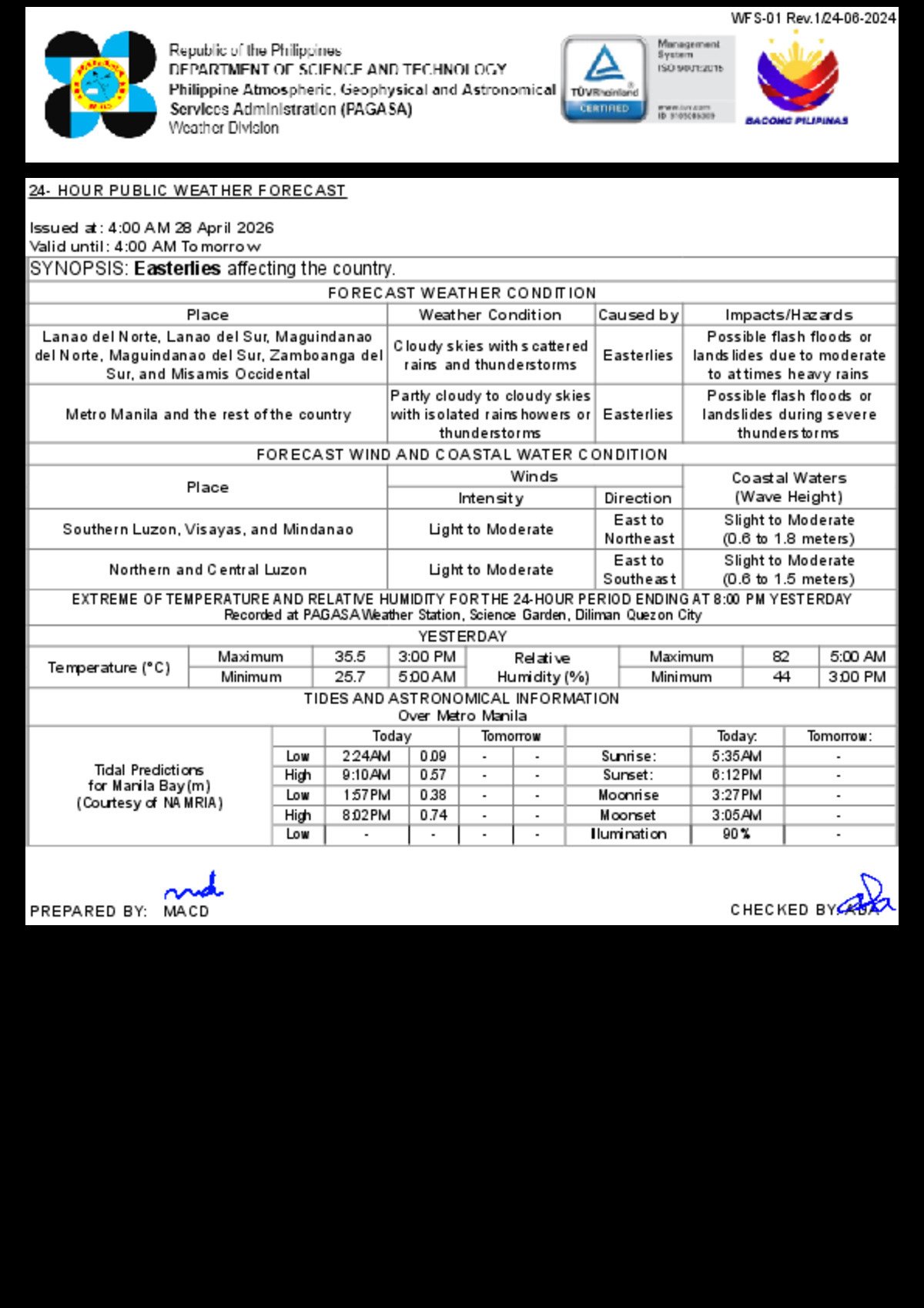
In its public weather forecast released at 4:00 AM on April 28, 2026, and effective until 4:00 AM the following day, the state weather bureau highlighted how easterlies—moisture-laden winds originating from the Pacific Ocean—are sustaining widespread weather disturbances across the Philippine archipelago.
Critical Weather Warnings for Southern Philippines
Six provinces across Mindanao are facing the most severe weather threats, with PAGASA advising residents to take immediate precautionary measures. Cloudy skies with scattered rains and thunderstorms will persist throughout the forecast period in Lanao del Norte, Lanao del Sur, Maguindanao del Norte, Maguindanao del Sur, Zamboanga del Sur, and Misamis Occidental.
The weather bureau has specifically identified these regions as vulnerable to flash floods and landslides due to anticipated moderate to heavy rainfall episodes. The convergence of scattered precipitation systems with active thunderstorm development creates conditions where rainfall accumulation can rapidly exceed safe levels, particularly threatening communities in flood-prone valleys and unstable mountainous terrain.
Authorities recommend that local government units and communities in these provinces maintain elevated vigilance, especially during late afternoon and evening periods when easterly-driven thunderstorm activity typically reaches peak intensity.
Broader National Weather Conditions
Beyond the high-risk Mindanao provinces, Metro Manila and remaining areas of the Philippines will encounter generally milder conditions characterized by partly cloudy to cloudy atmospheric patterns. Nevertheless, isolated rainshowers and thunderstorms may develop across any region not subject to the enhanced rainfall advisory.
Despite the relatively subdued national outlook, PAGASA maintains that severe thunderstorm cells can emerge unexpectedly in any location. These intense meteorological phenomena retain the capacity to trigger flash flooding or landslides, especially in metropolitan areas with inadequate drainage infrastructure or highland zones with geological instability.
Northern and Central Regions Weather Patterns
Luzon’s northern and central provinces will exhibit the typical partly cloudy to cloudy characteristics associated with easterly atmospheric influence. These areas will experience light to moderate easterly to southeasterly winds, while coastal waters maintain slight to moderate conditions with wave heights measuring 0.6 to 1.5 meters.
Southern Luzon will encounter similar wind dynamics to those affecting the Visayas and Mindanao, experiencing light to moderate east-northeasterly winds alongside marginally elevated coastal water conditions, with wave patterns ranging from 0.6 to 1.8 meters in height.
Central Islands Weather Outlook
The Visayas region aligns with the broader national forecast pattern of partly cloudy to cloudy conditions accompanied by isolated rainshowers or thunderstorms. The prevailing easterly system generates light to moderate east-northeasterly winds, producing coastal conditions comparable to those impacting Southern Luzon and Mindanao territories.
Island-based communities should closely track evolving meteorological conditions, as isolated thunderstorm systems can undergo rapid intensification within tropical maritime settings, potentially disrupting inter-island transportation networks and outdoor commercial activities.
Thermal and Atmospheric Moisture Analysis
Temperature measurements from PAGASA’s monitoring station at Science Garden, Diliman, Quezon City, reveal the thermal characteristics accompanying current weather patterns. The previous day’s peak temperature climbed to 35.5°C at 3:00 PM, while the overnight minimum fell to 25.7°C at 5:00 AM.
Relative humidity measurements demonstrated considerable daily variation, reaching maximum levels of 82% during cooler pre-dawn hours at 5:00 AM before declining to 44% at the afternoon temperature peak of 3:00 PM. These moisture fluctuations exemplify typical tropical atmospheric behavior under easterly influence, combining oceanic moisture influx with afternoon drying effects during maximum solar heating periods.
Maritime Safety and Coastal Conditions
Naval and fishing operations throughout the Philippines should consider location-specific coastal water variations. Northern and Central Luzon maritime zones will encounter wave heights spanning 0.6 to 1.5 meters, while Southern Luzon, Visayas, and Mindanao coastal waters experience moderately elevated conditions with waves measuring 0.6 to 1.8 meters.
These slight to moderate oceanic conditions typically accommodate routine maritime commerce, though operators of smaller vessels should implement standard safety protocols, particularly when thunderstorm activity develops near coastal zones. Fishing fleets and inter-island ferry services should continuously monitor localized weather evolution throughout operational periods.
Emergency Preparedness and Risk Mitigation
Considering the diverse weather hazards across regional boundaries, PAGASA stresses the critical importance of area-specific emergency preparation strategies. Communities within the six designated high-risk Mindanao provinces should implement immediate protective actions against flash flooding and landslide dangers.
Fundamental safety protocols include evacuating flood-prone lowland areas during heavy precipitation events, maintaining distance from swollen waterways and drainage channels, and avoiding transportation through landslide-susceptible zones during intense rainfall periods.
Throughout remaining national territory, standard thunderstorm safety procedures remain applicable. Citizens should suspend outdoor activities during active electrical storms, disconnect electronic equipment during lightning episodes, and maintain emergency supply inventories including battery-powered illumination devices, portable communication equipment, and medical aid supplies.
Metropolitan regions require heightened attention to stormwater management systems, as concentrated heavy rainfall can rapidly overwhelm urban infrastructure in high-density population centers. Rural settlements adjacent to steep gradients or geologically unstable areas should establish emergency communication networks enabling swift evacuation responses if weather conditions deteriorate significantly.
Meteorological Pattern Context and Agricultural Implications
The prevailing easterly wind configuration represents characteristic seasonal transitional weather typical for this calendar period across the Philippines. Easterly systems frequently generate variable atmospheric conditions throughout the island chain, with localized thunderstorm formation influenced by topographical features, oceanic interactions, and diurnal temperature cycles.
Such meteorological patterns may continue for multiple days, featuring daily fluctuations in precipitation intensity and geographical distribution. Communities should prepare for potentially sustained similar conditions while monitoring updated forecasts providing enhanced guidance for extended operational planning.
Agricultural sectors may experience disruptions in regions receiving enhanced rainfall, with crop management activities including planting schedules and harvest operations potentially requiring modification based on localized precipitation volumes and soil saturation levels.
Citizens seeking current meteorological information and forecast updates should consult official PAGASA communications through pagasa.dost.gov.ph for the most reliable weather guidance.