
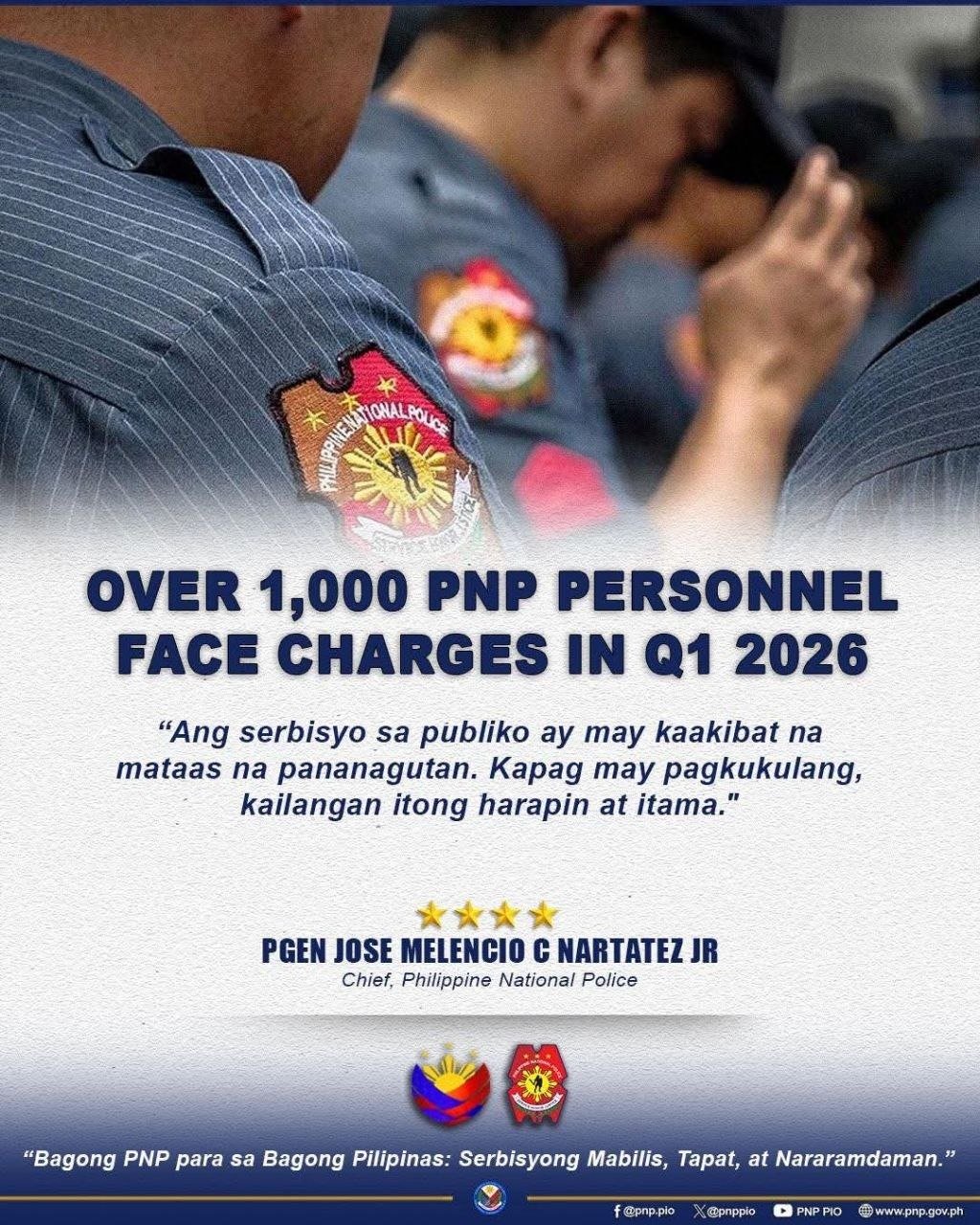
Administrative disciplinary proceedings were initiated against 1,048 Philippine National Police personnel during the initial three months of 2026, marking a substantial escalation in the force’s internal accountability measures, according to latest Internal Affairs Service reports.
The comprehensive disciplinary review encompassed 490 separate administrative cases processed between January and March, representing a notable surge compared to corresponding 2025 data and demonstrating enhanced institutional commitment to professional standards enforcement.
Statistical analysis reveals that Police Non-Commissioned Officers comprised the majority of those facing charges at 806 individuals, while Police Commissioned Officers accounted for 242 cases, indicating that disciplinary oversight extends uniformly across hierarchical levels within the organization.
Disciplinary Outcomes and Administrative Penalties
The Internal Affairs Service has issued recommendations for administrative sanctions affecting 323 personnel, encompassing a spectrum of penalties including 41 dismissals from service, 64 suspensions, 20 rank demotions, and 11 official reprimands. Conversely, 187 personnel received exoneration following thorough investigation processes.
Dismissal recommendations, representing the most severe administrative consequence, targeted officers whose actions constituted serious breaches of conduct or fundamental violations of established police procedures and protocols.
The predominant sanction category of suspensions affected 64 individuals, typically involving temporary duty removal either during ongoing investigations or as punishment for medium-level infractions requiring corrective action.
Demotion penalties impacted 20 officers whose regulatory violations warranted rank reduction while preserving their continued service eligibility in diminished operational capacities.
Year-Over-Year Statistical Comparison
Comparative analysis with first-quarter 2025 data, which recorded 770 charged personnel across 332 cases, reveals significant increases that underscore intensified internal oversight and more systematic disciplinary enforcement mechanisms.
The statistical progression from 770 to 1,048 charged individuals represents a 36 percent escalation, while total case volume increased by 48 percent, demonstrating expanded organizational capability to identify and process regulatory violations.
These ascending trends in administrative proceedings indicate either enhanced internal surveillance systems or increasingly stringent approaches to investigating misconduct allegations originating from both institutional and civilian sources.
Leadership Commitment to Institutional Standards
Police General Jose Melencio C. Nartatez Jr., serving as PNP Chief, emphasized the organization’s unwavering position regarding professional discipline and accountability standards.
“Ang serbisyo sa publiko ay may kaakibat na mataas na pananagutan. Kapag may pagkukulang, kailangan itong harapin at itama. We owe the people a police organization that acts with integrity at all times,” he declared.
The Chief PNP further indicated that institutional processes would continue receiving reinforcement to ensure expeditious misconduct resolution while safeguarding personnel who execute their responsibilities with honesty and professional excellence.
“We are firm when it comes to accountability, but we are also fair. Our goal is not just to correct lapses, but to build a culture where doing what is right becomes the standard,” the police chief stated.
Strategic Integration with Organizational Reform
These accountability initiatives constitute integral components of the PNP’s ongoing Focused Agenda implementation, specifically targeting Integrity Monitoring strengthening to enhance internal discipline and accountability frameworks throughout the organization.
This strategic direction aligns with President Ferdinand R. Marcos Jr.’s broader governmental approach emphasizing institutional public trust enhancement and transparent governance principles.
The Focused Agenda encompasses comprehensive police transformation efforts addressing disciplinary protocols, operational effectiveness, community engagement, and institutional capacity development simultaneously.
Current administrative directives prioritize transparency and accountability as essential public service delivery elements across all law enforcement agencies under federal oversight.
Enhanced Internal Oversight Capabilities
The Internal Affairs Service’s improved case processing performance reflects significant institutional advancement in investigative methodologies and case management protocols, with demonstrated capacity to handle 490 cases involving over 1,000 personnel effectively.
The proportional relationship between imposed sanctions and case exonerations—323 facing disciplinary measures versus 187 cleared—demonstrates adherence to established due process requirements while maintaining stringent accountability enforcement.
This outcome distribution indicates comprehensive investigative approaches yielding evidence-based determinations according to established protocols, rather than pursuing disciplinary actions irrespective of individual case merits.
Public Confidence Through Institutional Accountability
PNP leadership emphasized that consistent internal enforcement actions produce measurable outcomes, demonstrating active accountability implementation and reinforcing discipline as a fundamental service pillar, consistent with the “Bagong PNP para sa Bagong Pilipinas: Serbisyong Mabilis, Tapat, at Nararamdaman” commitment.
This organizational philosophy embodies dedication to delivering efficient, trustworthy, and responsive police services meeting Filipino public expectations and professional standards.
The expanded administrative case processing communicates to both personnel and citizens that professional standards receive consistent enforcement across all organizational levels, from junior officers through senior command positions.
Professional Standards Evolution
The dramatic increase in processed administrative cases during 2026’s opening quarter signifies fundamental transformation in PNP internal discipline and professional conduct standard approaches.
Processing approximately 50 percent more cases than the preceding year demonstrates enhanced organizational capability to address misconduct while preserving operational effectiveness across all departmental functions.
The graduated sanction system—spanning from formal reprimands through service dismissal—provides proportionate disciplinary responses enabling appropriate corrective action calibrated to violation severity and circumstances.