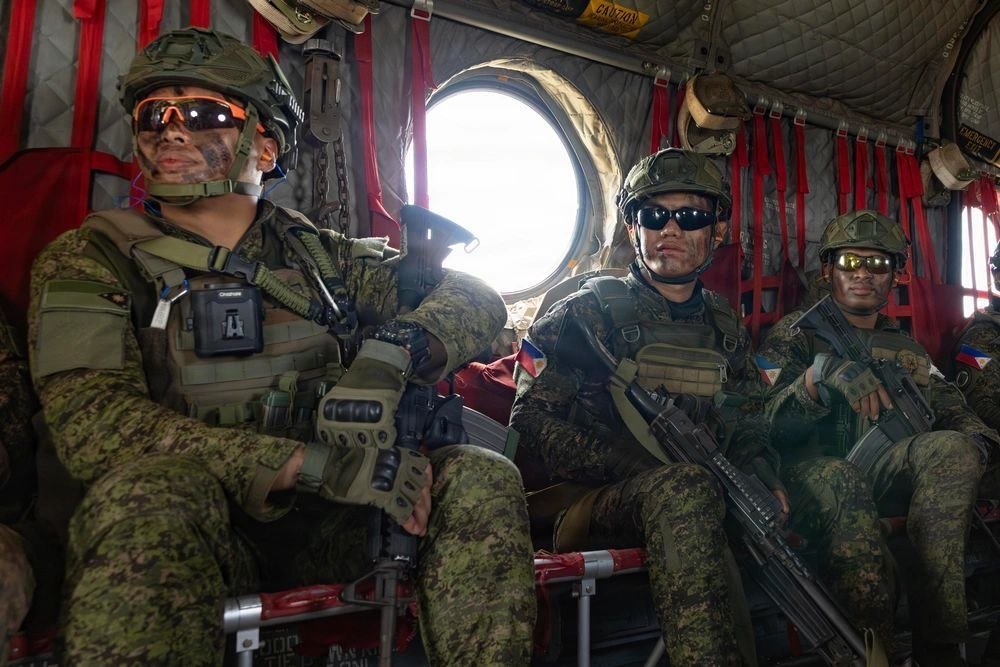
A multinational military formation involving troops from five countries executed a large-scale air assault exercise on May 17, 2026, inserting coalition ground forces into a simulated contested objective zone as part of the Joint Pacific Multinational Readiness Center Exportable (JPMRC-X) Exercise — a high-complexity training event conducted under the Salaknib Phase 2 series in Central Luzon.
Coalition Forces Deploy Across Central Luzon
The operation moved troops from Colonel Ernesto Ravina Air Base (CERAB) in Capas, Tarlac, to the Combat Readiness Training Area (CRTA) inside Fort Magsaysay in Nueva Ecija. According to a statement issued by Col. Louie G. Dema-ala, Chief Public Affairs of the Philippine Army, US Army CH-47 Chinook and UH-60 Black Hawk helicopters provided the primary airlift for the mission, transporting coalition infantry from the launch point to the designated objective area in a coordinated sequence of rotary-wing assault waves.
The Philippine Army statement described the execution as seamless, noting that the operation demonstrated the coalition’s capacity to conduct rapid troop insertion across complex and geographically fragmented terrain — conditions broadly representative of the Philippine archipelago and surrounding island environments where allied forces may be required to operate.
The CH-47 Chinook, a dual-rotor heavy-lift platform capable of carrying up to 55 fully equipped soldiers or equivalent cargo, provided the bulk lift capacity for the assault. The UH-60 Black Hawk, a versatile medium-utility aircraft used for troop movement, command support, and casualty evacuation, complemented the Chinook’s lift capability and added operational flexibility to the overall insertion plan. Together, the two aircraft gave commanders the ability to move large formations in coordinated, time-sensitive waves that closely replicated the tempo of real-world air assault missions.
Armies of Five Nations Operate in Unified Formation
The drill brought together ground forces from the Philippine Army, the US Army, the Japan Ground Self-Defense Force, the Australian Army, and the New Zealand Army — five distinct national militaries operating under a unified command framework for the duration of the exercise. The operation specifically tested enhanced interoperability, which refers to the capacity of different armed forces to work together using compatible procedures, communication systems, and tactical doctrines, as well as rapid deployment and coordinated multi-domain action.
The scope of participation reflects how significantly the Salaknib exercise series has grown since its origins as a bilateral Philippine-US Army training event. In recent years the exercise has incorporated a widening circle of Indo-Pacific partner nations, with the 2026 edition marking one of the broadest multinational line-ups to date.
Japan’s involvement is particularly notable given Tokyo’s revised national security strategy, which has moved the Japan Ground Self-Defense Force toward a more active posture in regional defense cooperation alongside treaty allies. Australia and New Zealand, both Five Eyes intelligence partners and ANZUS treaty signatories with the United States, have similarly increased operational engagement with Philippine and American forces in recent years, making their joint participation in a ground combat drill of this scale a visible indicator of deepening multilateral defense ties across the Indo-Pacific.
JPMRC-X: Bringing US Combat Training to Allied Territory
The JPMRC-X Exercise functions as the overarching operational framework for the Salaknib Phase 2 training cycle. It is an exportable adaptation of the Joint Pacific Multinational Readiness Center — a US Army program specifically designed to deliver high-caliber combat training to partner militaries within the Indo-Pacific theater. Rather than requiring partner-nation forces to travel to a fixed US training facility, the JPMRC-X model deploys the training architecture directly to allied territory, allowing multinational units to rehearse realistic, high-complexity scenarios within the actual operational environment they may be called upon to defend.
Fort Magsaysay in Nueva Ecija, which ranks among the largest military reservations in the entire Philippines, provides the kind of expansive combined-arms and air assault training terrain that exercises of this scale require, and has served as a recurring venue for large-scale joint training events between Philippine and allied forces across multiple exercise series.
Colonel Ernesto Ravina Air Base in Capas, Tarlac — the exercise launch point — is a dedicated Philippine Army aviation facility named in honor of a Philippine Army aviator, and has hosted previous joint training activities with allied forces prior to the 2026 Salaknib series.
Army Chief Frames Exercise as Instrument of Regional Peace
Philippine Army Chief Lieutenant General Antonio G. Nafarrete addressed the strategic rationale behind the joint exercise in a statement released through the Army’s public affairs office. Lt. Gen. Nafarrete stated that allied partnerships and collective strength serve as a deterrent against aggression, and that exercises like Salaknib build the shared capability necessary to maintain peace and stability across the Indo-Pacific region.
The Army chief’s remarks position Salaknib not as a provocative display of force, but as a deliberate confidence-building measure designed to signal to potential adversaries that coalition partners are capable of operating together effectively, rapidly, and at scale in contested environments. This framing is consistent with how Philippine military officials have publicly characterized other large joint exercises, including the annual Balikatan series conducted with US forces.
Regional Security Context Shapes Exercise Priorities
The Salaknib 2026 exercises are unfolding against an active regional security backdrop. The Philippines has been consistently asserting its sovereign maritime rights under the United Nations Convention on the Law of the Sea (UNCLOS) and the 2016 ruling of the Permanent Court of Arbitration, which struck down China’s broad territorial claims in the South China Sea. The drill’s explicit training focus on operations within a “contested archipelagic environment” aligns directly with the kinds of scenarios that regional security analysts consider most relevant to potential contingencies in the South China Sea and adjacent waters.
The exercise’s emphasis on rapid, multi-domain joint action — combining air movement, ground assault, communications interoperability, and coordinated multinational command — reflects a broader allied training philosophy that prioritizes the ability to respond quickly and collectively to developing crises across the region’s dispersed island geography.
Salaknib Phase 2 to Continue Through June 2026
The Salaknib exercise series takes its name from a Filipino term meaning “to shield” or “to protect,” a designation that reflects its foundational purpose as a readiness and deterrence exercise. Phase 2 of the 2026 series is scheduled to run through June 2026 and is expected to encompass additional training events and exercises beyond the May 17 JPMRC-X air assault drill, according to the Philippine Army. The complete schedule of remaining Phase 2 activities had not been publicly released as of the time of this report.
The successful execution of the five-nation air assault on May 17 establishes a high benchmark for the remainder of Phase 2 and underscores the degree to which the Salaknib series has evolved from a focused bilateral training event into a genuinely multilateral exercise platform capable of integrating the ground combat forces of multiple Indo-Pacific allies into complex, realistic operational scenarios.
Originally reported by: wire reports