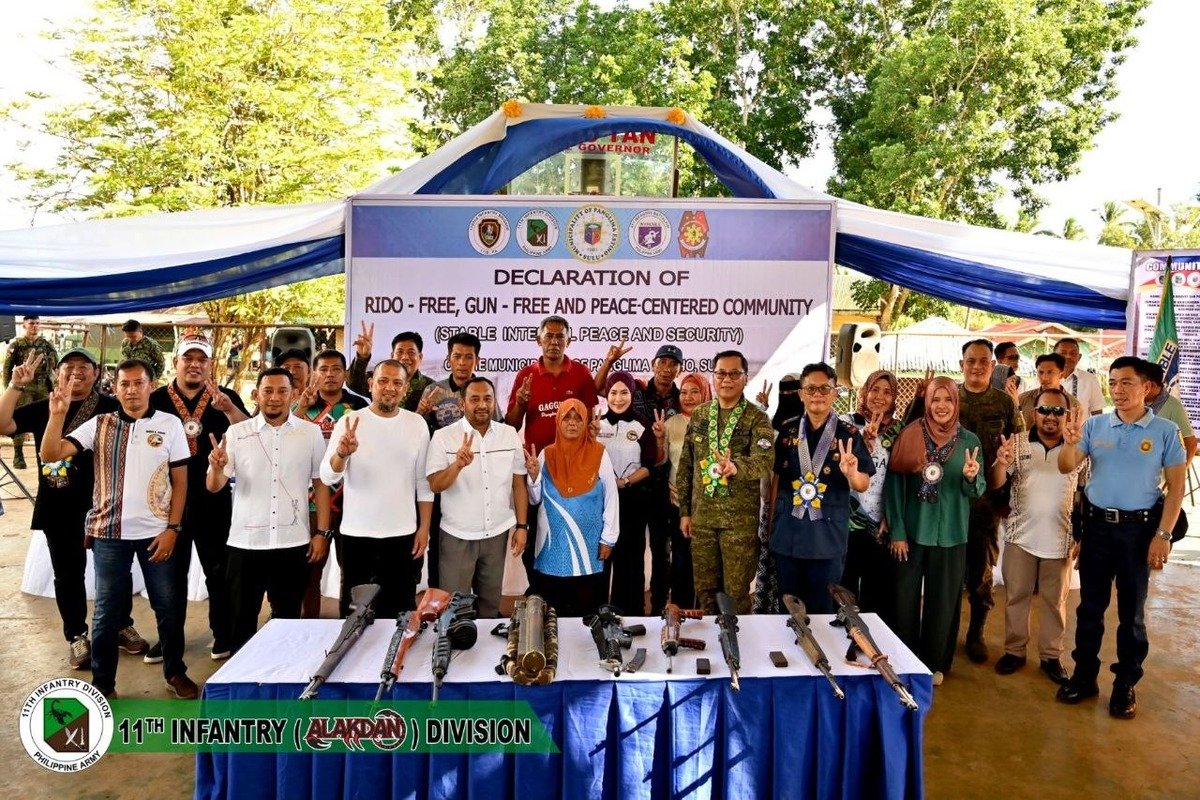
A ceremonial program held in Panglima Estino, Sulu, has marked one of the most significant peace milestones the municipality has ever seen — its formal declaration as a Rido-Free, Gun-Free, and Peace-Centered Community, as well as its recognition as having achieved Stable Internal Peace and Security (SIPS) status. The event brought together local government officials, senior military and police leaders, religious figures, and community stakeholders in a unified demonstration of the gains made through years of sustained peacebuilding work, according to a statement authenticated by Maj. Genesis S. Dizon of the 11th Infantry “Alakdan” Division Public Affairs Office.
A Community-Wide Milestone Celebrated with Symbolic Ceremony
The declaration program was marked by a series of meaningful symbolic acts that captured the spirit of Panglima Estino’s transition toward lasting peace. Attendees witnessed the unveiling of an official peace declaration marker, the signing of a formal peace covenant by key community and government stakeholders, and a symbolic release of doves — a gesture representing reconciliation, unity, and the collective hope for a peaceful future in the municipality.
Sulu Provincial Governor Abdusakur A. Tan II served as the Guest of Honor and Speaker at the event. His attendance lent the full weight of provincial leadership to the occasion and sent a clear signal of strong civilian government support for the peace gains that Panglima Estino has achieved. Governor Tan has been a consistent champion of community-driven peace processes across Sulu, and his presence underscored the provincial government’s commitment to sustaining those efforts.
Municipal Mayor Benshar S. Estino and Municipal Vice Mayor Morsid M. Estino were also among the officials who joined the ceremony, representing the local leadership that has played a frontline role in guiding the municipality through the peacebuilding process.
Military and Police Leadership Present at the Historic Event
The security sector turned out in force for the declaration. Col. Alex H. Gagula, Deputy Brigade Commander of the 1102nd Infantry Brigade, was in attendance, as was PLt. Col. Kris Conrad M. Gutierrez, who serves as Deputy Provincial Director for Operations of the Sulu Provincial Police Office (PPO). Lt. Col. Ronald A. Borras, Commanding Officer of the 21st Infantry Battalion — one of the military units operationally involved in maintaining security and supporting peace initiatives across Sulu — was likewise present at the ceremony.
Their collective attendance reflected what authorities describe as a coordinated civil-military-police approach that has proven central to bringing Panglima Estino to its current state of peace and stability. The broad representation of the security sector at the event also signaled the depth of institutional investment in the municipality’s peace trajectory.
11ID Commander Highlights Power of Collaborative Peacebuilding
Maj. Gen. Leonardo I. Peña, Commander of the 11th Infantry “Alakdan” Division and Joint Task Force Orion, delivered a message during the ceremony in which he commended the cooperation of local government units, community leaders, and security forces in achieving this milestone. According to the 11th Infantry Division Public Affairs Office, Maj. Gen. Peña framed the declaration as concrete evidence that collaborative peacebuilding works — and that Sulu, once a byword for armed conflict and instability in the southern Philippines, is now a province being recognized for measurable improvements in its peace and security environment.
The general’s remarks acknowledged the decades-long struggle that Sulu has endured — marked by armed group activity, persistent clan violence, and deep-seated community tensions — while emphasizing that the declaration in Panglima Estino is not a finishing line but a product of sustained, multi-sector effort. His message called on all parties to remain engaged in the work of maintaining peace long after the ceremony’s conclusion.
Governor Tan Calls on All Sectors to Protect Hard-Won Peace
In his address, Governor Tan praised the people and leaders of Panglima Estino for their unity and steadfast commitment to peace. According to the statement from the 11th Infantry Division, the governor stressed the critical importance of sustaining harmony and deepening partnerships among all sectors of the community to protect and build upon what has already been achieved.
Governor Tan’s appeal carried particular resonance given Sulu’s broader peace trajectory. Across the province, a growing number of municipalities have received similar peace declarations in recent years, and Panglima Estino’s designation adds to a list that reflects a province in the midst of genuine transformation. The governor’s call for continued vigilance served as a grounding reminder that formal declarations, while symbolically powerful, must be backed by ongoing commitment from government, military, religious leaders, and ordinary residents to translate into lasting change.
What SIPS Status Means for Panglima Estino
The Stable Internal Peace and Security (SIPS) designation is a formal classification used by the Philippine government and the security sector to identify communities that have achieved a sufficient level of peace and order to allow the transfer of primary security responsibility from military forces to civilian authorities and local government units. It is not granted lightly.
Achieving SIPS status generally requires a sustained reduction in armed incidents, the successful resolution of community conflicts, and the disarmament or neutralization of threat groups previously active in the area. The designation signals that a community has moved past the phase of active conflict management and is now positioned for development-oriented governance — where resources and attention can shift from security operations to economic growth, social services, and community development.
According to the 11th Infantry Division’s statement, Panglima Estino’s declaration follows similar achievements in several other Sulu municipalities, reflecting a province-wide momentum toward sustained peace and development that has been building steadily over recent years.
Rido Resolution and Firearms Control at the Heart of the Declaration
Two benchmarks sit at the core of what Panglima Estino has accomplished: the resolution of rido, or clan feuds, and the significant reduction of loose firearms in the community. Both have historically been among the most persistent and destabilizing sources of violence in Sulu and across Muslim Mindanao.
Rido is a tradition of retaliatory clan conflict deeply embedded in parts of the Sulu Archipelago and Muslim Mindanao. Unlike politically or ideologically motivated armed conflict, rido is driven by grievances between families and clans, and it can perpetuate cycles of violence across generations. Resolving rido requires painstaking community engagement, mediation by respected elders and religious leaders, and active cooperation between local authorities and security forces — a process that cannot be rushed or imposed from the outside.
The gun-free component addresses what security authorities have long identified as a critical enabler of both rido violence and armed group activity: the widespread presence of unlicensed and unregistered firearms. Reducing loose firearms in a community is considered essential to normalizing everyday life and ensuring that disputes — when they arise — are handled through dialogue and legal processes rather than armed confrontation.
A Whole-of-Community Achievement in Sulu’s Continuing Peace Story
The 11th Infantry Division Public Affairs Office described the Panglima Estino declaration as “another testament to the continuing efforts of the government, security sector, and local communities in promoting peace, security, and development throughout the Province of Sulu.” The statement reflected a broader institutional recognition that durable peace is never the product of any single actor but requires the sustained cooperation of every sector of society.
For Panglima Estino and its residents, the declaration marks a turning point — a formal acknowledgment that the hard work of building peace has reached a threshold worthy of recognition, and a foundation upon which the community can now pursue the development and progress that stability makes possible.
Originally reported by: Philippine News Agency / 11th Infantry Division Public Affairs Office