A Private Collection That Official Institutions Cannot Match
Before you reach the town proper of Valencia, Negros Oriental, a modest wooden sign along the Dumaguete-Valencia highway — positioned just after the TOTAL Gas Station — points curious travelers toward a place unlike any government-run heritage facility in the province: the Cata-al World War II Museum. Unsponsored, uncommercialized, and largely unadvertised, it holds a collection of wartime materials that no regional public institution has managed to assemble.
Sitting roughly seven kilometers from Dumaguete City, the privately maintained site has quietly earned a reputation among students, academic researchers, historians, and heritage-minded travelers seeking direct, physical contact with the history of the Second World War in Negros Oriental. The collection is not polished for mass tourism. It is raw, personal, and rooted — and that is precisely what makes it matter.
Two Generations Behind One Collection
The story of the Cata-al Museum begins not with Felix Constantino V. Cata-al, its current steward, but with his father, Porforio Cata-al. According to the museum’s own account, Porforio served in the guerrilla resistance against the Japanese occupation of the Philippines — a movement that was especially active throughout Negros Oriental during the war years. As the conflict unfolded and in the immediate postwar period, the elder Cata-al began gathering wartime relics left behind by retreating forces or recovered from the surrounding landscape.
Felix, a former National Power Corporation official, inherited both the collection and the mission. Over the decades that followed, he continued expanding what his father had started, accepting donated materials from war veterans and community members who had quietly preserved pieces of the conflict in their own homes. That two-generation commitment gives the museum a character that formal state institutions rarely achieve — it is, at its core, a community archive that grew from personal sacrifice and civic memory.
In a statement attributed to the museum, Felix Cata-al explained the driving force behind his life’s work: “Someone had to collect the relics of the past because if no one does, it will be forgotten. This is my legacy, re-living the opulence and glory of the World War II,” Cata-al said. The quote has been widely associated with the museum and reflects the collector’s stated motivation for maintaining the site.
Negros Oriental During the Japanese Occupation
To appreciate what the Cata-al Museum holds, it helps to understand what Negros Oriental endured. Japanese forces seized control of the Philippine archipelago beginning in 1942, and Negros Oriental became a theater of sustained guerrilla resistance. Local fighters, working in coordination with American and Filipino military units, waged a prolonged campaign that lasted several years before Japanese control in the region was finally broken in 1945.
For many families in the province, the memory of that period survived primarily through oral history passed down across generations. Physical evidence was scarce — much of it lost, destroyed, or scattered. The Cata-al collection, according to the museum, represents some of the most tangible remaining proof of that wartime presence: not reconstructions, not replicas, but actual recovered materials from the conflict itself.
What Visitors Find Inside
The range of objects on display at the Cata-al Museum is broad and, at times, startling. Shelves and display cases hold Japanese and military-era banknotes and coins, old telephone models, bullets recovered from the ground, firearms, helmets, military uniforms, medals, gas masks, newspaper clippings, wartime flags, porcelain, silverware, bottles, and various personal effects that once belonged to soldiers or civilians caught up in the occupation.
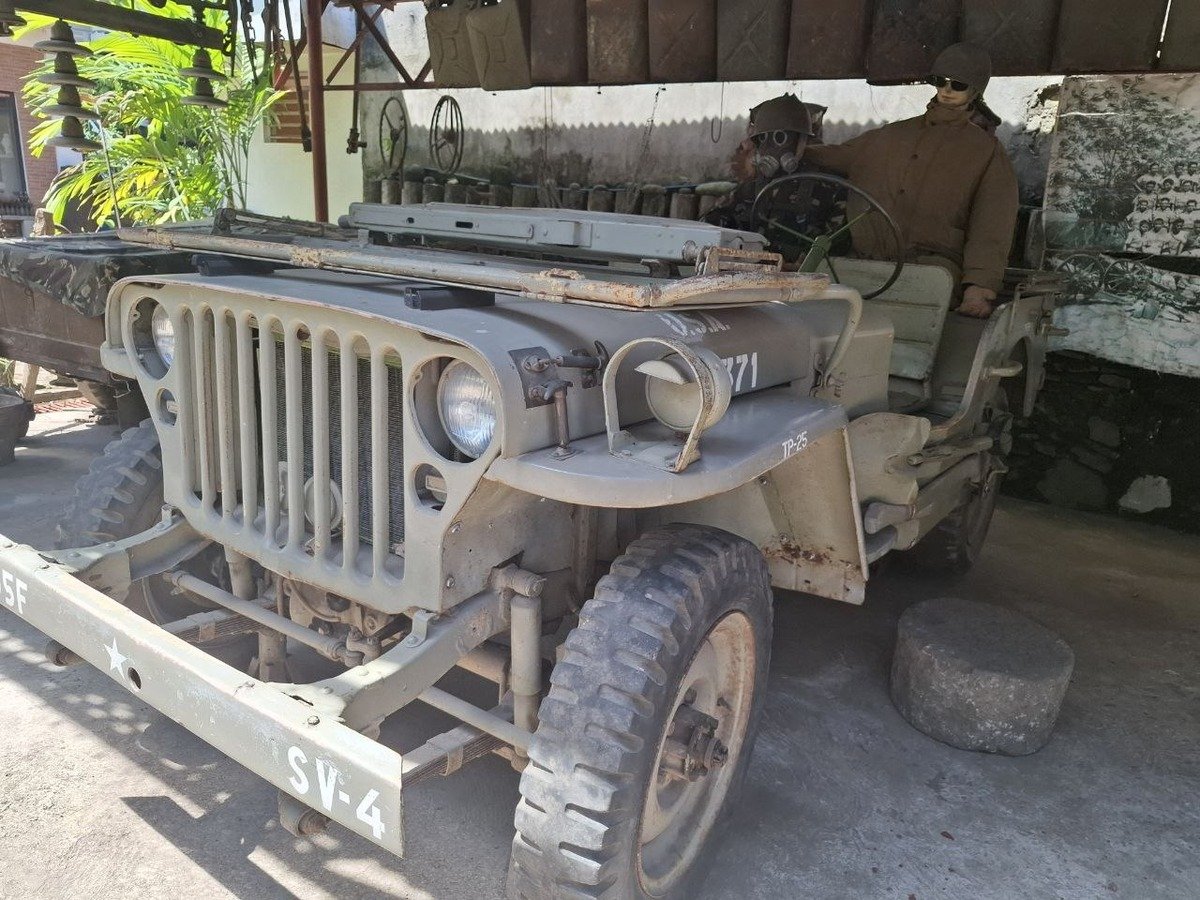
One of the most visually arresting displays is a World War II-era military jeep complete with seated soldier figures dressed in full military gear — face coverings, sunglasses, and period-accurate regalia. The figures are described by visitors as convincingly lifelike upon first approach, functioning as an immersive entry point into the exhibit rather than a simple prop.
Alongside the militaria, the museum also displays everyday civilian objects — old soft drink bottles, damaged household goods, and commercial remnants — that together illustrate what life looked like under Japanese occupation for ordinary people in the province. This range, from battlefield hardware to domestic debris, gives the museum a texture and completeness that more heavily curated institutions often sacrifice in the name of presentation.
Wartime Remains and Repatriation Efforts
Among the most sensitive materials in the collection are human skulls and physical remains believed to have been recovered from areas in and around Valencia. According to Cata-al, remains that have been positively identified as belonging to Japanese soldiers have been returned to the Japanese government when verification could be established. The museum has thus served not only as a place of heritage display but as a site of active historical reckoning — one that has, in documented cases, facilitated the repatriation of wartime dead to their country of origin.
Jewish Refugee Materials and the Philippines’ Open Doors Policy
The Cata-al Museum also holds materials said to be connected to Jewish families who fled Nazi persecution in Europe during the Holocaust — a connection that draws the collection into one of Philippine history’s lesser-discussed wartime chapters.
Historical records document that between 1937 and 1941, the Philippine Commonwealth government under President Manuel L. Quezon admitted an estimated 1,300 Jewish refugees through what later came to be called the “Open Doors” policy. The majority of those refugees settled in Manila, according to historical accounts of the period.
Whether any of those refugees eventually made their way to Negros Oriental — as the museum’s account implies — is a claim that remains difficult to verify through independent archival sources. The museum’s narrative on this point rests primarily on local memory and the collector’s own account. Researchers and heritage travelers should treat this dimension of the collection as an invitation to further academic and archival inquiry rather than a settled historical conclusion. The museum’s strength lies in what it physically holds; specific claims benefit from corroboration through additional documentation.
The Museum in Valencia’s Broader Visitor Landscape
Valencia is most often visited for its natural attractions — its highland climate, waterfalls, forested resorts, and an expanding café scene that draws day-trippers from Dumaguete City. The Cata-al Museum fits alongside those attractions as a different kind of destination: one rooted in memory rather than scenery, in historical weight rather than recreational ease.
For visitors passing through Valencia on leisure trips, a stop at the museum offers engagement with the province’s wartime past in a way that is immediate and human rather than academic and distant. The collection carries the unmistakable quality of things saved by people who believed they mattered — and who were determined that they would not disappear entirely.
Combined with Valencia’s natural stops, a visit to the Cata-al Museum can anchor a day trip that moves meaningfully between landscape and history.
Getting to the Cata-al World War II Museum
The Cata-al World War II Museum is located along the Dumaguete-Valencia highway in Valencia, Negros Oriental, approximately seven kilometers from Dumaguete City. Travelers heading toward Valencia from Dumaguete should look for the museum on the right side of the road, just past the TOTAL Gas Station and before reaching the Valencia town proper. A wooden sign marks the turn.
The site is best suited for history enthusiasts, students, academic researchers, and heritage travelers with an interest in the Second World War and its impact across the Visayas. Visitors should approach the space as a privately maintained family archive rather than a commercial tourist facility. The Cata-al Museum, according to accounts associated with the site, remains open to those who wish to engage seriously with what it preserves — a rare and irreplaceable record of one of the most consequential periods in Philippine history.
Source: Breaking News Negros Oriental (breakingnewsnegrosoriental.com)