
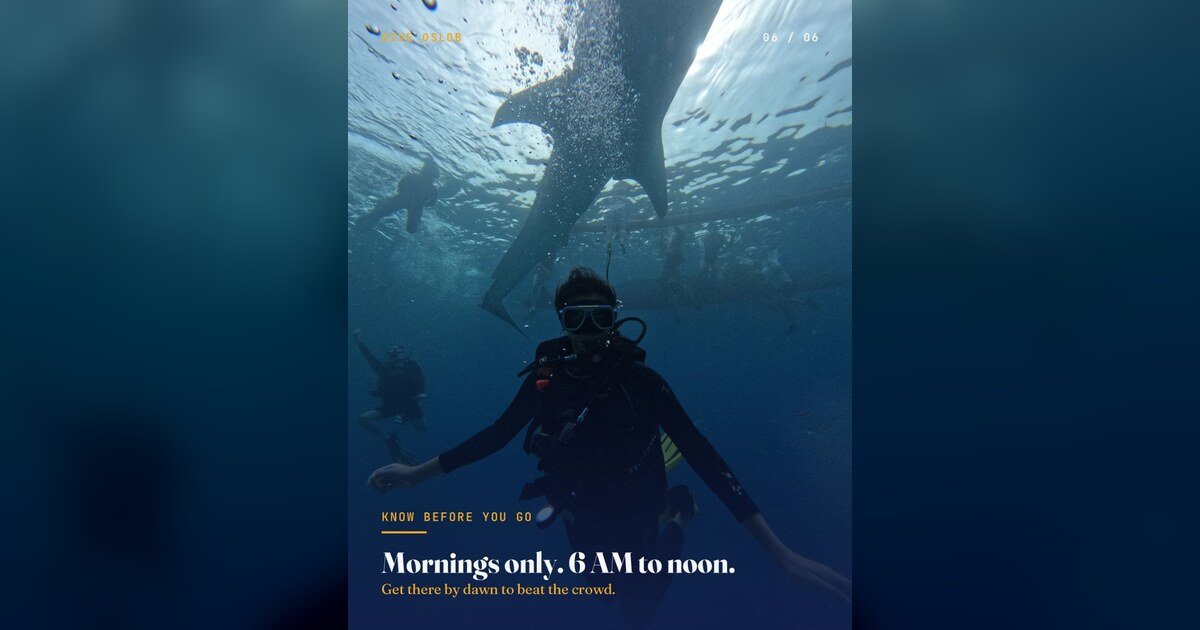
Long before sunrise, the road leading south from Cebu City fills with vans and motorcycles bound for a coastal barangay where the world’s largest fish shows up, almost without fail, every single morning. Barangay Tan-awan in Oslob has quietly become one of the most-visited marine tourism sites in the entire Philippine archipelago — drawing snorkelers, scuba divers, and wildlife enthusiasts to its waters for a face-to-face encounter with Rhincodon typus, the whale shark, called butanding or tuki in local dialects.
The journey from Cebu City takes between two and three hours by road, according to on-site travel protocols, with most group vehicles departing as early as 3:00 a.m. The early start is deliberate: the site enforces a noon cutoff for the final permitted swim of the day, and arriving late means missing the window entirely.
Mandatory Rules Before Anyone Enters the Water
Spontaneity has no place at Tan-awan. Before a single fin enters the sea, every visitor must complete a required safety orientation conducted by local guides and officers from the Department of Environment and Natural Resources (DENR). The DENR-enforced briefing covers a non-negotiable set of behavioral rules: swimmers must stay no closer than four meters to any whale shark at all times, physical contact with the animals is strictly forbidden, sunscreen must be removed before entering the water, and underwater camera flash is prohibited.
Once the orientation is complete, participants board a banca — the traditional Filipino outrigger boat — which ferries them roughly fifty meters offshore. Equipped with snorkel gear and life vests, guests then slip into the water under close supervision for a brief, structured interaction with the sharks before returning to the beach. The entire sequence is designed to minimize stress on the animals while still delivering the encounter visitors have traveled hours to experience.
Going Deeper: The Scuba Dive Option
Snorkeling offers a view from the surface, but scuba diving at Oslob provides a fundamentally different experience. Certified divers descend beneath the whale sharks and watch them from below — the animals drifting overhead, their pale-spotted undersides silhouetted against the morning light filtering down from above.
Several resorts operating along the Oslob mainland market “Dive Oslob” packages beginning at approximately ₱2,500 per person. Prospective participants should note that these are guided dive experiences intended for certified divers — a valid dive certification card and a completed logbook are required at check-in. This is not a beginner’s introduction course.
An Exclusive Alternative: Sumilon Island
Travelers willing to pay a premium for a less crowded encounter have another option. The Bluewater Sumilon Island Resort offers exclusive dive packages to the whale shark interaction zone, with rates starting at around ₱6,500 per dive. That figure covers the dive itself but does not include the private boat charter required to travel from the island to the interaction area — a ride of approximately twenty minutes that departs early in the morning, before the mainland visitor surge begins.
Sumilon Island is worth visiting in its own right. The 24-hectare island carries a singular distinction in Philippine conservation history: it was declared the country’s very first marine protected area in 1974, according to historical records cited by the resort and conservation organizations. Its waters remain exceptionally clear, and the island’s coral reef system is among the better-preserved in central Visayas. Travelers should be aware, however, that dive services at the Sumilon property have been reported as intermittently unavailable in recent months. Confirming current availability directly with the resort before booking travel is strongly advised.
Why the Sharks Appear Every Day
The consistency of whale shark sightings at Tan-awan is not accidental. Each morning, licensed bangkeros — local boatmen holding permits to operate in the interaction zone — paddle out before visitors arrive and distribute small quantities of krill in the water offshore. Over years of repeated conditioning, the whale sharks have learned to congregate in this area daily, drawn by the reliable food source. This deliberate feeding practice is precisely what transforms Oslob from a place where whale sharks might appear into a site where their presence can be counted on — making it one of the very few locations worldwide where an encounter with the planet’s largest fish can be scheduled in advance.
It is also the reason Oslob remains one of the most debated marine tourism operations in Southeast Asia. Researchers from LAMAVE, the large marine vertebrate research group, have published documented concerns about the long-term consequences of routine provisioning: regular feeding is believed to disrupt the sharks’ natural migratory patterns and instinctive foraging behavior, diminish their wariness of watercraft, and increase the probability of serious injuries from boat hull strikes, according to LAMAVE’s published findings.
Those who defend the Oslob model point to a different set of outcomes. Site operators report that the program converted a community of subsistence fishermen — who once hunted whale sharks — into active protectors of the species. The economic architecture of the site reinforces that shift: according to operators, sixty percent of every fee collected is distributed directly to local fisherfolk associations, giving the community a financial stake in keeping the sharks alive and unharmed. Both the conservation critique and the community benefit argument are supported by documented evidence, and neither can be dismissed without engaging the other.
By the Numbers
- 2–3 hours — travel time from Cebu City to Barangay Tan-awan, Oslob
- 4 meters — mandatory minimum distance between swimmers and whale sharks
- 50 meters — how far offshore guests enter the water from the banca
- ₱2,500 — entry-level price for mainland dive packages
- ₱6,500 — starting rate for exclusive dive packages at Bluewater Sumilon Island Resort
- 20 minutes — boat ride from Sumilon Island to the interaction zone
- 24 hectares — total land area of Sumilon Island
- 1974 — year Sumilon was designated the Philippines’ first marine protected area
- 60 percent — portion of collected fees returned to local fisherfolk associations
Why This Matters
The Oslob whale shark site is one of the Philippines’ highest-profile marine tourism operations, generating income for fisherfolk communities in southern Cebu through a structured fee-sharing system while simultaneously attracting visitors from across the country and abroad. LAMAVE and other marine science organizations have raised substantiated concerns that daily feeding may cause lasting behavioral changes in a species that remains protected under Philippine law. The ongoing tension between documented community livelihood benefits and documented conservation risks makes Oslob a critical case study for how the Philippines — and other nations — regulate wildlife-based tourism at ecologically sensitive sites.
Source: Breaking News Negros Oriental (breakingnewsnegrosoriental.com)
Related stories