Days after a magnitude 7.8 earthquake tore through Davao Occidental and Sarangani, military forces were on the ground and in the air delivering critical supplies to thousands of displaced residents cut off by landslides and collapsed infrastructure — a massive humanitarian response now being sustained across multiple fronts, according to an official statement released by the Philippine Army on June 17, 2026.
Thousands Displaced as Quake Wrecks Mindanao Communities
The 7.8-magnitude earthquake struck Davao Occidental and surrounding portions of Sarangani province, unleashing widespread destruction across barangays and triggering numerous landslides that buried communities, severed road connections, and rendered thousands of residents dependent on outside assistance for survival. Remote communities tucked into the mountainous interiors of both provinces were among the hardest hit, with road access either severely compromised or entirely blocked in several zones.
Davao Occidental, a largely rural province situated along the Celebes Sea on the western edge of Mindanao’s Davao Region, and Sarangani to its east share a geography of coastal lowlands and rugged mountain ranges — terrain that amplifies landslide risks considerably during major seismic events. The towns of Jose Abad Santos in Davao Occidental and Maasim and Glan in Sarangani were identified in Philippine Army reports as areas requiring priority relief delivery given the severity of displacement and access difficulties.
Philippine Army Deploys HADR Units Across Affected Zones
The Philippine Army activated its Humanitarian Assistance and Disaster Response (HADR) units shortly after the earthquake struck, mobilizing personnel and equipment to reach isolated barangays in both provinces. According to the Philippine Army’s official statement, relief operations coordinated between the Army and the Philippine Air Force have already reached dozens of remote communities across Jose Abad Santos in Davao Occidental and multiple localities in Sarangani province.
More than 600 families have received some form of assistance since operations commenced, the Philippine Army reported, with missions running continuously from June 11 through June 15, 2026.
Mobile Water Purification Unit Serves 600 Families in Sarangani
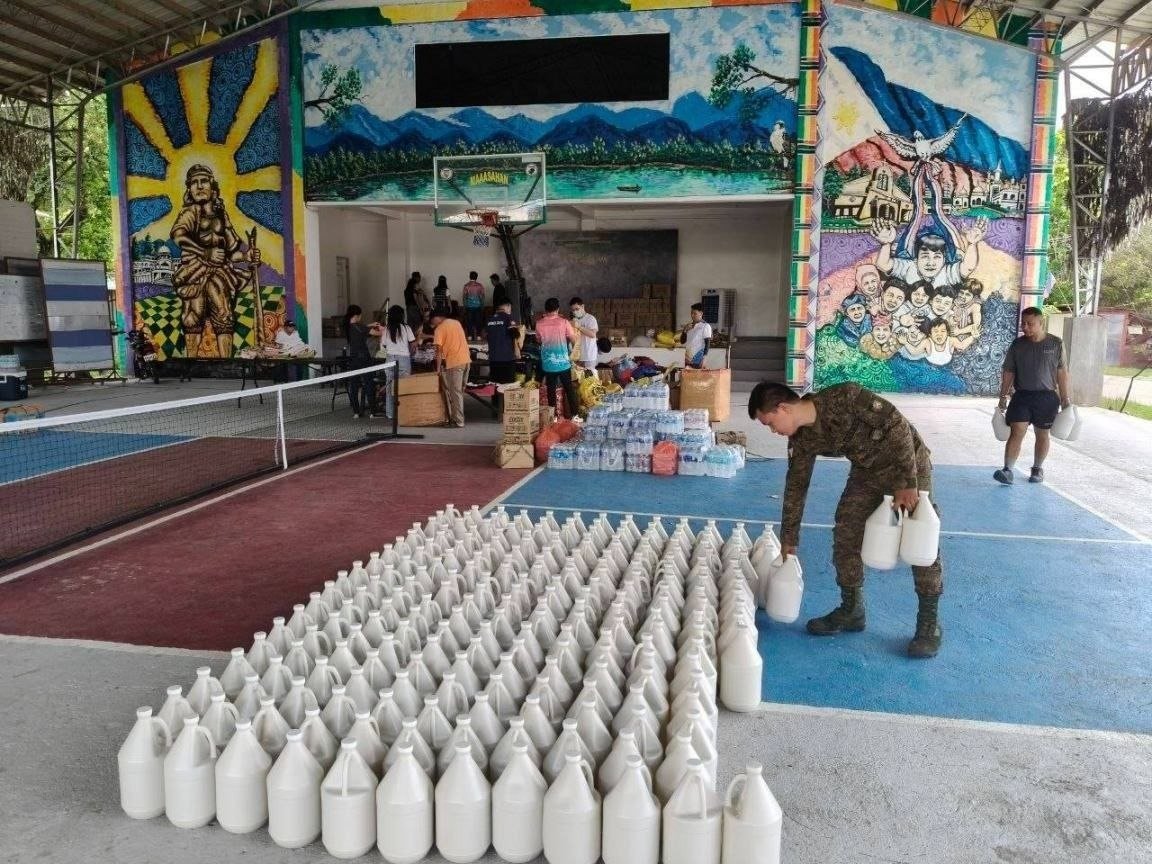
One of the earliest and most urgently needed interventions involved the deployment of the Army’s Mobile Water Purification Station to Sitio Linao, Barangay Tinoto, in Maasim, Sarangani. The unit produced and distributed approximately 190 gallons of potable water to around 600 displaced families in the community, according to the Philippine Army’s statement.
Access to safe drinking water ranks among the most critical needs in the immediate aftermath of a powerful earthquake, particularly in communities where ground movement and landslide activity have damaged or destroyed local water supply infrastructure. The mobile purification capability allows military responders to generate clean water directly on-site, reducing dependence on pre-packaged bottled supplies that are limited in volume and logistically cumbersome to transport.
Army personnel were also reported to have assisted civilian volunteers in distributing donated relief goods to displaced families in Barangay Butulan, Jose Abad Santos, Davao Occidental, the Philippine Army confirmed in the same statement.
Nearly 5,000 Food Packs Airlifted to Cut-Off Barangays
Working alongside the Philippine Air Force, Army HADR teams carried out multiple airlift missions between June 11 and June 15 to deliver essential goods to barangays where overland routes remained impassable. Target areas included Barangays Molmol, Quiapo, San Isidro, and Sitio Makina of Barangay Kalbay in Jose Abad Santos, as well as Barangay E. Alegado in Glan, Sarangani — all communities where road access had been severely disrupted or entirely cut off by earthquake-triggered landslides.
According to the Philippine Army, the following relief items were delivered via airlift operations during that five-day period:
- Approximately 4,925 food packs
- 800 five-kilogram rice packs
- 3,400 bottles of water
- 400 boxes of assorted relief goods
- 100 containers of 20-liter potable water
- 40 cases of six-liter bottled water
The volume and variety of supplies delivered through airlift alone illustrate the scale and urgency of the humanitarian response now underway in Mindanao’s southern provinces.
Ground Convoys Supplement Air Deliveries from General Santos City
Where roads remained passable, Philippine Army ground teams organized overland convoys to move relief goods from General Santos City into the disaster zone. Soldiers assisted with the loading, transport, and unloading of approximately 400 boxes of relief items distributed across key receiving points in affected communities, according to the Philippine Army.
Army personnel further supported the handling and onward distribution of assistance brought in by the Philippine Charity Sweepstakes Office (PCSO) through the General Santos City International Airport. The airport has functioned as a central logistics hub for the relief operation, particularly given how severely road infrastructure has been impacted in many parts of Davao Occidental and Sarangani. The Philippine Army noted in its statement that coordination between military logistics teams and civilian agencies has been essential in preventing gaps and duplications in relief delivery.
Search and Retrieval Teams Active in Landslide Areas
The Philippine Army’s HADR units have not limited their role to the delivery of goods. Search, rescue, and retrieval operations have also been running in parallel across landslide-affected areas within the earthquake zone, with Army teams deployed alongside other first-responder units to locate missing residents and clear buried sites.
Landslides are among the most dangerous secondary hazards that follow large-magnitude earthquakes in the Philippines, especially in highland and mountainous regions where steep terrain and unstable soil are highly susceptible to ground movement triggered by seismic shaking. According to the Philippine Army’s most recent update, search and retrieval missions in these zones remained ongoing, with some communities still difficult to access by both land and air routes.
Multi-Agency Framework Guides Relief Effort
The overall relief operation follows the established disaster response framework of the National Disaster Risk Reduction and Management Council (NDRRMC), which designates the Department of Social Welfare and Development (DSWD) as the primary agency responsible for relief distribution, with the Armed Forces of the Philippines (AFP) providing logistics, transportation, and security support throughout the operation.
The Philippine Army stated that its HADR teams are coordinating closely with national government agencies and local government units (LGUs) to sustain the delivery of essential assistance as operations move forward. The Philippine Air Force’s airlift contribution has been described as particularly vital, given that a significant number of affected communities in both provinces can only realistically be reached by helicopter or light aircraft under current conditions.
Operations to Continue in Coming Days
The Philippine Army has made clear that its humanitarian operations in the earthquake-affected areas of Davao Occidental and Sarangani will not wind down in the near term. Authorities are still working to account for all displaced and affected residents, finalize the initial phase of relief distribution, and begin planning for longer-term recovery assistance as the disaster response transitions beyond its immediate emergency stage.
Further updates on the total number of affected families, the progress of ongoing search and retrieval efforts, and the broader scope of the relief operation are expected from the Philippine Army, the Office of Civil Defense, and other relevant national government agencies in the days ahead.
Originally reported by: Philippine Army official statement via wire reports