
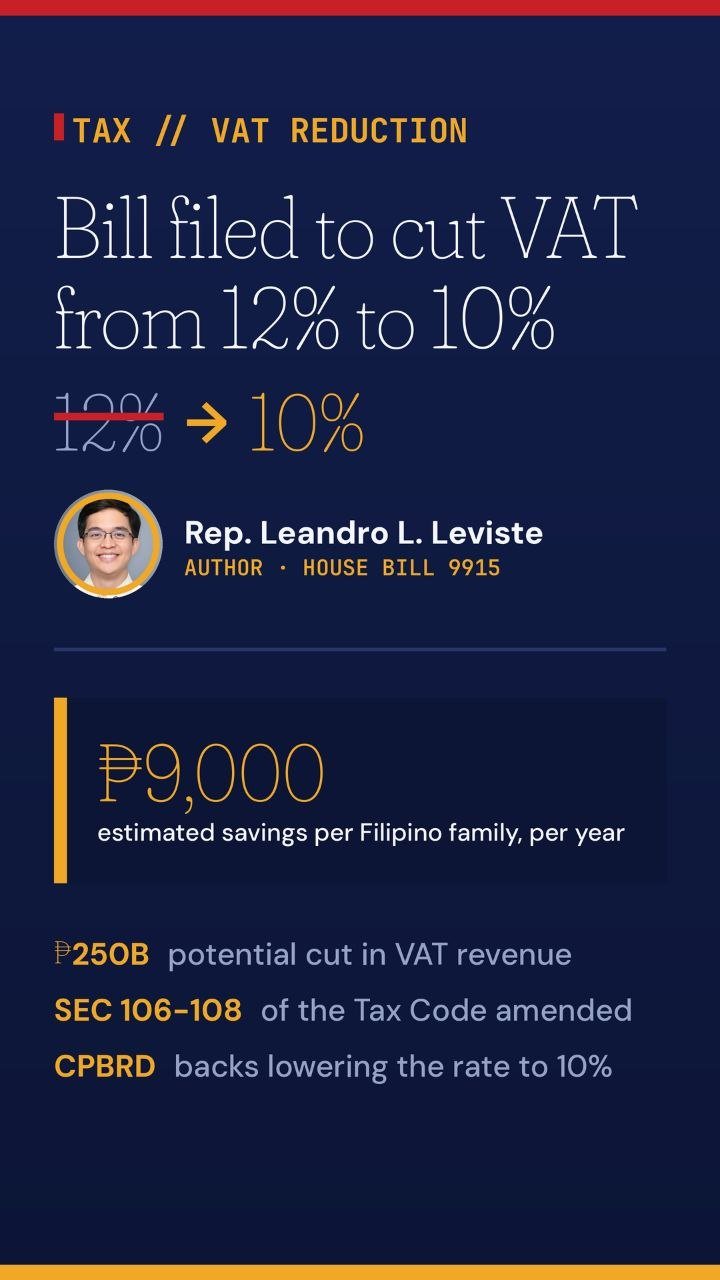
A sitting lawmaker has introduced legislation that would roll back the country’s value-added tax from its current 12 percent to 10 percent — a move projected to put more than ₱250 billion back into the hands of Filipino consumers each year. The measure, filed by Representative Leandro Legarda Leviste, is being positioned not merely as tax relief but as a constitutional obligation for Congress to pursue a fairer system of taxation.
House Bill No. 9915, formally called the “VAT Reduction Act,” was officially received by the House’s Bills and Index Service on June 23, 2026. The measure targets three specific provisions of the National Internal Revenue Code of 1997 — Sections 106, 107, and 108 — which respectively cover the sale of goods and properties, the importation of goods, and the sale of services, including digital services.
What the Bill Proposes to Change
All three of the affected tax code sections currently carry a uniform 12 percent VAT rate. Under the terms of House Bill 9915, each provision would be amended to reflect a 10 percent rate — a straightforward, across-the-board two-percentage-point reduction that would apply to the sale and exchange of goods, the entry of imported products, and the delivery of both traditional and digital services.
The bill’s scope is broad by design: it covers nearly every taxable economic transaction in the country, meaning the reduction would be felt across the entire supply chain from producers and importers down to ordinary consumers.
VAT Collections Have Multiplied Since the 2005 Rate Increase
According to the bill’s explanatory note, collections from VAT by the Bureau of Internal Revenue (BIR) and the Bureau of Customs (BOC) exploded from ₱156.67 billion in 2005 — the year before the Expanded VAT Law pushed the rate up from 10 to 12 percent — to ₱1.20 trillion in 2024. That nearly eightfold increase, the bill argues, demonstrates that government revenue has far outpaced the original justification for raising the rate.
If the rate were brought back down to 10 percent, the bill estimates that annual collections would fall by more than ₱250 billion. Leviste argued in his explanatory note that this apparent shortfall need not be catastrophic to public finances, as it could be addressed by reducing wasteful government spending or through targeted taxes on the country’s wealthiest citizens.
Leviste further described the VAT as a regressive tax — one that disproportionately burdens lower-income households since they spend a larger share of their earnings on consumption — and said that reducing it is consistent with the constitutional requirement for Congress to pursue a progressive system of taxation.
Framed as an Alternative to Budget Expansion
In a public statement, Leviste directly contrasted his proposal with the government’s planned budget increase — from ₱6.79 trillion in 2026 to ₱7.2 trillion in 2027, an increment of over ₱400 billion.
“Instead of increasing spending, we can reduce the VAT by two percent to save ₱250 billion, or ₱9,000 per Filipino family,” the representative said in Filipino, as cited in his official statement.
The framing is notable: rather than pitching the tax cut as a standalone fiscal measure, Leviste presented it as a choice between enlarging the government’s budget and returning money directly to households.
Philippine VAT Among the Steepest in the Region
The explanatory note also situates the Philippine VAT within the broader Southeast Asian context, and the comparison is unflattering. The Philippines’ 12 percent rate is among the highest in the region. According to the bill, Indonesia applies approximately 11 percent; Cambodia and Vietnam both sit at 10 percent; Singapore’s Goods and Services Tax stands at 9 percent; Malaysia charges 8 percent; Thailand and Laos each apply 7 percent; Myanmar levies 5 percent; and Timor-Leste has a rate as low as 2.5 percent.
The bill contends that bringing the Philippine rate down to 10 percent would meaningfully improve the country’s economic competitiveness and make it a more attractive environment for trade and investment within the region.
Congressional Research Body Supports the Reduction
Leviste’s proposal draws on analysis from the Congressional Policy and Budget Research Department (CPBRD), which issued a finding in January 2026 stating that reducing the VAT from 12 to 10 percent is advisable and likely to produce positive economic outcomes. The CPBRD noted that the net revenue impact would be partially cushioned by secondary effects: higher household consumption, an expansion of formal-sector economic activity, and an uptick in private investment.
The CPBRD’s endorsement lends the bill a degree of analytical credibility that goes beyond the typical legislative filing and signals that the proposal has been subjected to substantive policy review.
A Second Attempt After the 2025 Version Stalled
This is not Leviste’s first attempt at VAT reduction legislation. The representative disclosed that he introduced a similar proposal in 2025, which drew support from the CPBRD at the time but was never scheduled for a vote before Congress adjourned that session.
“I am refiling this proposal, and I am hopeful there are still ways to get it approved,” Leviste said in Filipino, indicating his determination to push the measure through the current Congress.
Implementation Timeline if Enacted
Should the bill be signed into law, the Department of Finance — working in coordination with the BIR — would be required to issue implementing rules and regulations within 60 calendar days of the law’s effectivity. The law itself would take effect 15 days after publication in the Official Gazette or in a newspaper of general circulation.
By the Numbers
- 12% to 10%: The proposed VAT rate reduction under House Bill 9915
- ₱156.67 billion: VAT collections recorded in 2005, prior to the rate hike
- ₱1.20 trillion: VAT collections recorded in 2024
- ₱250 billion+: Estimated annual reduction in VAT revenues if the cut is enacted
- ₱9,000: Projected annual savings per Filipino household
- ₱6.79 trillion → ₱7.2 trillion: The government’s proposed budget growth from 2026 to 2027
- 60 days: Deadline for the Department of Finance to release implementing rules after the law takes effect
- January 2026: Month the CPBRD issued its recommendation backing the VAT reduction
Why This Matters
VAT remains one of the Philippine government’s primary revenue engines, and any reduction in its rate would represent the first such rollback since the Expanded VAT Law elevated the rate to 12 percent two decades ago. Because VAT applies broadly to goods, services, and imports, a two-percentage-point cut would directly reduce the cost burden on every Filipino household and business that participates in the formal economy. The bill’s path forward still depends on surviving committee deliberations and a full plenary vote, but the CPBRD’s analytical backing and Leviste’s constitutional argument give it a stronger foundation than most standalone tax proposals receive at the filing stage.
Source: Originally reported by BreakingNewsNegrosOriental.com / wire reports