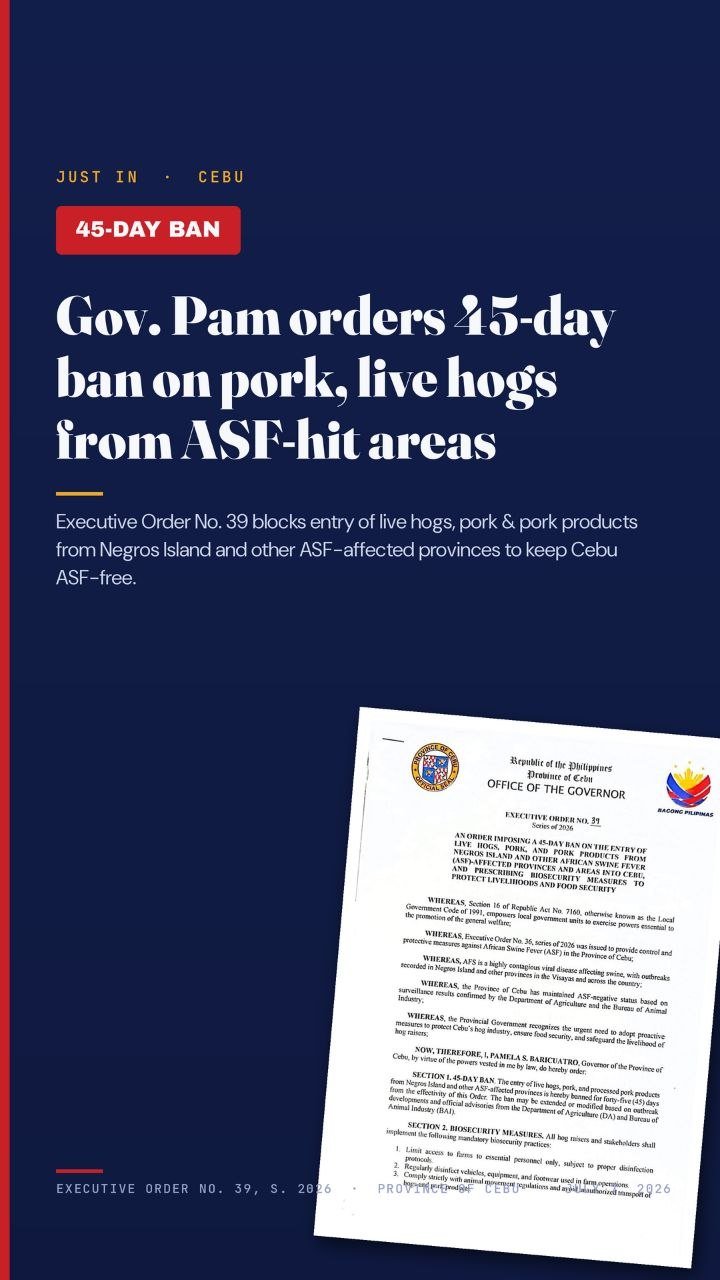
A strict 45-day prohibition on the entry of live hogs, fresh pork, and processed pork products is now in force across Cebu province after Governor Pamela Baricuatro signed Executive Order No. 39 on July 7, 2026. The measure, which took effect immediately upon signing, targets shipments originating from Negros Island and any other province where African swine fever (ASF) outbreaks have been confirmed.
The order covers all entry points in the province — seaports, airports, and land crossings alike — and may be extended or adjusted as the situation evolves, depending on guidance from the Department of Agriculture (DA) and the Bureau of Animal Industry (BAI), according to the text of the executive order.
Negros Island Outbreaks Spur Cebu to Act
Confirmed ASF outbreaks in both Negros Occidental and Negros Oriental, along with other affected areas across the Visayas, pushed the provincial government to escalate its response. Despite the regional spread of the disease, the DA and BAI have confirmed through surveillance results that Cebu has maintained its ASF-free status — a condition the provincial government is determined to preserve.
EO No. 39 builds on an earlier preventive measure. Baricuatro had already signed EO No. 36 on June 24, which reinforced biosecurity protocols, surveillance operations, and border monitoring throughout the province. The July 7 order goes further by placing a full ban on pork and hog imports from areas where the disease has taken hold.
Illegal Nighttime Shipments Flagged by Hog Raisers
A key driver behind the escalation was intelligence gathered directly from the hog-raising community. At a meeting with hog raisers held last week, Governor Baricuatro received reports of alleged illegal transport of pigs through smaller provincial ports during nighttime and early morning hours. The ports implicated in these reports were located in the towns of Ronda, Santander, Dumanjug, and Tabuelan.
“We need urgent action here. Sampolan nato na sila,” the governor stated, signaling an unambiguous shift toward firmer enforcement against unauthorized hog movements.
The provincial legislature moved in step with the executive branch. On Monday, the Cebu Provincial Board approved a resolution — authored by Board Member Dason Larenz Lagon — urging the Provincial Veterinary Office (PVO) and the Cebu Police Provincial Office to intensify monitoring at all entry points and block any possible smuggling of ASF-infected animals into the province.
Agencies Directed to Confiscate Prohibited Goods
Under EO No. 39, several government bodies have been tasked with enforcing the prohibition at the ground level. The Cebu Port Authority, the Philippine Coast Guard, the Philippine National Police, and concerned local government units were all directed to strictly implement the ban and to confiscate any prohibited shipments found in violation of the order. Penalties under existing laws apply to those caught in violation.
The order also places obligations on hog raisers and other industry stakeholders. Under the directive, farms must restrict access to essential personnel only, routinely disinfect vehicles, equipment, and footwear used in farm operations, and comply with all applicable regulations governing the movement of animals and pork products.
PVO Frames Order as Balance Between Health and Economy
Provincial Veterinarian Dr. Mary Rose Vincoy offered context on the rationale behind the ban at a press conference held on Tuesday. “This decision balances disease prevention efforts while considering the economic importance of the hog industry,” Vincoy said, describing the temporary prohibition as a proactive step rather than a reactive one.
Vincoy confirmed to reporters that local government units have activated their respective ASF task forces, which are now coordinating with the BAI and the Regional Veterinary Quarantine Service to reinforce border controls at seaports. She emphasized the financial stakes involved: “Cebu remains ASF-free, and we need to protect the province’s P20-billion hog industry,” the provincial veterinarian said.
The PVO, working alongside city and municipal veterinarians, has also been directed under EO No. 39 to maintain ongoing surveillance, conduct laboratory testing, and monitor hog populations to ensure any potential ASF incursion is detected as early as possible.
Cebu Joins Bohol, Capiz, and Guimaras in Regional Response
Cebu’s action is part of a broader pattern of defensive measures being adopted across the Visayas. According to reports, the provinces of Bohol, Capiz, and Guimaras have similarly moved to restrict the movement of live hogs and pork products following the confirmation of ASF cases in Negros Occidental and Negros Oriental. The coordinated response across multiple provinces underscores the scale of concern over the disease’s spread and the economic damage it threatens to inflict on hog industries throughout the region.
By the Numbers
- 45 days — duration of the ban on live hogs and pork imports from ASF-affected provinces
- P20 billion — estimated value of Cebu’s hog industry, as stated by Provincial Veterinarian Dr. Mary Rose Vincoy
- June 24 — date EO No. 36 was signed, tightening biosecurity and border surveillance
- July 7, 2026 — date EO No. 39 was signed and immediately took effect
- 4 towns — Ronda, Santander, Dumanjug, and Tabuelan, where illegal nighttime hog shipments were allegedly passing through
- 4 provinces — Cebu, Bohol, Capiz, and Guimaras have each imposed restrictions on hog movements from ASF-hit areas
Why This Matters
With ASF outbreaks confirmed in Negros Occidental and Negros Oriental and reports of illegal hog shipments already circulating through secondary ports, Cebu faces a real and immediate risk of losing its ASF-free status — a designation that protects a hog industry the provincial veterinarian values at P20 billion. Enforcement at seaports, airports, and land entry points is now a frontline priority, with multiple agencies activated and tasked with confiscating prohibited goods. Should the disease breach Cebu’s borders, the consequences would extend beyond hog raisers to pork consumers across the wider Visayas, where the industry already faces mounting pressure from outbreaks in neighboring provinces.
Source: Breaking News Negros Oriental / Cebu Provincial Government