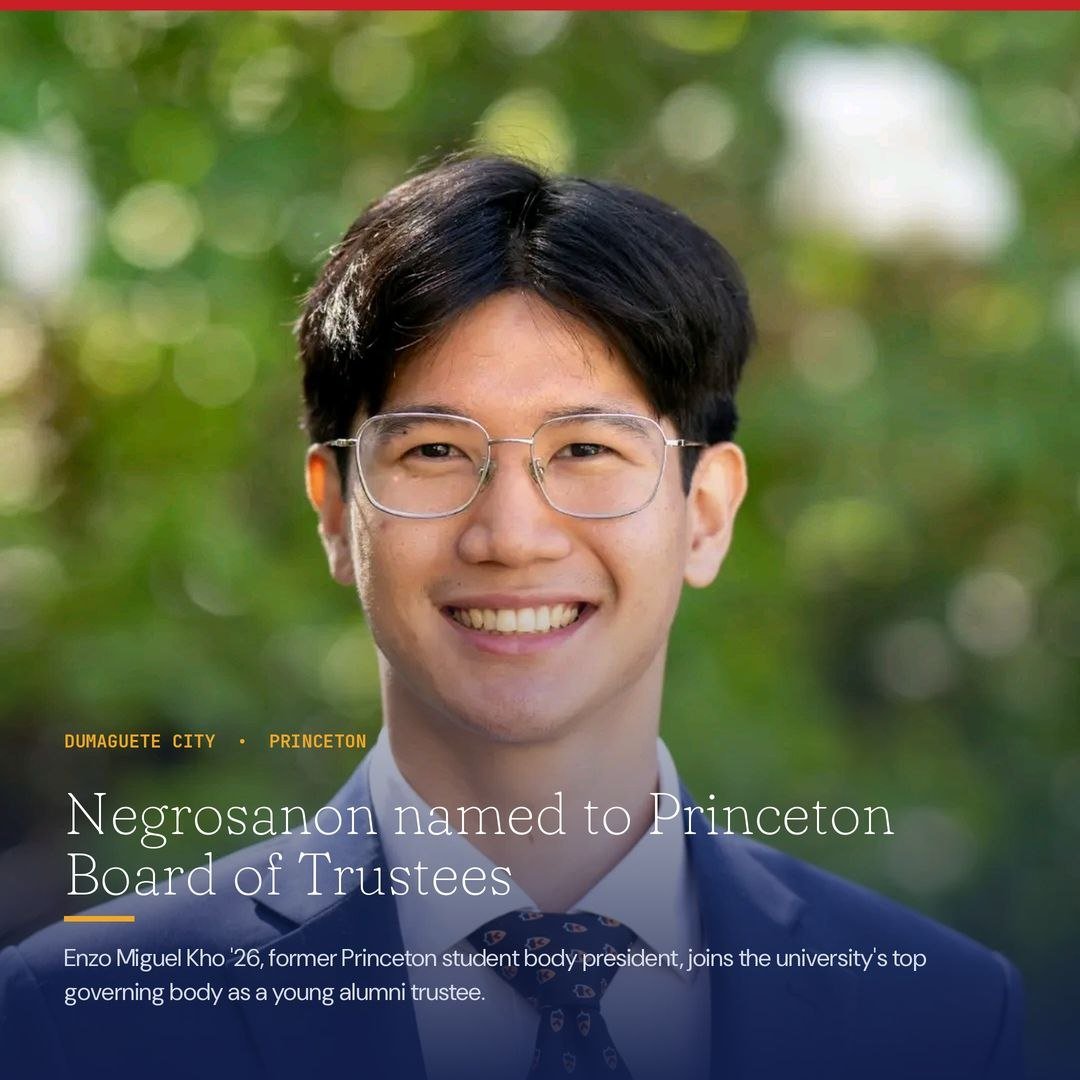
A Negros Oriental native whose parents hail from Mabinay, and who spent his elementary and high school years in Dumaguete City, has earned a seat at the table of one of the most powerful governing bodies in global higher education — and he is, by a considerable margin, the youngest person sitting on it.
Enzo Miguel Kho, who graduated from Princeton University in 2026 with a bachelor’s degree in sociology and a certificate in urban studies, was appointed to Princeton’s Board of Trustees as a young alumni trustee. The university announced his appointment along with seven other new trustees in late June, and his four-year term officially began on July 1, 2026, according to Princeton University.
Chosen by Students, Confirmed by the Institution
Kho did not receive a presidential appointment or a corporate nomination — he was elected by his own peers. Princeton’s junior and senior undergraduate classes, together with the two most recently graduated classes, cast votes that put Kho into one of four young alumni trustee seats on the board, according to university records cited by The Daily Princetonian. He won the election in May, besting two classmates who also vied for the position.
Upon learning of the result, Kho told The Daily Princetonian: “I’m super excited.” The quote, understated as it was, carried real weight — his election placed him among a group of incoming trustees that includes the outgoing president of the California Institute of Technology, the chairman of HCA Healthcare, the retired president and co-chief investment officer of Citadel, and a Caltech professor who received a National Medal of Science in 2025.
What the Board Actually Controls
The Princeton Board of Trustees is not ceremonial. According to Princeton University, it is the institution’s supreme governing authority, exercising oversight over the university’s budget, its endowment, real estate holdings, admissions policies, and all major institutional decisions. The board now stands at 40 members — the ceiling permitted under Princeton’s bylaws — making Kho one of a fixed and limited number of individuals with direct governance power over the university.
A Record-Setting Undergraduate Career
Before the board seat, Kho had already built a notable record on campus. He served as president of Princeton’s Undergraduate Student Government — a position that, according to university records cited by The Daily Princetonian, had never before been held by a Filipino student. That milestone alone would have marked him as a significant figure in the university’s history.
His involvement on campus extended well beyond student government. He worked as a peer career adviser, served on the executive board of the Student Volunteers Council, and acted as community outreach coordinator for the Princeton Filipino Community. He also worked as a student coordinator for Princeton’s Office of International Programs and performed with three campus dance and arts companies — a breadth of engagement that reflected both organizational commitment and cultural roots.
Beyond Princeton’s gates, Kho is a co-founder of the Alliance of Empowered Youth in the Philippines, a nonprofit organisation that works to connect young people in rural communities across the country with opportunities they might not otherwise be able to access. Through Princeton, he completed internships in Singapore and Malaysia, where he studied the institutions and policies driving development across Southeast Asia.
Research Rooted in Dumaguete
Breaking News Negros Oriental first spoke with Kho in Dumaguete last year, when he returned home during his senior year to conduct the fieldwork at the centre of his undergraduate thesis. His research examined the business process outsourcing industry in the Philippines’ next-wave cities — emerging urban centres being positioned as new drivers of employment and economic growth beyond Metro Manila and Cebu.
That research led Kho into direct conversations with Dumaguete’s civic and political leadership. He sat with former Dumaguete mayor and lawyer Felipe “Ipe” Remollo — over kamote and saging — to probe what the BPO industry has genuinely delivered to the city, what it has promised but not yet fulfilled, and what it continues to demand from local governance structures.
His questions were precise and grounded: What categories of jobs are actually being created? Who has realistic access to those jobs? What protections exist for workers inside the industry? How are local governments negotiating with, enabling, and regulating BPO operators? These are not abstract questions — they are policy questions that bear directly on economic life in cities like Dumaguete.
Celebration at Home, Then Beijing
Kho is currently back in Dumaguete, where family members and friends gathered this month to mark both his graduation and his board appointment with an evening that included speeches, a microphone, and orange-and-black balloons — Princeton’s colours, displayed far from Nassau Hall in Princeton, New Jersey.
The celebration will be brief. This coming fall, Kho departs once more — this time for Beijing, where he will pursue a master’s degree in politics and international relations at Peking University as a Yenching Scholar, one of the most competitive postgraduate fellowships available to students focused on China and Asia.
By the Numbers
- 40 — total seats on Princeton’s Board of Trustees, the maximum allowed under the university’s bylaws
- 4 — young alumni trustee positions on the board
- 4 years — duration of Kho’s trustee term, which began July 1, 2026
- 8 — total new trustees announced by Princeton in late June
- 2025 — year one of Kho’s fellow incoming trustees was awarded a National Medal of Science
Why This Matters
Kho’s appointment places a graduate from Negros Oriental on the governing board that holds direct authority over Princeton University’s budget, endowment, admissions policy, and institutional direction — an institution whose decisions shape higher education far beyond the United States. His undergraduate thesis, grounded in fieldwork conducted in Dumaguete on BPO employment in Philippine next-wave cities, ties his academic record directly to questions of economic development and labour policy in the region. His progression from Negros Oriental to Princeton’s board and then to Peking University as a Yenching Scholar represents a documented arc connecting local roots with some of the world’s most influential academic and governance institutions.
Source: Breaking News Negros Oriental (breakingnewsnegrosoriental.com)