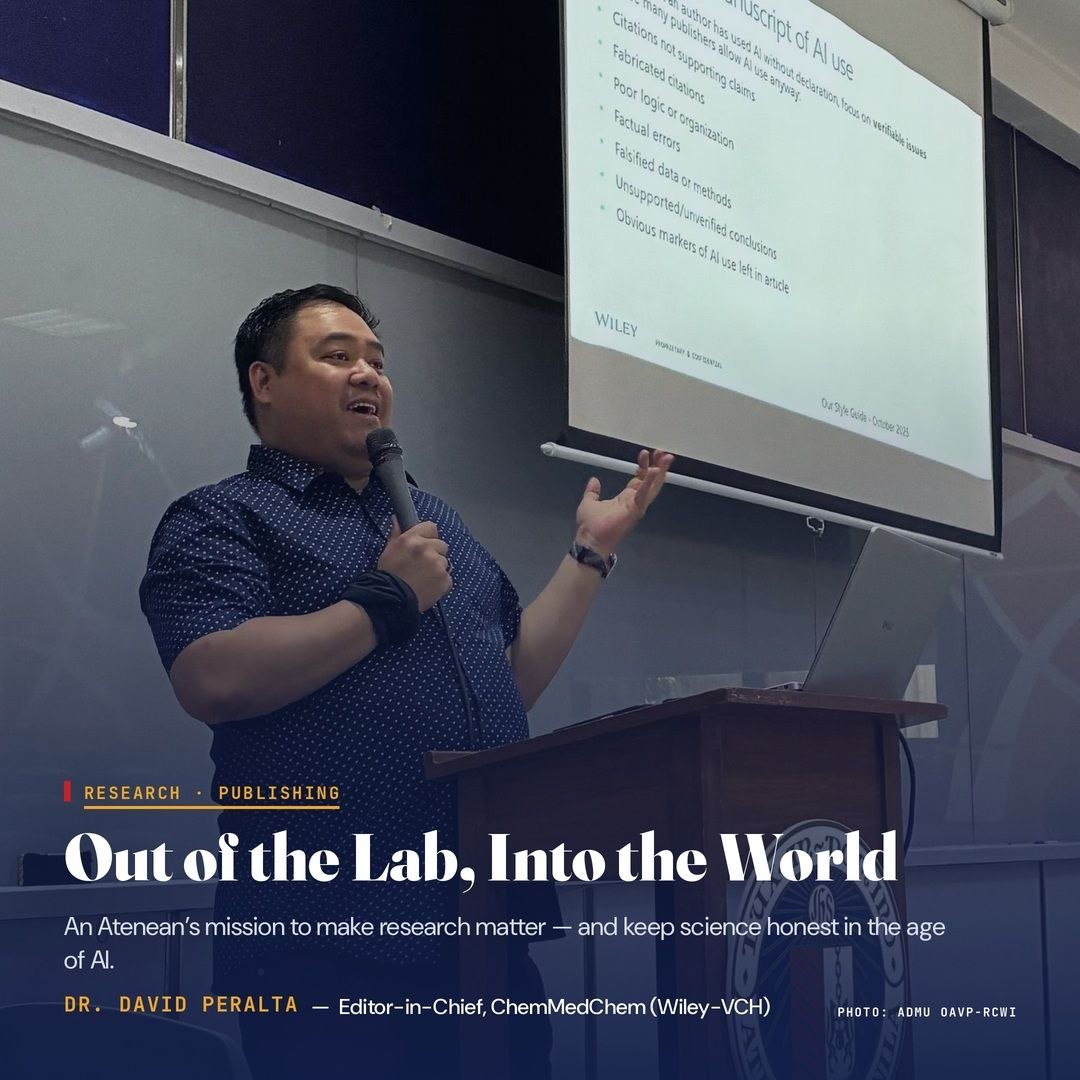
Before a discovery can change the world, someone has to write it down — and write it well. That conviction brought Dr. David Peralta back to Ateneo de Manila, where the Editor-in-Chief of the peer-reviewed international journal ChemMedChem led a hands-on workshop designed to help Filipino scientists close the gap between doing research and actually communicating it to the people who need it most.
The event, organized in collaboration with global academic publisher Wiley-VCH, covered a range of topics including scientific publishing practices, research communication strategies, publication ethics, and the increasingly contentious role of artificial intelligence in academic writing. Kuryente News reported on Peralta’s return visit to his alma mater and the goals he brought with him.
A Filipino Chemist Who Found His Calling Between the Lab and the Page
Peralta’s journey to the editorial side of science was anything but straightforward. As an undergraduate at Ateneo de Manila, he pursued chemistry alongside studies in German language and culture — a pairing that, at the time, seemed more personal than professional. That combination would eventually rewrite his career path entirely.
A study tour gave him his first exposure to Heidelberg, and by 2009, Peralta had relocated to Germany to begin doctoral research at the German Cancer Research Center, known by its German acronym DKFZ. He completed his PhD in the biosciences in 2015, but even before he finished, he had started to question where he truly belonged in the research world.
“I realized that I still really love science, but I didn’t necessarily want to stay in a laboratory doing the lab work myself,” Peralta said, as quoted by Kuryente News. That honest self-assessment sent him looking for a role that would keep him close to cutting-edge science without anchoring him to a single bench or a single experiment.
How Scientific Publishing Keeps a Researcher at the Frontier
For Peralta, scientific publishing became exactly that kind of role. Rather than narrowing his focus to one research question, he now sits at the crossroads of hundreds of them — reviewing, editing, and helping shape the work that enters the public scientific record through ChemMedChem, a Wiley-VCH publication specializing in medicinal chemistry.
“It put me at the forefront of science,” he explained. “It combined my love for science, my love for writing and communication, and my love of teaching.”
Crucially, Peralta does not treat publishing as a formality that researchers complete after the real work is done. In his view, communicating a discovery is as integral to the research process as conducting the experiment in the first place. A finding that never reaches its intended audience — whether fellow scientists, policymakers, or the broader public — is, in his framing, a finding that has only done half its job.
“Doing the scientific work is important, but so is knowing how to communicate it,” he said. “These days, when people are searching for answers more than ever, we need to be able to explain what we do as scientists to everyone.”
Workshops Designed to Build the Next Wave of Filipino Science Communicators
Author engagement programs like the one held at Ateneo are a core part of how Peralta channels that belief into action. Through these sessions, he works directly with early-career researchers to build the skills they will need not just to complete studies, but to present them clearly, compellingly, and credibly to a global audience.
He encourages participating scientists to think of their findings as stories — narratives with structure, purpose, and an audience waiting to receive them. The technical rigor of the science, he argues, is undermined whenever it is buried in poor writing or presented without regard for who will read it.
“We do these workshops to help communities and to support the next generation of researchers who will determine and shape the future research landscape,” Peralta said, according to Kuryente News.
The broader implication of his message is significant for Philippine higher education: scientific training that stops at the laboratory door leaves researchers unprepared for a world where public trust in science is hard-won and easily lost. Findings that cannot be communicated effectively risk being ignored by the very practitioners and decision-makers who could act on them.
The Growing Threat of AI Misuse in Academic Publishing
A substantial section of the Ateneo workshop was devoted to one of the most urgent challenges now facing journals and researchers alike: the unchecked or undisclosed use of artificial intelligence in the preparation of academic manuscripts.
Peralta walked workshop participants through concrete warning signs that editorial teams look for when reviewing submissions. According to Kuryente News, these red flags include fabricated citations, factual errors embedded in the text, falsified descriptions of data or research methods, and conclusions that the actual research does not support.
His message to participants was direct: AI tools are not a substitute for honest, verifiable scientific work, and relying on them as a shortcut carries serious professional and ethical consequences. As journal editors around the world sharpen their detection methods, researchers who cut corners now face increasingly serious risks to their credibility and careers.
The session underscored that the integrity of science depends not just on what happens in the laboratory, but on how accurately and transparently that work is reported to the wider world.
Interdisciplinary Roots, Global Perspective
Much of what makes Peralta an effective editor and communicator, he suggests, traces back to the breadth of his own education. The combination of chemistry and German studies at Ateneo was not merely a curiosity — it trained him to move between different ways of thinking, speaking, and understanding the world. That capacity, he believes, is precisely what today’s researchers need most.
“To be an effective scientist, you need to learn how to understand people,” he said. “You need to be aware of social and geopolitical situations that can shape your career, your work, and how your science is applied. Especially today, scientists need to clearly explain what they do, why it matters, and how it impacts the world around them.”
In his view, the experiment ends at the laboratory door — but the work of science does not. The second half begins the moment a researcher sits down to explain what was found, why it matters, and what the world should do with the knowledge.
By the Numbers
- 2009: Year Dr. Peralta relocated to Germany to begin doctoral research at the German Cancer Research Center (DKFZ)
- 2015: Year he was awarded his PhD in the biosciences
- 4 red flags of undisclosed or careless AI use flagged during the workshop: fabricated citations, factual errors, falsified data or methods, and conclusions unsupported by the research
Why This Matters
Scientific communication remains a critical but frequently undertrained skill among early-career researchers in the Philippines, leaving important findings vulnerable to being overlooked by policymakers, practitioners, and the public. Workshops like the one Dr. Peralta led at Ateneo de Manila directly address that gap, equipping scientists with the publishing literacy they need to make their work count beyond the laboratory. At the same time, his focused warning about AI misuse in academic manuscripts responds to a challenge that journal editors worldwide are actively confronting as AI-generated or AI-assisted content becomes harder to detect and more widespread in academic submissions.
Source: Kuryente News