Standfirst: When the habagat picks up, the question in every Dumaguete group chat is the same: are the boats running? The answer is decided by three different bodies, in a fixed order — and knowing which one to check saves you a wasted trip to the port. If your trip is called off, the refund rules are set nationally, and they are not the operator’s to invent.
Standing page. Operators and routes verified 30 August 2026; entitlements verified against the text of MARINA Circular 2018-07 and added 17 September 2026. Schedules change — confirm sailing times with the operator, not with this article.
Nobody at the pier decides this
The most common misunderstanding is that the shipping line cancels your trip. Usually it does not decide first — it responds.
The sequence runs like this:
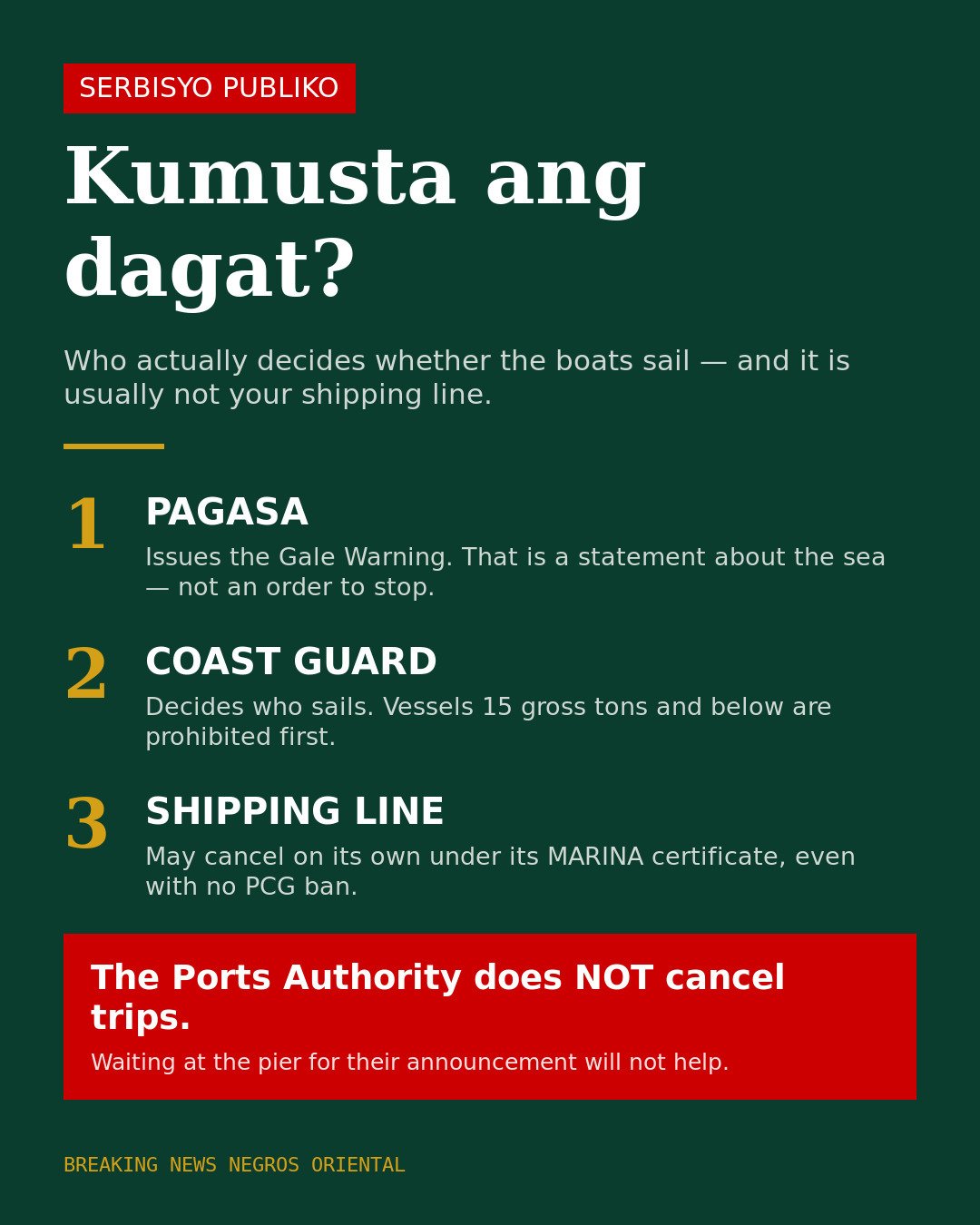
1. PAGASA issues the warning. The state weather bureau issues a Gale Warning when seas become hazardous, most often during the southwest monsoon — the habagat — or when a storm is enhancing it. The Gale Warning is a statement about sea conditions, not an order.
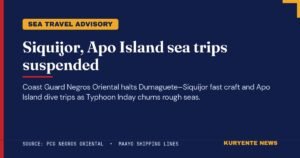
2. The Philippine Coast Guard decides who sails. The PCG enforces the no-sail rule. Under Memorandum Circular No. 03-01, small craft operations are suspended during adverse weather, and PCG directives routinely prohibit all motorboats and vessels of 15 gross tons and below from sailing. This is why a small fastcraft can be grounded on a day when a larger vessel still sails — it is a size threshold, not a judgment call about your particular route.
3. Shipping lines may cancel on their own. Separately from any PCG prohibition, an operator may cancel a voyage under the terms of its Certificate of Public Convenience issued by MARINA. A line can therefore cancel when the Coast Guard has not prohibited sailing at all.
Worth knowing: the Philippine Ports Authority does not cancel trips. The PPA has stated plainly that it does not cancel voyages directly; shutdowns follow from PCG prohibitions and from operators’ own decisions.
What this means when you are deciding whether to travel
A Gale Warning is not a cancellation. It is the trigger that makes one likely. If you see a Gale Warning covering the Bohol Sea or the Negros seaboard, expect small craft to be held first.
Vessel size is the best predictor. On the Dumaguete–Siquijor run this is a practical distinction, not a technicality: OceanJet runs fastcraft for foot passengers, while Aleson Shipping and Montenegro Lines run RoRo vessels that carry vehicles. HS Star Marine’s Anika Star and Super Shuttle Ferry also serve the route, between them giving well over a dozen crossings a day.
A suspension aimed at small craft reaches the fastcraft first. If you can move your booking to a RoRo, you are more likely to sail.
The Sibulan–Liloan crossing to southern Cebu is a different case again: a short RoRo hop of roughly 20 minutes across the Tañon Strait, and the usual bus-and-ferry route to Cebu City.
Where to check, in order
- PAGASA — whether hazardous seas have been declared at all. The Gale Warning page states plainly when no warning is in force, and the High Seas and Offshore Waters Forecast carries the wider picture. Gale warnings cover sea areas within 30 nautical miles of the coast and carry the standard line that sea travel is risky for small seacraft. For Negros Oriental, the waters that matter are the Bohol Sea to the south and east — the Siquijor, Bohol and Dapitan crossings — and the Tañon Strait to the west, which is the Sibulan and Tampi run to Cebu.
- Coast Guard Station Negros Oriental — the unit with jurisdiction here. Based at Brgy. Looc in the Dumaguete port area, it posts suspensions and liftings on its Facebook page. It has suspended voyages across all ports in the province during storm conditions, so its directive covers Dumaguete and Sibulan together rather than port by port.
- Your shipping line’s own page — the cancellation itself. For this route that means OceanJet, Aleson Shipping, Montenegro Lines, HS Star Marine or Super Shuttle Ferry, depending on your booking.
If your trip is cancelled, this is what you are owed
Cancellation for weather is a safety decision, not a service failure — but it does not cancel your rights as a passenger. Those rights are set by MARINA Circular No. 2018-07, approved by the MARINA Board on 20 September 2018, which applies to passengers on liner passenger ships holding a Certificate of Public Convenience in domestic waters. That covers the scheduled Dumaguete, Sibulan and Tampi services; it does not cover a private banca you hired yourself.
The part most passengers are told wrongly at the counter is this. The circular’s main list of remedies opens with cancellations “for causes attributable to the operator” — but Section VIII(2) then says the two that matter most survive any cause: “The right to refund or revalidation applies regardless of the nature of the cause of the cancellation or delay, except for causes attributable to the passengers.” Weather is expressly a fortuitous event under the circular, which defines force majeure to include “weather conditions endangering the safe operation of the ship,” and a Coast Guard no-sail order is an “extraordinary circumstance,” defined to include “orders and decisions of competent authorities with regard to transport needs, public safety and interest.”
So a habagat cancellation still leaves you with a choice between two things:
- A refund — the full purchase value of the ticket, or the value of the untravelled part of the voyage. It is paid on your request and, under Section IV(2), “in no case more than seven calendar (7) days” after it. Granting a refund beyond those seven days is listed as a prohibited act. Section VIII(3) is blunt about deductions: the operator “shall not, for any reason, deduct any processing fee or similar charge.”
- Revalidation — rebooking instead of money back, at your option, not theirs. The operator must re-schedule you “at the earliest opportunity for the same route, or for an alternative route with the consent of the passenger, at no additional cost.” A displaced passenger takes priority over walk-ins on the operator’s other ships, and if the operator cannot fit you at all, it must arrange your passage on another operator’s ship in the same route — again at no additional cost to you.
What weather does take away are the comforts. Meals, first aid, communications access, accommodation and cash compensation in place of a hotel are all in the circular, but Section VIII(6)(c) removes the right to those amenities where the operator demonstrates that the cancellation was caused by a fortuitous event, force majeure or an extraordinary circumstance. A gale that grounds the fleet is exactly that. Amenities also fall away if you were told at least four hours before departure, or if you are rebooked onto a sailing within four hours of the original one.
Two definitions decide which rules apply to you. A voyage counts as cancelled when it is called off and deferred to the next day — more than 24 hours from the scheduled departure — or to an indefinite date and time. A voyage merely running late is a delay, and there the trigger is three hours: past that, the operator must offer you the same choice of refund or revalidation.
Asking for it, and what to do if you are refused
- Keep the ticket. The circular requires you to present it to claim anything, so do not surrender it without getting your refund or revalidation recorded first. An e-ticket counts.
- Ask which decision cancelled your trip — a Coast Guard prohibition, or the line’s own call. It changes nothing about your refund, but it tells you whether every operator at that port is grounded or only yours, which is what you need to know to get home.
- Ask for it in writing. The operator is already obliged to issue a written notice or public announcement setting out the circumstances of the cancellation.
- If you are refused, the complaint does not go to the port. Under Section X it is filed with the MARINA office having jurisdiction over the operator’s principal place of business — so ask the line where that is, or file at any MARINA office, which must forward it. Refusing a refund or revalidation at the passenger’s option, charging unauthorised fees, or paying out beyond seven days are all prohibited acts, and the fines run ₱100,000 for a first violation per voyage, ₱200,000 and a five-day suspension for a second, and ₱300,000 and ten days for the third.
One last point in your favour: Section VIII(7) states that everything above is the minimum entitlement. An operator is free to be more generous than the rule, and some are. None of them is free to be less.
Sources: PAGASA Gale Warning and High Seas and Offshore Waters Forecast bulletins; Philippine Coast Guard Memorandum Circular No. 03-01 and PCG suspension directives, including suspensions issued by Coast Guard Station Negros Oriental; Philippine Ports Authority statements on trip cancellation; MARINA Circular No. 2018-07 on the rights of passengers in cases of cancelled, delayed or unfinished voyages (Sections II, III, IV, V, VIII, IX, X, XI and XII, read in full for this article); MARINA Certificates of Public Convenience; operator route information for Dumaguete, Sibulan and Siquijor.
Related stories