GENERAL SANTOS CITY — Hours after a significant earthquake rattled multiple areas across Mindanao on the morning of Monday, June 8, 2026, the Armed Forces of the Philippines’ Eastern Mindanao Command (EastMinCom) swiftly moved to activate its emergency response machinery, deploying personnel for aerial assessments and initiating coordinated damage evaluation procedures across its area of responsibility.
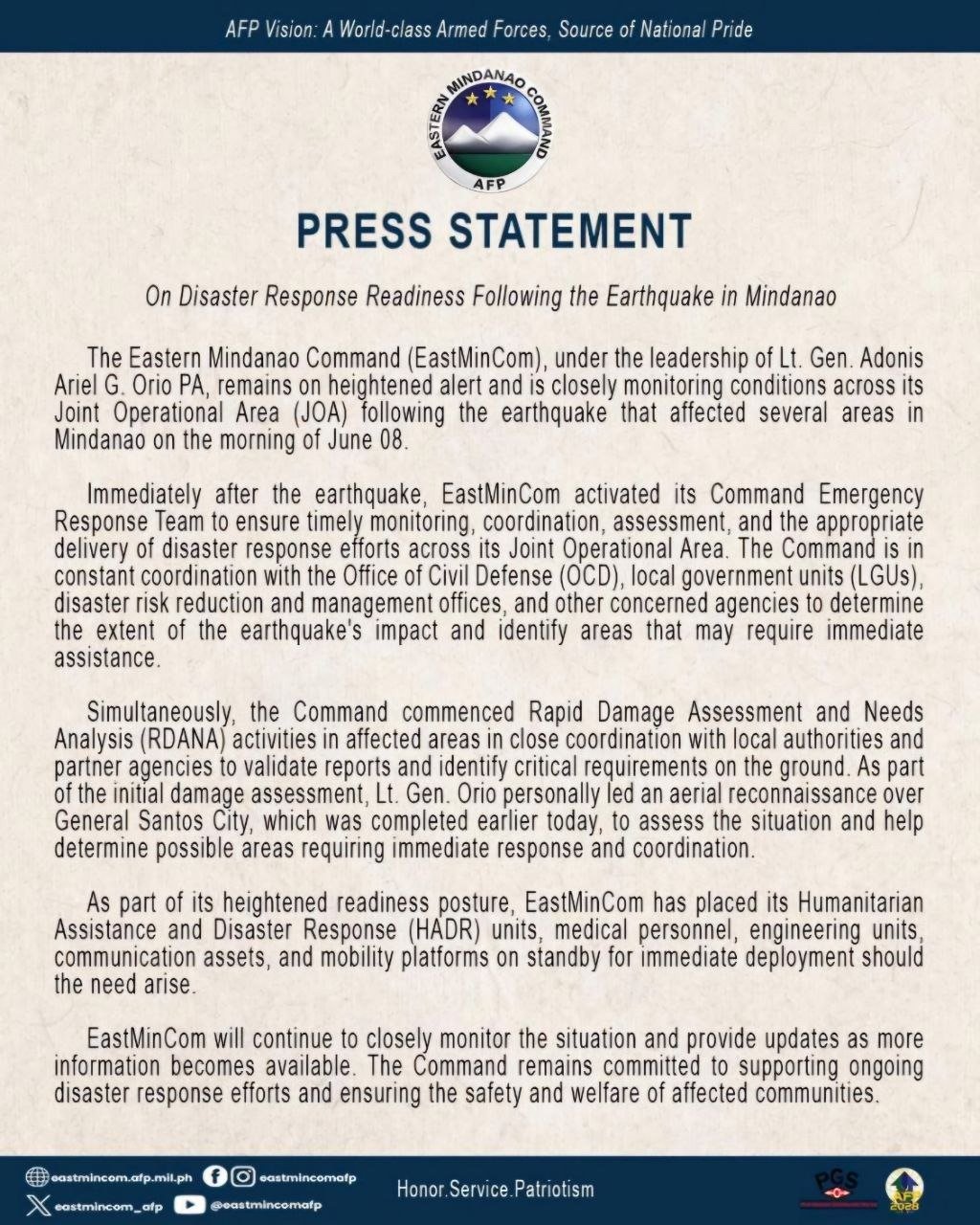
The seismic event triggered an immediate chain of military preparedness actions, with EastMinCom placing its Humanitarian Assistance and Disaster Response (HADR) units, medical teams, engineering assets, communication resources, and mobility platforms on standby for rapid deployment to communities across its Joint Operational Area (JOA).
Emergency Response Team Activated Without Delay
According to a formal statement issued by Col. Rosa Ma. Cristina Rosete-Manuel PA, Chief of the EastMinCom Public Information Office, the Command Emergency Response Team was activated immediately after the earthquake struck on the morning of June 8. This activation followed established protocols that EastMinCom implements whenever natural disaster events occur within its operational coverage area.
The purpose of activating the emergency response team, Col. Rosete-Manuel’s statement explained, was to ensure that monitoring, inter-agency coordination, damage assessment, and the actual delivery of disaster assistance to affected communities would proceed in a timely and organized manner.
EastMinCom further confirmed it has opened and is maintaining active communication lines with the Office of Civil Defense (OCD), local government units (LGUs), disaster risk reduction and management offices (DRRMOs) at both provincial and municipal levels, and other relevant government bodies. These coordinated efforts are designed to build a clear and verified picture of the earthquake’s impact across Mindanao and to pinpoint communities requiring the most urgent assistance.
Commander Personally Oversees Aerial Survey of General Santos City
Taking a direct hand in the response effort, Lt. Gen. Adonis Ariel G. Orio PA, EastMinCom’s commanding general, personally led an aerial reconnaissance mission over General Santos City on the same morning the earthquake occurred. The flyover, which was completed earlier in the day on June 8, according to the command’s Public Information Office, gave Lt. Gen. Orio a firsthand visual read of ground conditions in one of the affected urban centers within EastMinCom’s JOA.
General Santos City falls squarely within EastMinCom’s area of responsibility and is among the locations covered by the command’s disaster response mandate. The aerial reconnaissance allowed military leadership to make more informed decisions about where concentrated response efforts and resources should be directed in the immediate aftermath of the quake.
Such command-level participation in initial assessment missions underscores the AFP’s emphasis on leadership-driven disaster response, particularly in the critical early hours following a seismic event when damage information remains incomplete and rapidly evolving.
RDANA Process Rolled Out Across Affected Zones
Running concurrently with the emergency response team activation, EastMinCom launched Rapid Damage Assessment and Needs Analysis (RDANA) operations across areas of Mindanao affected by the June 8 earthquake. The RDANA is a standardized government assessment tool used to validate initial damage reports, determine the scope of infrastructure destruction, document displacement of residents, and identify specific requirements for medical or logistical support on the ground.
As Col. Rosete-Manuel’s statement noted, these RDANA activities are being conducted hand-in-hand with local authorities and partner agencies to ensure that the data collected is accurate and can reliably guide the decisions of officials overseeing relief operations.
Once assessment findings are compiled and validated, EastMinCom said results will inform the deployment of specialized military assets — including engineering battalions capable of clearing debris or restoring access routes, medical units to serve injured residents, and communication teams to restore connectivity in areas where it may have been disrupted — to the highest-priority affected locations.
Specialized Units and Assets on Standby for Deployment
EastMinCom stated in its June 8 release that the following assets have been placed on standby, ready for immediate field deployment pending the results of ongoing assessments and formal requests from LGUs and DRRMOs:
- Humanitarian Assistance and Disaster Response (HADR) units
- Medical personnel and field medical teams
- Military engineering units
- Communication assets and equipment
- Mobility platforms for personnel and equipment transport
The command emphasized that the standby posture is consistent with the AFP’s broader mandate to extend support to civilian government authorities during natural calamity situations, and that these units can be mobilized at short notice once priority deployment areas are confirmed through field assessments.
Sustained Coordination With Civilian Agencies
A core component of EastMinCom’s response framework involves sustained engagement with the OCD and LGUs across the affected portions of Mindanao. According to the command’s official statement, disaster risk reduction offices at the local level are considered essential partners in this response precisely because they hold ground-level knowledge of affected communities, existing vulnerabilities, and local response capacities that military planners need in order to make effective deployment decisions.
EastMinCom said it will continue to work closely with all relevant agencies as the situation on the ground develops and as more detailed and verified information about damage and humanitarian needs emerges from field teams conducting assessments.
Monitoring to Continue; Full Damage Picture Still Being Developed
As of the time of publication on June 8, 2026, the complete extent of damage to infrastructure, property, and communities across affected areas of Mindanao had not yet been officially confirmed, with assessment teams still in the field conducting validation activities, the EastMinCom statement indicated.
“EastMinCom will continue to closely monitor the situation and provide updates as more information becomes available,” Col. Rosete-Manuel’s statement read. “The Command remains committed to supporting ongoing disaster response efforts and ensuring the safety and welfare of affected communities.”
Further official statements on damage assessments and the status of relief operations are expected to be released by EastMinCom and relevant civilian government agencies in the hours and days following the earthquake.
Mindanao’s Seismic Vulnerability and AFP Preparedness
EastMinCom is one of the AFP’s major unified commands, holding responsibility for military operations and disaster response across the eastern portion of Mindanao, encompassing a wide geographic area that includes multiple provinces and cities periodically exposed to seismic risk.
Mindanao sits within the Pacific Ring of Fire — the geologically active zone that makes the Philippine archipelago among the most earthquake-prone territories in the world. Because of this persistent seismic risk, the AFP regularly conducts disaster preparedness drills and pre-positions HADR assets across Mindanao in anticipation of earthquake events. The activation of emergency protocols following the June 8 quake is consistent with established AFP and national government procedures for natural disaster response, according to the command’s public communications.
EastMinCom’s response to the June 8 Mindanao earthquake reflects the AFP’s institutionalized approach to disaster response: immediate activation of emergency mechanisms, command-level leadership engagement, rapid inter-agency coordination, and structured deployment of specialized assets to serve affected civilian populations.
Originally reported by: Philippine News Agency / EastMinCom Public Information Office
Related stories