
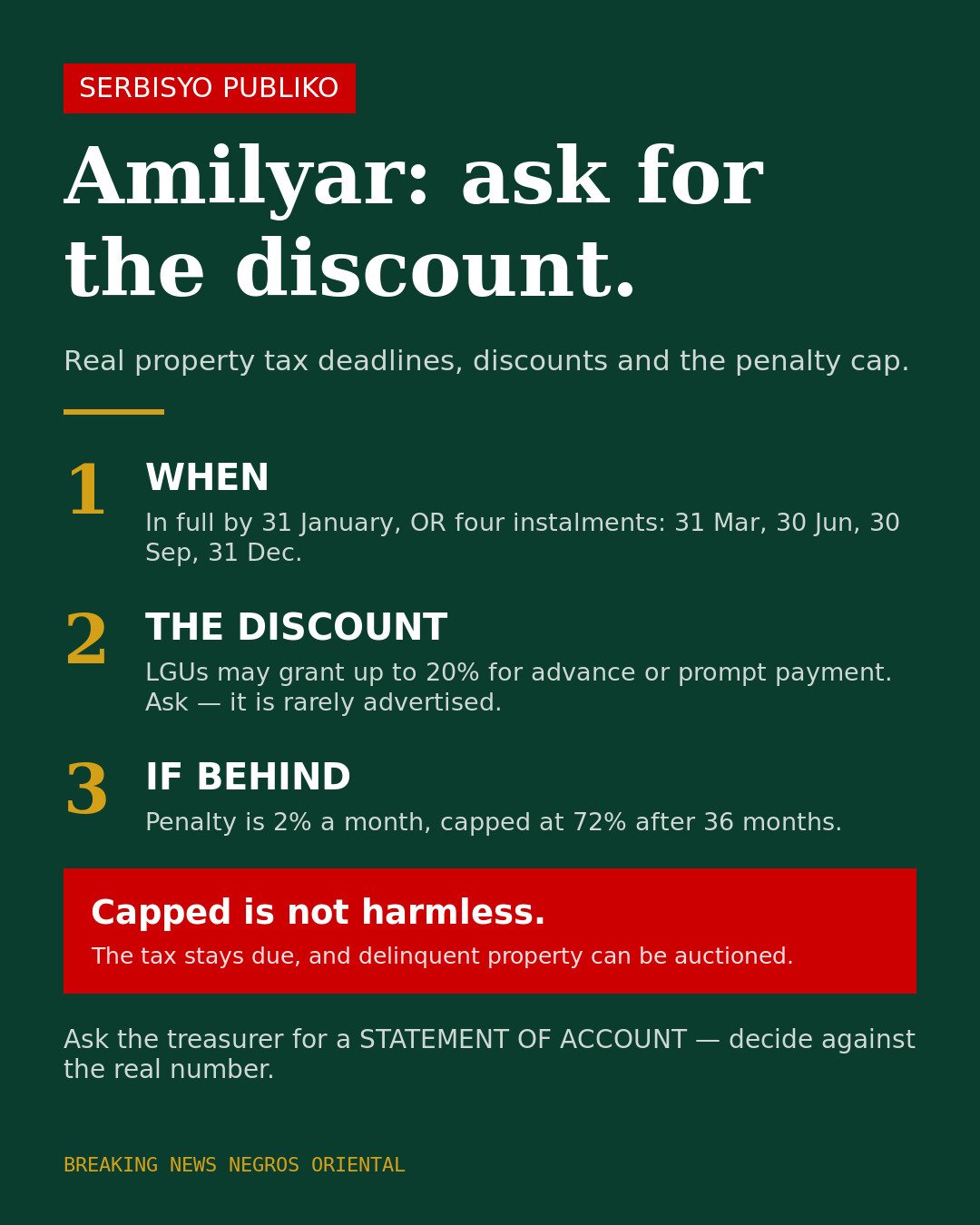
Standfirst: Real property tax can be paid in one go by 31 January or in four instalments, and paying early can earn a discount of up to 20 percent. If you are already behind, there is a second thing worth knowing: the penalty is capped.
Rates, discounts and instalment schemes are set by local ordinance within the ceilings in the Local Government Code. Confirm the figures for your own LGU at the treasurer’s office — this explains the framework, not your bill.
The two ways to pay, and the deadlines
In full — on or before 31 January.
Or in four equal instalments, due on or before 31 March, 30 June, 30 September and 31 December.
Both are available to you. The instalment option exists precisely so a whole year’s tax does not have to be found in January, and choosing it is not a concession you have to ask for as a favour.
The discount for paying early
A local government may grant a discount of up to 20 percent for advance or prompt payment.
“May” matters — the discount and its size are set by local ordinance, so it is not automatic everywhere and the percentage differs. But where it exists it is a straightforward reduction for doing something you were going to do anyway, and it is not usually advertised.
Ask at the treasurer’s office, in these words: is there a prompt-payment or advance-payment discount ordinance in force this year, and what is the rate?
If you are already behind
The penalty is 2 percent of the unpaid amount per month.
The part almost nobody knows: it is capped at 72 percent, reached after 36 months. Three years of arrears and the penalty stops compounding upward.
This is worth understanding precisely, and not misreading. It does not mean old debt becomes harmless — 72 percent on top of the principal is severe, the tax itself remains due, and a property in long delinquency can be advertised and sold at public auction for tax. What it means is that a five-year-old arrears is not five years’ worth of penalty, and the fear of an unknowably large number should not be the reason someone avoids the treasurer’s office.
If you are behind, ask for a statement of account. It will show principal, penalty and the period — and that is the number to make decisions against, rather than a guess.
What you are actually paying
Under the Local Government Code the basic rate is up to 1 percent of assessed value in provinces and up to 2 percent in cities and municipalities within Metro Manila, plus an additional 1 percent for the Special Education Fund.
Assessed value is not market value. It is a percentage of market value set by assessment level for the property’s classification, which is why the tax on a property is usually far lower than owners expect when they first hear “1 percent.”
Worth checking while you are there
- Whether your declared classification still matches the actual use of the property
- Whether any tax declaration in your name is duplicated or outdated
- Whether an amnesty or condonation ordinance is in force — LGUs periodically pass them, and they are time-limited
Sources: Local Government Code of 1991 — real property taxation, basic rate ceilings, the Special Education Fund, the 31 January and quarterly instalment deadlines, the discount of up to 20 percent for advance or prompt payment, and the 2 percent monthly penalty capped at 72 percent.