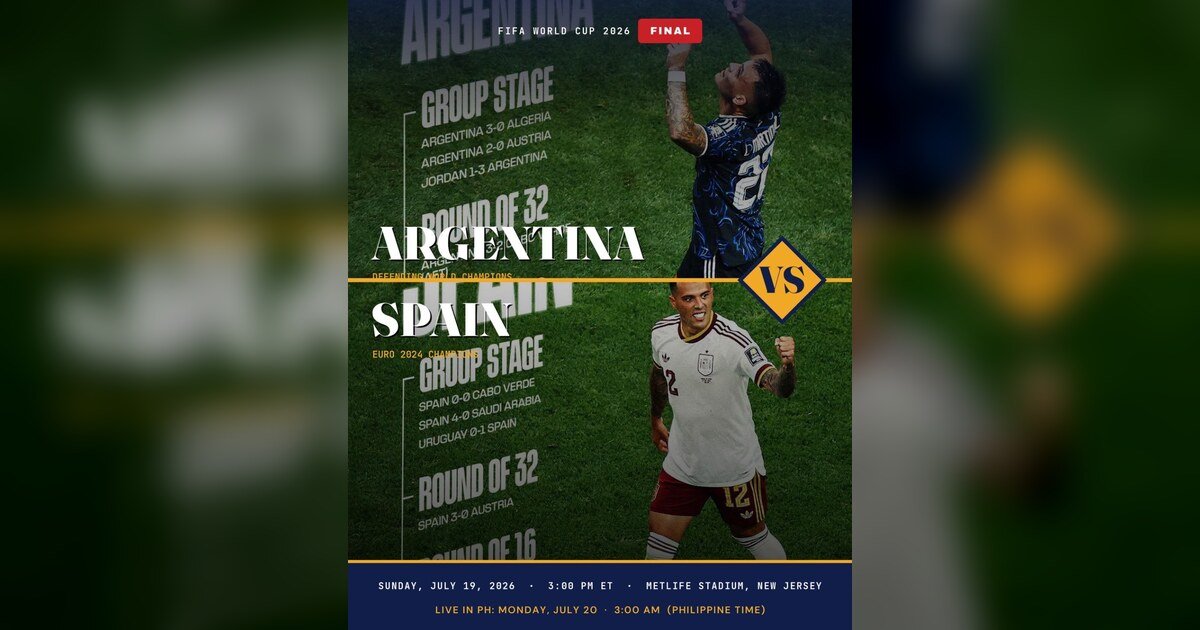
When the whistle blows at MetLife Stadium in East Rutherford, New Jersey on Sunday, July 19, football history will be made before a single pass is played. For the first time ever, the reigning South American champion and the reigning European champion will face each other in a FIFA World Cup final — with the broadcast set for 3 a.m. Monday, July 20 (Philippine time).
On one side stands Argentina, the defending world titleholders led by a 39-year-old Lionel Messi who is widely expected to be playing in his last World Cup. On the other, a Spanish squad that has not dropped a single match throughout the entire tournament and has barely allowed any opponent to score. According to tournament records, it is also the first World Cup final ever contested between the two highest-ranked teams on the planet.
Argentina’s Comeback-Filled Campaign
Coach Lionel Scaloni guided Argentina through six wins — none of them straightforward once the knockout rounds began. The group stage, at least, offered smoother sailing. Messi opened proceedings with a hat-trick in a 3-0 demolition of Algeria, then scored twice in a 2-0 win over Austria — a brace that pushed him past Miroslav Klose as the World Cup’s all-time top scorer across all editions. A 3-1 victory over Jordan, with Messi contributing a free-kick goal, completed a dominant group phase.
The knockout stage, however, repeatedly tested the Albiceleste’s nerves. Debutants Cabo Verde forced Argentina into extra time in the Round of 32, with the South American giants only escaping 3-2 when a goal arrived in the 111th minute following a Messi corner. Against Egypt in the Round of 16, Argentina found themselves trailing 2-0 with barely 11 minutes left, only to mount a stunning comeback that ended 3-2 — Enzo Fernández heading home in stoppage time to seal the turnaround.
Switzerland pushed Argentina to extra time again in the quarter-finals, a match that finished 3-1 after Julián Álvarez and Lautaro Martínez pounced while the Swiss were reduced to ten men following a red card. The semi-final against England produced yet another late drama: Anthony Gordon handed England the lead, Fernández levelled in the 85th minute, and substitute Lautaro Martínez headed in a stoppage-time winner for a 2-1 final score. Messi provided assists on both of Argentina’s goals in that match.
Spain’s Fortress-Like March to the Final
Spain’s journey to the final looked entirely different — clinical, controlled, and historically stingy at the back. According to tournament records, La Roja conceded just one goal in seven matches and set a new World Cup record with six consecutive clean sheets. In doing so, goalkeeper Unai Simón surpassed Walter Zenga’s 36-year-old record for the longest scoreless run in World Cup history.
Spain’s group stage began with a surprising 0-0 draw against the same Cabo Verde side that would later trouble Argentina. They recovered emphatically with a 4-0 thrashing of Saudi Arabia — during which 19-year-old Lamine Yamal got on the scoresheet — and wrapped up the group with a 1-0 victory over Uruguay.
The knockout rounds saw Spain shift into another gear entirely. They beat Austria 3-0 in the Round of 32, then knocked out rivals Portugal 1-0 in the Round of 16 thanks to a 91st-minute goal from substitute Mikel Merino — a result widely regarded as the likely end of Cristiano Ronaldo’s World Cup career, according to widespread football reporting. Merino then struck again to help eliminate Belgium 2-1 in the quarter-finals, Spain’s only goal conceded in the entire tournament. The semi-final saw Spain dismantle top-scorers France 2-0, with a Mikel Oyarzabal penalty and a Pedro Porro strike finishing off the job.
Historic Firsts That Define This Match
Tournament records confirm this final is layered with historic significance. It is the first World Cup title match to feature both the reigning European champion and the reigning South American champion simultaneously. It is also the first final ever played by the world’s two top-ranked teams. Argentina and Spain enter the match level in their all-time head-to-head record — six wins each — and while they have met before at a World Cup, this marks the first time they face each other in the knockout stage of the tournament.
Slovenia’s Slavko Vinčić has been appointed as the match referee for the occasion. MetLife Stadium, officially rebranded the New York New Jersey Stadium for this edition of the tournament, holds 82,500 spectators. Adding to the spectacle, this final will be the first World Cup to feature a halftime show — an 11-minute performance curated by Coldplay’s Chris Martin, headlined by Madonna, Shakira, BTS, and Justin Bieber.
What Each Side Is Playing For
Argentina’s motivation is layered. A victory would make them the first nation to win back-to-back World Cups since Brazil claimed consecutive titles in 1958 and 1962, and would earn the country a fourth star on the shirt. For Messi personally, who currently leads the Golden Boot race with eight goals in the tournament, a second consecutive world title would serve as a fitting — and in all likelihood final — chapter to one of football’s most celebrated careers.
For Spain, the stakes are equally historic. A win would deliver their second-ever World Cup title and complete a rare back-to-back of European and world crowns following their Euro 2024 triumph. Young forward Lamine Yamal, who turned 19 during the course of the tournament, has emerged as the symbolic face of a new golden generation. According to available match data, Spain have not lost a single game in which Yamal has featured.
How to Watch in the Philippines
Filipino viewers can tune in at 3 a.m. on Monday, July 20, Philippine time. According to available tournament information, official coverage in the Philippines is handled by rights-holder TAP DMV, with streaming access through Tap Go and the pay-per-view platform Pilipinas Live, which has provided Filipino-language commentary across all 104 matches of the 2026 World Cup. Additionally, Aleph’s Aleph Arena YouTube channel has streamed numerous matches for free throughout the tournament, and the final is expected to be among those offered.
By the Numbers
- 1 — Goals conceded by Spain across seven tournament matches, a World Cup record
- 6 — Consecutive clean sheets by Spain, breaking Walter Zenga’s record that stood for 36 years
- 8 — Goals scored by Messi, leading the tournament’s Golden Boot standings
- 82,500 — Seating capacity of MetLife Stadium, venue for the final
- 111 — Minute in which Argentina scored the decisive goal against Cabo Verde in the Round of 32
- 39 — Age of Lionel Messi, in what is widely expected to be his final World Cup appearance
- 2010 — The last year Spain lifted the FIFA World Cup trophy
- 11 — Duration in minutes of the tournament’s first-ever halftime show
- 104 — Total matches contested at the 2026 FIFA World Cup
Why This Matters
This World Cup final carries more historical weight than almost any that preceded it: it is the first title match between the world’s two top-ranked nations and the first ever to pair the reigning European and South American champions simultaneously, according to tournament records. A win for Argentina would place them alongside only one other nation — Brazil — in having won back-to-back World Cups, while simultaneously closing the book on Lionel Messi’s extraordinary international career atop the all-time single-tournament scoring charts. For Spain, victory would complete one of football’s rarest achievements: a consecutive European Championship and World Cup double within the same generation of players.
Source: Originally reported by wire reports
Related stories