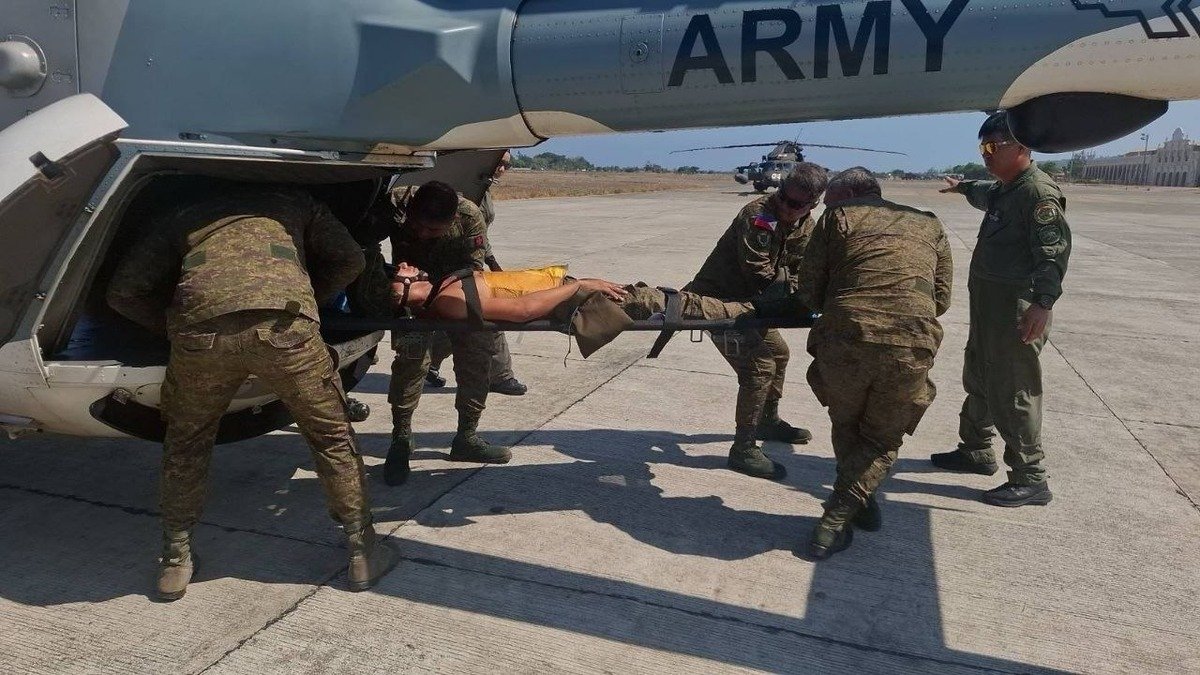
Amid the sweeping sand dunes of Laoag, Ilocos Norte, military helicopters descended and lifted off in carefully choreographed sequences last Saturday, May 9, 2026 — not in response to an actual emergency, but as part of a high-stakes simulation designed to keep Philippine Army aviation crews sharp and ready. The Army Aviation “Hiraya” Regiment executed Air Medical Evacuation (MEDEVAC) training drills at the La Paz Sand Dunes as one of the featured activities under the 41st iteration of Exercise Balikatan, the annual large-scale military exercise that brings together the Armed Forces of the Philippines and allied partner nations.
The announcement was made through an official public affairs release signed by Colonel Louie G. Dema-ala, the Philippine Army’s Chief Public Affairs, operating out of Fort Bonifacio in Taguig City.
La Paz Sand Dunes as a Training Ground for Air Evacuation Operations
The choice of the La Paz Sand Dunes as the venue for the MEDEVAC simulation was deliberate. The site’s wide, open terrain — characterized by undulating sand formations and limited natural obstacles — offers a demanding yet accessible environment for practicing helicopter landings and take-offs in conditions that can approximate real-world emergency scenarios. In actual disaster or combat situations, helicopters are often required to operate in open, unimproved terrain far from established airstrips, making such environments ideal for realistic training.
The Hiraya Regiment deployed its Messerschmitt-Bölkow-Blohm Bo 105 helicopters for the exercise. This light utility rotorcraft, of German engineering origin, is well regarded for its maneuverability in tight and challenging operational spaces, and has a proven track record in emergency medical transport roles. Its deployment in the Balikatan 2026 drills reflects the Philippine Army’s continued use of dependable aviation platforms in multinational training environments.
According to the Philippine Army’s public affairs office, the drill emphasized three core operational principles guiding the regiment’s performance: preparedness, teamwork, and a steadfast commitment to effective emergency response. These values were embedded throughout each phase of the simulated evacuation sequence.
What the MEDEVAC Simulation Involved
Air medical evacuation operations are among the most time-critical procedures in military medicine. A successful MEDEVAC mission requires rapid coordination across multiple teams — from the ground personnel who identify and stabilize a casualty, to the flight crew who must navigate to the site, land safely in potentially hazardous conditions, load the patient, and transport them to a medical facility within a window that directly impacts survival outcomes.
During the La Paz drills, each stage of this process was reportedly rehearsed in full. Crew coordination, ground-to-air communication protocols, and flight safety procedures were all placed under evaluation during the simulation. The exercise was structured not merely as a showcase of technical skills but as a thorough rehearsal of the end-to-end procedures that would be activated in a genuine emergency — whether on a battlefield or in the aftermath of a natural disaster.
The regiment’s performance during the drill also served as an informal assessment of how well flight crews and ground support teams function under simulated pressure, identifying potential gaps in coordination that can then be addressed through further training.
Balikatan 2026: Four Decades of Philippine-US Defense Cooperation
Exercise Balikatan — a Filipino phrase translating to “shoulder to shoulder” — has been a fixture of Philippine-American defense relations for more than four decades. Now in its 41st iteration, the exercise has evolved considerably since its early editions, expanding to include participation from other allied and partner nations and broadening its operational scope beyond conventional warfighting drills.
Balikatan 2026 continues this trajectory. The current exercise encompasses activities ranging from live-fire training and maritime domain operations to cyber defense components and humanitarian assistance and disaster response (HADR) simulations. MEDEVAC operations, as demonstrated by the Hiraya Regiment at La Paz, fall squarely within the HADR dimension of the exercise — one that has grown in prominence as the Philippines’ strategic environment increasingly demands dual-use military capabilities applicable in both conflict and disaster scenarios.
The Philippine Army has described this edition of Balikatan as essential not only for enhancing warfighting readiness but also for promoting stability and security across the wider Indo-Pacific Region — a theater that has seen heightened strategic attention in recent years due to ongoing maritime tensions and territorial disputes in surrounding waters.
The Hiraya Regiment’s Broader Role in Philippine Military Aviation
The Army Aviation “Hiraya” Regiment occupies a central position among the Philippine Army’s rotary-wing assets. The regiment’s operational mandate covers aerial mobility, reconnaissance, and medical evacuation support — roles that are indispensable across a wide range of mission profiles, from counterinsurgency operations to disaster relief deployments.
Its participation in Balikatan 2026 underscores the regiment’s growing importance in joint and multilateral military exercises, where interoperability with allied forces is as critical as individual unit capability. The drills at La Paz gave the regiment an opportunity to demonstrate its readiness not only to Philippine military leadership but also to allied observers who participate in or monitor the exercise.
In its official statement, the Philippine Army reaffirmed its institutional dedication to developing and sustaining robust emergency response capabilities — a commitment framed as extending beyond the military’s conventional mandate to include active support for civilian populations during disasters. The Philippine Army’s guiding motto, Serving the People, Securing the Land, was cited in the release as the principle underpinning the regiment’s approach to both training and operations.
MEDEVAC Readiness Critical for a Disaster-Prone Nation
The Philippines sits at the intersection of multiple natural hazard zones — along the Pacific typhoon belt and within one of the world’s most seismically active regions. This geographic reality means that military MEDEVAC assets are not merely tools of war; they are frequently called upon to evacuate injured civilians and stranded communities in the wake of typhoons, earthquakes, and flooding events.
The integration of MEDEVAC training into an exercise as prominent as Balikatan reflects an institutional recognition of this reality. By rehearsing air evacuation procedures under simulated field conditions, the Philippine Army ensures that its aviation units remain capable of responding effectively when civilian lives depend on their speed and precision.
Photographic documentation of the La Paz drills was released by the Office of the Assistant Chief of Staff for Civil-Military Operations (OG7) of the Aviation Regiment, providing a visual record of the exercise activities conducted on May 9.
Balikatan 2026 Continues Across Multiple Philippine Locations
The Ilocos Norte MEDEVAC drill is just one component of a sprawling, multi-location exercise unfolding across the Philippines under the Balikatan 2026 umbrella. Various branches of the Armed Forces of the Philippines are engaged simultaneously in different regions, conducting drills across varied terrain and operational settings to test the military’s ability to coordinate across a broad geographic footprint.
Additional activity updates from Balikatan 2026 are expected to be issued by the Philippine Army’s public affairs office as the exercise progresses. As of the time of this report, the Philippine Army has not announced a specific end date for the current phase of Balikatan 2026 activities.
Photo credit: OG7, Aviation Regiment, Philippine Army