A multinational live-fire maritime exercise brought together the armed forces of the Philippines, the United States, Japan, and Canada on May 6, 2026, at Culili Point in Paoay, Ilocos Norte — setting a new precedent in the four-decade history of Exercise Balikatan with the first-ever deployment of a Japanese ground-based anti-ship missile system in the annual drill.
The Maritime Strike, or MARSTRIKE, activity conducted under Exercise Balikatan 41-2026 was described by military officials as a demonstration of deepening multi-domain interoperability among the Philippines and its Indo-Pacific allies, executed across sea, air, and land platforms under a simulated complex threat environment.
Japan’s Type 88 Missile System Makes Balikatan Debut
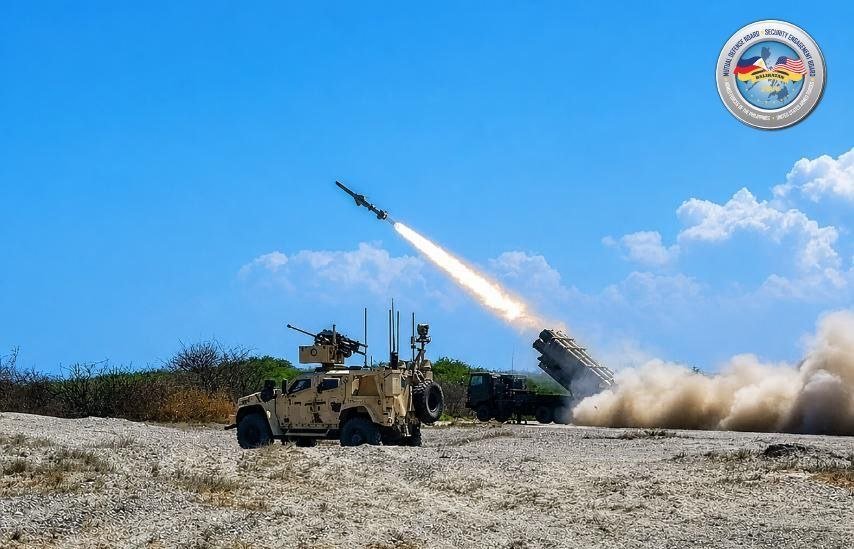
The focal point of the May 6 drill was the live-fire engagement of BRP Quezon (PS70), a decommissioned Philippine Navy vessel designated as the surface target for the exercise. The Japan Ground Self-Defense Force (JGSDF) deployed its Type 88 Surface-to-Ship Missile System to strike the vessel — a historic first in the annals of Balikatan exercises.
The Type 88 is a land-based, long-range anti-ship missile platform capable of engaging naval surface targets at extended distances from the shoreline. Its use alongside combined Philippine and American strike assets represented a notable expansion in both the technical scope and allied participation of what has traditionally been a bilateral Philippine-American exercise.
The Armed Forces of the Philippines (AFP) confirmed that BRP Quezon was successfully neutralized during the engagement, validating the effectiveness of the synchronized precision strike sequence conducted by participating allied forces.
Combined Assets from All Four Nations Deployed
The Philippine military fielded a substantial force package for the MARSTRIKE activity. The Philippine Navy deployed two of its most modern warships — BRP Miguel Malvar (FFG6) and BRP Antonio Luna (FFG15). Fixed-wing air power was provided by the Philippine Air Force through its FA-50 fighter jets and A-29 Super Tucano aircraft.
The United States contributed a wide array of advanced systems to the strike package. These included the P-8A Poseidon maritime patrol aircraft, MQ-9 Reaper unmanned aerial vehicles, High Mobility Artillery Rocket Systems (HIMARS), the Naval Strike Missile Employable Shore-based Integrated System known as NMESIS, and the K-1000 system.
Canada’s participation was marked by the deployment of HMCS Charlottetown (FFH-339), a Halifax-class guided-missile frigate, reinforcing the exercise’s growing multilateral character. Japan, in addition to the Type 88 missile engagement, contributed ISR capability through the ScanEagle unmanned aerial system, providing aerial surveillance and targeting support during the operation.
A total of 18 international observers were present at the training site, reflecting broad interest from the defense community in the scope and results of the Balikatan 41 maritime exercise.
President Marcos Monitors Remotely; Teodoro Witnesses On-Site
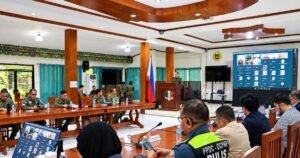
President Ferdinand R. Marcos Jr. observed the MARSTRIKE exercise from the Camp Aguinaldo Command and Control Center in Quezon City, joined by AFP Chief of Staff General Romeo S. Brawner Jr. and U.S. Chargé d’Affaires a.i. Y. Robert Ewing. The real-time monitoring setup allowed the Commander-in-Chief to observe the live-fire engagement as it unfolded at the Ilocos Norte training area.
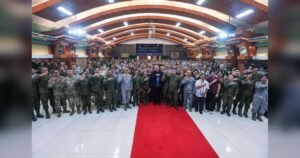
At the scene in Paoay, Defense Secretary Gilberto C. Teodoro Jr. was present in person to witness the exercise alongside Japanese Defense Minister Shinjiro Koizumi and Japanese Ambassador to the Philippines Kazuhiko Endo. The on-site attendance of senior defense officials from both Manila and Tokyo added considerable diplomatic weight to what was already a historically significant military activity.
The dual-observation arrangement — the head of state monitoring remotely from the capital while the defense secretary stood at the firing site — underscored the scale of the operation and the political significance of the Balikatan 41-2026 MARSTRIKE milestone.
AFP Spokesperson Cites Growing Interoperability Among Allies
Following the conclusion of the exercise, AFP Balikatan spokesperson Col. Dennis Hernandez issued a statement highlighting the operational value of the MARSTRIKE drill in the context of regional maritime security.
“The successful execution of the Maritime Strike activity demonstrates the growing level of interoperability between the Armed Forces of the Philippines and our allies. Through coordinated planning, information-sharing, and precision engagement, we were able to effectively integrate maritime, air, and ground capabilities in a complex operational environment,” Colonel Hernandez said.
Hernandez further emphasized that the exercise strengthens collective maritime security efforts and contributes to the maintenance of a stable, rules-based order across the Indo-Pacific — a position consistent with longstanding Philippine and American policy stances on freedom of navigation and international maritime law.
Ilocos Norte Site Faces South China Sea
The selection of Culili Point in Paoay, Ilocos Norte as the venue for the MARSTRIKE placed the exercise along Luzon’s northwestern coastline, directly fronting the South China Sea — a body of water at the center of unresolved territorial disputes involving the Philippines, China, and several other regional claimants.
The coastal geography of the site made it well-suited for live-fire maritime engagement scenarios, particularly those involving surface targets at extended ranges from shore. The decommissioned BRP Quezon, cleared of all personnel and equipment, served as a controlled target that enabled participating forces to conduct a realistic coordinated strike within established safety protocols.
The AFP confirmed that joint planning mechanisms involving all four participating nations were in place well ahead of the May 6 exercise, ensuring the activity was coordinated across Philippine, American, Japanese, and Canadian defense authorities.
Balikatan’s Evolution Into a Multilateral Platform
Exercise Balikatan — whose name derives from a Filipino phrase meaning “shoulder to shoulder” — began as a bilateral annual military exercise between the Philippines and the United States and has been conducted for over four decades. In recent years, the exercise has grown substantially in terms of both scale and the number of participating nations, with Japan and other partner countries assuming more active roles in annual drills.
The involvement of Canada’s guided-missile frigate and Japan’s Type 88 missile system in the May 6 activity signals a continued shift in Balikatan’s character — from a primarily Philippine-American exercise into an increasingly broad multilateral forum for Indo-Pacific security cooperation.
Previous Balikatan iterations have incorporated cyber defense exercises, humanitarian assistance and disaster response simulations, amphibious landing drills, and live-fire components. The 41st edition adds to that record with the first-ever use of the JGSDF’s Type 88 Surface-to-Ship Missile System within the Balikatan framework — a milestone that military analysts are likely to regard as a benchmark in the exercise’s evolution.
Deepening Defense Ties Across the Indo-Pacific
Balikatan 41-2026 is being conducted against the backdrop of heightened maritime security concerns across the Indo-Pacific, with the Philippines, the United States, Japan, and Canada each maintaining strong stated commitments to a free and open regional order grounded in international law.
In recent years, the Philippines has progressively strengthened its defense partnerships with Washington, Tokyo, Canberra, and other allied capitals through expanded basing access agreements, coordinated maritime patrols, and increased defense equipment cooperation. The presence of Japanese Defense Minister Koizumi alongside Defense Secretary Teodoro at the Ilocos Norte site signals the continued deepening of the Japan-Philippines bilateral defense relationship, which has grown markedly in strategic importance over the past several years.
The MARSTRIKE exercise at Culili Point on May 6, 2026, now occupies a distinct place in the history of Exercise Balikatan — as the first engagement to bring together Philippine, American, Japanese, and Canadian strike platforms in a single coordinated maritime live-fire operation, and the first to see Japan’s Type 88 missile system deployed within the exercise’s framework.