
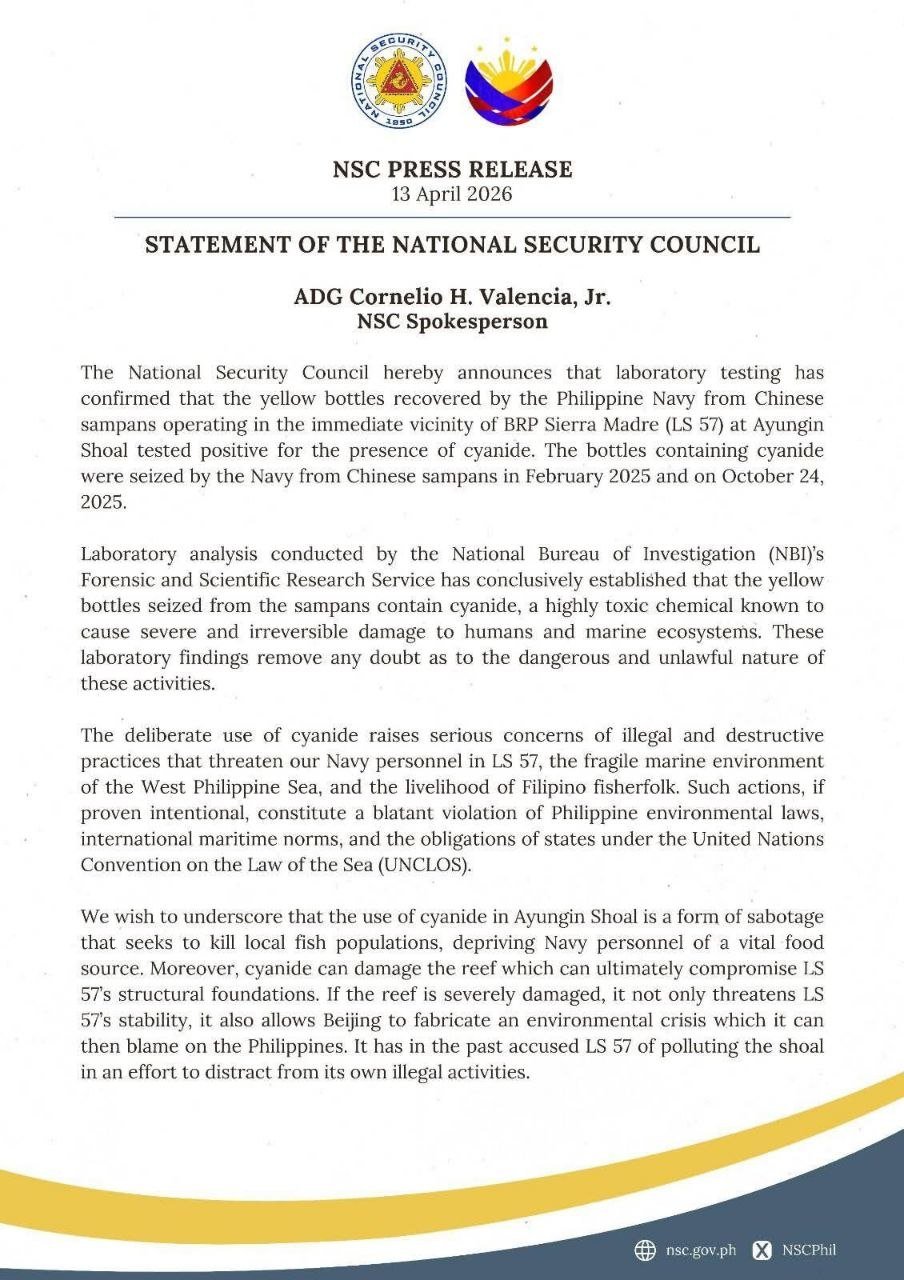
Laboratory tests have definitively proven that Chinese fishing boats deployed toxic cyanide chemicals in waters surrounding Ayungin Shoal, creating unprecedented environmental and security threats in the West Philippine Sea, the National Security Council announced.
The confirmation comes through forensic analysis performed by the National Bureau of Investigation’s Forensic and Scientific Research Service, which examined yellow containers confiscated from Chinese sampans operating near the Philippine naval outpost. NSC spokesperson ADG Cornelio H. Valencia Jr. disclosed the findings in an official statement dated April 13, 2026.
Philippine Navy personnel retrieved the suspicious containers during two distinct operations—one in February 2025 and another on October 24, 2025—from Chinese vessels conducting activities in close proximity to the BRP Sierra Madre stationed at Ayungin Shoal. The comprehensive laboratory examination required nearly twelve months to complete following the initial seizure.
Deliberate Environmental Sabotage Campaign
The National Security Council characterizes the cyanide deployment as a calculated campaign of environmental sabotage targeting fish populations that provide essential sustenance for Navy personnel maintaining the Philippines’ presence on Ayungin Shoal. The BRP Sierra Madre has functioned as the country’s strategic outpost in the area for multiple decades.
Beyond threatening human health, the toxic chemicals pose severe risks to the coral reef ecosystem that forms the foundation supporting the grounded naval vessel. The NSC warns that extensive reef destruction could create circumstances Beijing might manipulate to manufacture an environmental controversy while obscuring its own unlawful maritime operations.
According to the National Security Council assessment, cyanide represents “a highly toxic chemical known to cause severe and irreversible damage to humans and marine ecosystems.” The intentional introduction of such hazardous materials indicates the systematic nature of these destructive fishing methods in Philippine territorial waters.
Multiple Legal and Environmental Breaches
The intentional release of cyanide compounds within Philippine waters violates numerous domestic environmental statutes, international maritime regulations, and obligations under the United Nations Convention on the Law of the Sea, according to the NSC analysis. These activities occur within the Philippines’ exclusive economic zone, where the nation maintains sovereign authority over natural resources and maritime operations.
The National Security Council emphasizes that these scientific findings “remove any doubt as to the dangerous and unlawful nature of these activities” perpetrated by Chinese fishing vessels in the contested maritime areas. The laboratory evidence provides concrete documentation of environmental crimes committed in Philippine waters.
Ayungin Shoal’s location firmly within the Philippines’ exclusive economic zone makes Chinese vessel operations using dangerous chemicals both “irresponsible and unacceptable,” according to the official NSC position. The territorial violations compound the environmental damage caused by the toxic fishing practices.
Enhanced Maritime Security Directives
Following confirmation of the cyanide findings, the National Security Council has issued comprehensive directives to multiple government agencies requiring intensified maritime security operations throughout the West Philippine Sea. The Armed Forces of the Philippines, Philippine Coast Guard, and additional relevant agencies received orders to enhance maritime domain awareness and expand patrol operations.
The enhanced security framework includes mandates to “take all necessary measures to prevent further environmental harm and safeguard national security interests in the area,” as outlined in the official NSC directive. These strengthened security protocols represent a significant escalation in the Philippines’ operational response to foreign vessel activities in disputed waters.
The government’s comprehensive response acknowledges the dual environmental and security challenges posed by foreign vessels operating with hazardous materials in Philippine territorial waters. The cyanide presence introduces new complexities to existing tensions throughout the South China Sea region.
Regional Security and Strategic Consequences
The verified deployment of cyanide by Chinese vessels marks a critical development in ongoing South China Sea territorial disputes. The NSC statement indicates Beijing has historically attempted to deflect scrutiny from its maritime activities by falsely accusing the BRP Sierra Madre of environmental pollution in the shoal vicinity.
The toxic fishing methods endanger not only the immediate marine environment but also the broader ecosystem supporting Filipino fishing communities throughout the region. The systematic targeting of fish populations serving as food sources for naval personnel stationed aboard the BRP Sierra Madre reveals the strategic calculation behind these environmental crimes.
The National Security Council cautions that coral reef damage could enable Beijing to fabricate an environmental crisis while simultaneously undermining the natural foundation that maintains the Philippine naval presence at the strategic location.
Unwavering Commitment to Territorial Defense
The NSC statement concludes with an unequivocal declaration that “the Philippines will not tolerate any act—whether by state or non-state actors—that endangers its personnel or the marine environment, violates its sovereign rights, or undermines peace and stability in the West Philippine Sea.”
The government reaffirmed its dedication to “defending the nation’s territory, protecting its natural resources, and upholding the rule of law” against these combined environmental and security challenges. This stance reflects the Philippines’ comprehensive strategy of asserting territorial claims while documenting the environmental impact of foreign maritime activities.
The scientific confirmation of cyanide deployment provides crucial evidence supporting ongoing diplomatic and legal initiatives addressing Chinese activities in the disputed waters. The laboratory documentation offers verifiable proof of environmental violations that the Philippines can present in international venues and bilateral negotiations.