City Hall’s finance committee threw out the lowest offer on the table because its interest rate could move. The contracts it chose instead can move too — and the executive’s own September 4 letters to both banks prove it knew.
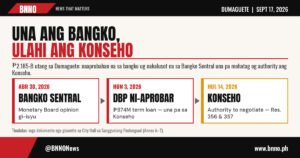
DUMAGUETE CITY — On July 31, 2026, the Local Finance Committee of the City of Dumaguete, with Mayor Manuel Sagarbarria signing, resolved that the loan offers of Land Bank and the Development Bank of the Philippines were “more beneficial and advantageous” than a proposal from Philippine Veterans Bank, “particularly with respect to the interest rates.” Veterans had offered 4 percent. The two government banks offered 4.5 percent. The committee chose the higher rate, and gave one reason: Veterans’ rate was “variable and escalating,” while Land Bank and DBP offered “the more stable indicative fixed interest rate of 4.50% per annum.”
Every document in the City’s own file says the second half of that sentence is not true. Neither Land Bank nor DBP guaranteed 4.5 percent for fifteen years. Both offers were “indicative.” Both condition the rate on the City parking “substantial deposits” with the lender. Both draft contracts contain machinery to raise it. And on September 4, four days before the Council voted, the City Legal Officer wrote both banks asking them to delete those clauses — a request that only makes sense if the rate was not fixed to begin with.
The bank that said its rate could change was punished for saying so. The two banks that said “fixed” and wrote “adjustable” were rewarded.
What Veterans actually offered
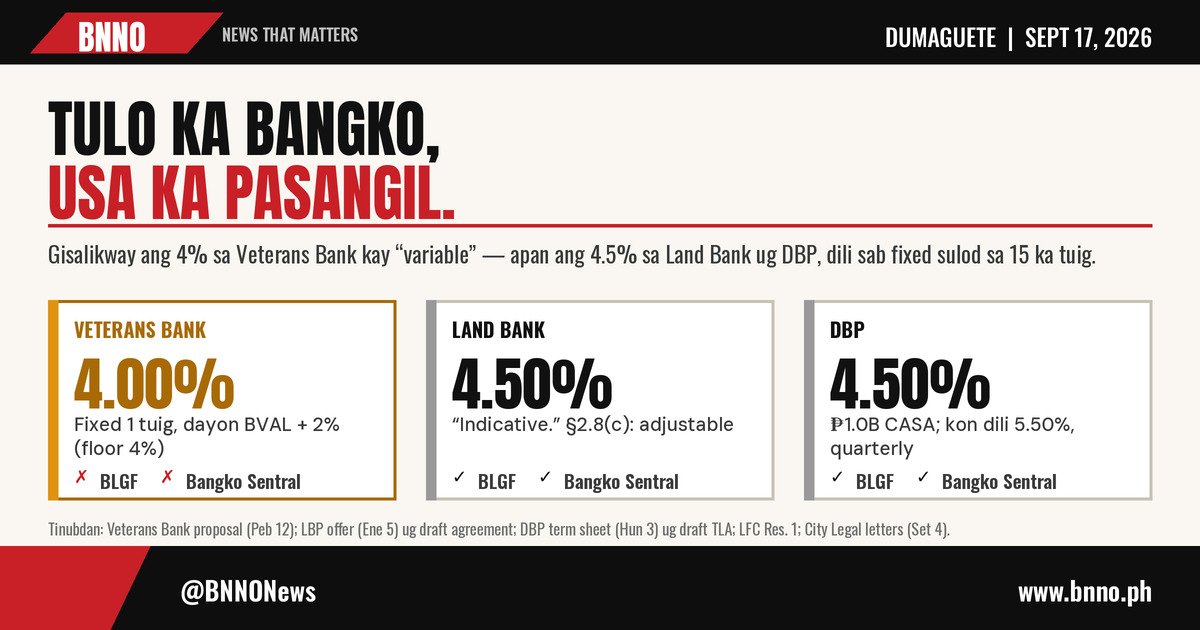
The Veterans Bank proposal is dated February 12, 2026 and stamped received by the Office of the City Mayor the next afternoon. It is a two-page term sheet for a facility of up to fifteen years — “per client request,” the proposal notes, contradicting the committee’s later description of it as unsolicited — with a two-year grace period on principal, monthly amortizations thereafter, and a two-year availability period. The interest rate is 4 percent per annum, fixed for the first year and thereafter repriced annually at the one-year BVAL benchmark plus a 2 percent margin, with a floor of 4 percent. The bank’s July 23 follow-up letter describes the rate as a preferential one that required special approval. The proposal also asks the City to keep average daily deposits with the bank equal to at least 40 percent of the outstanding balance, failing which one percentage point is added the following year.
That is a variable-rate loan, and Veterans described it as one. The question is not whether its rate could rise. The question is whether the alternatives were any different.
What “fixed” means in the DBP papers
DBP’s February 13 offer sheet quotes 4.5 percent “provided that substantial deposits continue to be maintained with DBP.” Its June 3 approval, the document the executive later submitted to the Council as Annex H, spells out what happens otherwise: “Otherwise, variable rate based on 3-month BVAL plus credit spread or at 5.50% p.a., inclusive of GRT, whichever is higher subject to quarterly re-pricing.” The same term sheet defines “substantial”: “Maintenance of at least ₱1.0 Billion in CASA deposits in order to maintain the 4.50% p.a. interest rate.” The City’s total revenue in 2022, per the financial statements in the same submission, was ₱1.22 billion.
The draft Term Loan Agreement DBP sent the City, transmitted to the Council on August 27, keeps the structure and removes the number. Section 2.07(a) states the rate is fixed “provided that substantial deposits continue to be maintained,” then provides that any interest adjustment takes effect on prior notice; if the City finds the new rate unacceptable, its only recourse is to prepay the entire principal and interest, and if it fails to do so “the Adjusted Interest Rate shall be considered deemed accepted by the Borrower.” Section 2.07(b) allows either party to trigger a re-determination of the rate when it is “no longer reflective of the market.” The promissory note the City would sign for each drawdown is captioned “Form of Promissory Note (Variable Interest Rate)” and refers to an “initial rate.” The minimum deposit balance in Section 9.11(a) is left blank.
By August 12, DBP had issued a revised term sheet with the ₱1 billion condition and the 5.5 percent fallback deleted. The contract’s adjustment clauses were not.
What “fixed” means in the Land Bank papers
Land Bank’s January 5 offer, reiterated word for word on July 23, quotes “(Indicative) At 4.50% p.a.… provided that substantial deposits continue to be maintained with LBP,” and states that its terms “are subject to market conditions at the time of availment.” Its Summary of Terms, incorporated into the contract as Annex A, repeats the market-conditions caveat. The draft Loan Agreement’s General Conditions, Section 2.8(c), make the interest rate “subject to upward or downward adjustment” if any law, rule or regulation changes the lender’s cost of funds or cost of intermediation, effective on thirty days’ written notice, with each such notice forming “part of this Agreement by reference.” The City’s escape, under Section 4.2, is to prepay the whole loan within thirty days. “Substantial” is never defined.
So the honest comparison is this. Veterans: 4 percent, variable after year one by a published formula, with a floor. DBP: 4.5 percent, contingent on a deposit balance the bank once put at ₱1 billion, otherwise repriced quarterly, with a contractual “deemed accepted” mechanism. Land Bank: 4.5 percent, “indicative,” contingent on an undefined deposit balance, adjustable on a change in the bank’s cost of funds. One of the three told the City exactly how its rate would move. It was the one rejected for having a rate that moves.
The 6.80 percent nobody computed
The committee’s resolution says the Veterans rate “may reasonably be expected to increase to around 6.80% per annum.” No BVAL reading, no date, no computation accompanies the figure; the City Legal Officer’s chronology, submitted in September, describes the same offer as “6% interest rate per annum at the minimum,” which is wrong on its face — the proposal’s minimum is 4 percent. Whatever assumption produced 6.80 percent, it was not applied to DBP’s own June 3 fallback, which is pegged to the same family of benchmarks plus a spread, or to Land Bank’s cost-of-funds clause. The committee projected the variable rate of the bank it rejected and assumed away the variable rates of the banks it kept.
The comparison the City never ran
Veterans was not just outscored; it was kept off the field. The Bureau of Local Government Finance certified the City’s borrowing capacity on March 12 for a loan application naming only Land Bank and DBP. The City’s March 23 requests to the Bangko Sentral for a Monetary Board opinion named only Land Bank and DBP. When the mayor wrote to the banks on July 31 asking for their draft agreements and for clarification of fees, penalties and the effect of the security on the City’s accounts, he wrote to two banks. Veterans, whose proposal had been in the mayor’s office since February 13, received no such letter. The Feasibility Study Committee then told the Independent Review Committee, on August 25, that the loan terms were “fixed for the full 15-year term, no repricing.” The Veterans offer appears nowhere in the review record.
Veterans’ proposal, notably, listed the Monetary Board opinion, the BLGF certification and a Sanggunian resolution among its own conditions precedent. It was asking for the same process. It was never put through it.
“Unsolicited,” “per client request,” and a July 21 visit
The committee’s resolution calls the Veterans proposal “unsolicited.” The proposal itself says its fifteen-year term was set “per client request.” And on July 21, according to Veterans’ July 23 letter, a City Hall officer, Leonidasa C. Oira, visited the bank’s Dumaguete branch and asked that the February 12 proposal be re-dated to July 23 with the same terms. The bank declined, explaining that a new date would require fresh approval and that, with rates having risen since February, any new proposal would carry a higher rate than the preferential one already granted.
That visit is hard to square with an offer that had been “outright disregarded,” as the City Legal Officer put it. An office does not ask a bank to move a document inside the Council’s July 14 authorization window unless the document mattered.
What a fair process would have looked like
There may be defensible reasons to prefer a government bank: Veterans is smaller, its proposal caps the loan at its single-borrower limit, DBP is already the City’s National Tax Allotment depository, and the security Veterans asked for — an assignment of NTA “and other local revenues” — is broader than the 20 percent of NTA the two government banks took. None of those reasons appears in the committee’s resolution. The reason it gave, in writing, over the mayor’s signature, was the interest rate. And the documents the executive itself later handed the Council show that reason does not hold.
A fair comparison would have put all three offers through the same BLGF application and the same Monetary Board request, sent all three banks the same July 31 clarification letter, presented all three to the Independent Review Committee, and compared each bank’s rate under the same benchmark assumptions — including the deposit balances each one demanded in exchange for its headline rate. Only then could anyone say whether 4 percent with a published formula was worse than 4.5 percent with a blank.
The questions that remain
Who computed 6.80 percent, from what BVAL reading, and why was the same exercise not run on DBP’s 5.5 percent fallback. What deposit balance the City will actually be required to hold with each government bank, and what it costs to keep ₱1 billion — or any figure — idle in a current account for fifteen years. Whether the banks have agreed to delete the repricing clauses the City asked them to strike on September 4. Why the mayor’s office, having received the lowest offer on February 13, never sent it to BLGF, the central bank or the reviewers. And whose decision it was, on July 21, to ask a bank to change a date.
The City rejected the one bank that was candid about its rate, on the ground that the rate was not fixed. It then told the Council the rates it chose were fixed. The contracts say otherwise, and City Hall’s own lawyer has now said so to the banks.