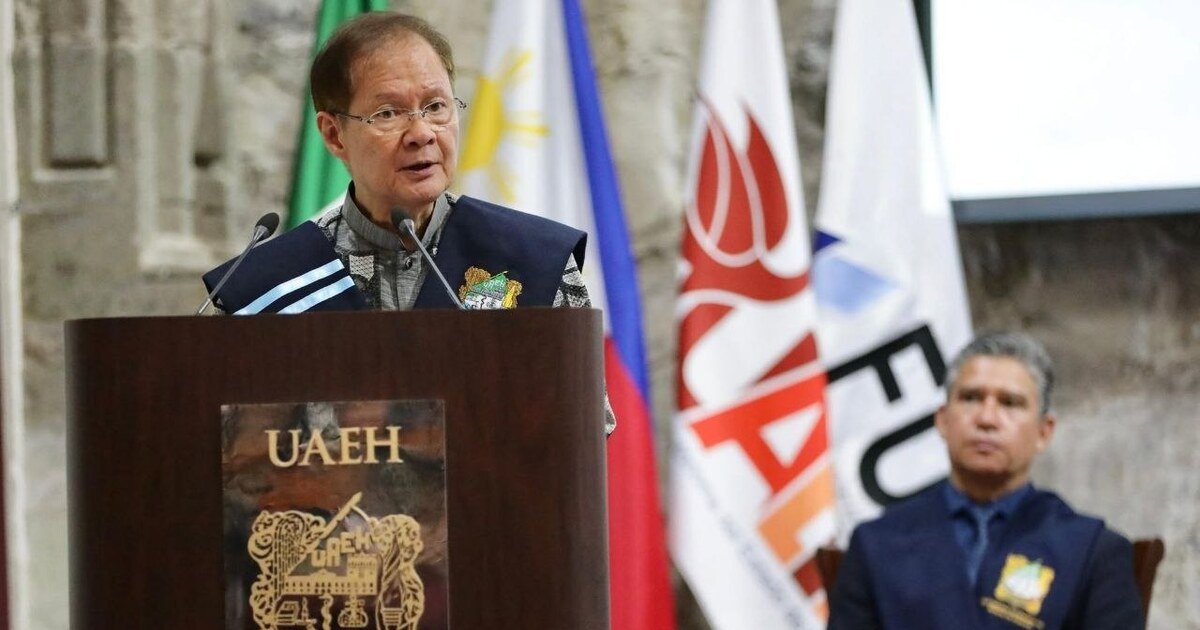
A Filipino historian from one of the country’s most prestigious universities has received a distinguished academic honor in Mexico, spotlighting the deep and often underappreciated historical ties between the Philippines and Latin America. Filomeno V. Aguilar Jr., a professor and administrator at Ateneo de Manila University, was formally conferred the title of International Honorary Professor by Mexico’s Universidad Autónoma del Estado de Hidalgo (UAEH) during the opening of the 39th Feria Universitaria del Libro (FUL).
The Conferral and Its Context
UAEH Rector Octavio Castillo Acosta personally inducted Aguilar at the book fair’s opening ceremony, according to the Ateneo de Manila. The Feria Universitaria del Libro runs from September 4 to 13, 2026, with the Philippines serving as this year’s guest country of honor — a distinction the Ateneo de Manila confirmed makes the Philippines the first Southeast Asian nation ever to hold that role at the fair.
The honorary professorship recognizes Aguilar’s decades of work as a historian and his sustained contributions to Philippine studies, a field that, through his scholarship, has gained increased visibility in international academic circles.
Aguilar’s Role at Ateneo de Manila
Within Ateneo de Manila University, Aguilar holds a dual appointment as Professor of History and Assistant Vice President for Research, Creative Work, and Innovation. His academic output in Philippine studies has consistently attracted international scholarly attention, helping situate Philippine history within broader global historiographical conversations.
Keynote Address: Two Countries at the Heart of World Trade
Aguilar delivered a keynote lecture titled “Mexico and the Philippines: The Beginning of World Trade,” in which he argued that the histories of both nations are fundamentally intertwined and cannot be fully understood in isolation from one another. Central to his argument was the Manila-Acapulco Galleon Trade, which he described as the mechanism that connected Asia and the Americas into a continuous, globe-spanning commercial network.
Drawing on the framework established by historians Dennis Flynn and Arturo Giráldez, Aguilar distinguished world trade from mere intercontinental exchange — defining it as a commercial system that simultaneously linked all permanently inhabited continents. He situated the galleon route as the founding moment of that system.
Aguilar also noted that the Philippines was historically administered through the Viceroyalty of Nueva España — the colonial structure that eventually gave rise to the modern Mexican state — cementing layers of administrative and commercial interdependence between the two countries that persist in historical memory.
“The Galleon Trade, for better or worse, put our two countries at the center of global history — at the birth of world trade,” Aguilar said during the lecture.
He concluded his address in Spanish, characterizing Mexico and the Philippines not as distant strangers but as brothers of the Pacific.
Colonial Inequalities and the Uneven Flow of Culture
Aguilar used his keynote to move beyond celebration of the trade connection, pointing to the structural inequalities it produced. He argued that the silver-driven galleon economy left the Philippine countryside chronically underdeveloped while bankrolling lavish consumption in the Americas.
He also examined how cultural exchange between the two countries moved in both directions but with notable asymmetry. A significant number of Indoamerican words entered Philippine languages by way of Spanish, while only a comparatively small set of Philippine-origin words survived in the Mexican Spanish spoken along that country’s western coast. According to Aguilar, this linguistic imbalance is a reflection of broader disparities rooted in administrative power, population, and the architecture of colonial trade.
Ateneo and UAEH Formalise Academic Cooperation
On the margins of the book fair, Ateneo de Manila and UAEH signed a memorandum of understanding that establishes a framework for faculty and student exchanges, joint research initiatives, internships, conferences, and other collaborative academic activities, according to the Ateneo de Manila. The agreement formalises institutional ties between the two universities and creates structured channels for advancing Philippine studies scholarship within the Latin American academic environment.
In addition to his keynote, Aguilar delivered two further lectures at the fair: one aimed at undergraduate students, focusing on national hero José Rizal and his novels; and a graduate-level session examining Philippine global migration patterns through a comparative Mexican lens.
A Major Philippine Cultural Presence at the Fair
The Philippine program at the Feria Universitaria del Libro was substantial. More than 300 publications were featured, with over 200 titles contributed by the University of the Philippines Press, alongside exhibitions on indigenous Philippine textiles and the historic Manila-Acapulco trade route.
Among the Philippine participants, according to available reports, were Ambassador Arvin de Leon, Second Secretary and Consul Marisa Winkler, poet, novelist, and filmmaker Kristian Sendon Cordero, and chef and author Claude Tayag. The UAEH Symphony Orchestra opened the fair’s proceedings with a performance of “Philippine Scenes,” a work by National Artist for Music Lucrecia Kasilag. This year’s fair carries the theme “Global Trade.”
By the Numbers
- 39th edition — the current running of the Feria Universitaria del Libro
- September 4–13, 2026 — dates of the 10-day book fair
- 300+ Philippine publications featured at the fair
- 200+ titles from the University of the Philippines Press alone
- 1st — the Philippines is the first Southeast Asian nation to serve as guest country of honor at the FUL
Why This Matters
The conferral of an international honorary professorship on Aguilar represents an uncommon form of institutional recognition abroad for a Filipino academic, and reflects the expanding global standing of Philippine studies as a scholarly discipline. The Philippines’ designation as the first Southeast Asian guest country of honor at one of Mexico’s longest-running university book fairs marks a meaningful elevation of Philippine cultural and intellectual visibility in Latin America. Additionally, the memorandum of understanding signed between Ateneo de Manila and UAEH establishes tangible institutional pathways for sustained cross-Pacific academic collaboration going forward.
Source: Ateneo de Manila University / originally reported by the Ateneo de Manila University communications office
Related stories