Just hours after a powerful Mw7.8 earthquake struck offshore Sarangani on June 8, 2026, a follow-up tremor of magnitude 4.6 rolled through multiple provinces across Mindanao at 7:22 in the evening, adding to what had already been a seismically active day for the southern Philippines. The Philippine Institute of Volcanology and Seismology (PHIVOLCS-DOST) released Earthquake Information No. 1 at 7:34 PM Philippine Standard Time (PHT), confirming the aftershock and providing instrumental intensity readings across the affected areas.
Epicenter and Technical Data
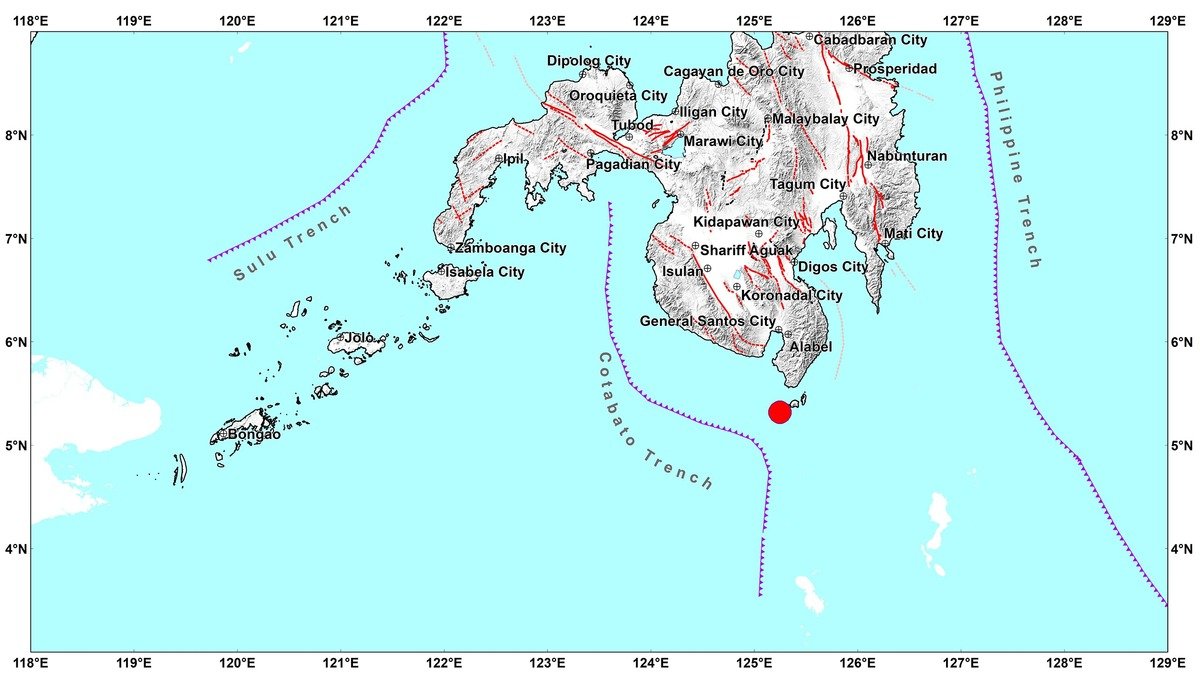
According to PHIVOLCS-DOST, the aftershock originated at coordinates 5.31°N, 125.25°E — placing the epicenter approximately 22 kilometers south-southwest of Balut Island, located within the Municipality of Sarangani in Davao Occidental. The agency recorded a focal depth of 55 kilometers and classified the tremor as tectonic in origin. The surface-wave magnitude was logged at Ms 4.6.
PHIVOLCS-DOST confirmed in its bulletin that this tremor is directly linked to the larger Mw7.8 Offshore Sarangani earthquake that also occurred on June 8, 2026, making it one of the aftershocks generated in the wake of that major seismic event.
Shaking Felt Across South Mindanao Provinces
Using the PHIVOLCS Earthquake Intensity Scale (PEIS), the state seismology agency recorded varying levels of ground shaking across several localities in the Soccsksargen region, Davao del Sur, and Davao Occidental. The intensities are based on instrumental measurements reported by PHIVOLCS in its official bulletin.
Intensity IV
The strongest shaking from the aftershock was recorded at Intensity IV in T’Boli, South Cotabato. At this level on the PEIS scale, shaking is described as being felt by many people indoors, with hanging objects swinging noticeably and some light sleepers potentially awakened.
Intensity III
A moderate Intensity III reading was recorded in four localities, according to PHIVOLCS-DOST: Tupi in South Cotabato; Bagumbayan in Sultan Kudarat; Maitum in Sarangani province; and Sta. Maria in Davao Occidental. Intensity III on the PEIS is described as perceptible to several people indoors, producing a slight vibration comparable to that caused by a passing vehicle.
Intensity II
The following localities registered an Intensity II reading: Kalamansig in Sultan Kudarat; Banga, Santo Niño, Surallah, and Tampakan in South Cotabato; as well as Digos City, Matanao, and Magsaysay in Davao del Sur. At this intensity level, the earthquake is typically felt only by a few people, particularly those at rest or situated on upper floors of buildings.
Intensity I
The lightest shaking, classified as Intensity I, was recorded in Columbio and President Quirino, both in Sultan Kudarat. Intensity I on the PEIS means the tremor is barely perceptible and is generally only detected under very favorable conditions or by sensitive instruments.
No Damage Expected, No Further Aftershocks Forecast
Despite the relatively wide geographic spread of the shaking, PHIVOLCS-DOST assessed that the magnitude 4.6 aftershock is not expected to cause any damage to structures or infrastructure. The agency also stated in its bulletin that no additional aftershocks are anticipated from this particular event specifically.
PHIVOLCS further noted that the bulletin issued at 7:34 PM PHT is expected to be the only one released for this earthquake, unless new or updated information comes to light that warrants a follow-up advisory. Residents in affected areas are nonetheless encouraged to stay alert and monitor official communications from the agency.
The Larger Seismic Event: Mw7.8 Sarangani Earthquake
This magnitude 4.6 tremor must be understood within the broader context of the powerful Mw7.8 Offshore Sarangani earthquake that struck on the same day, June 8, 2026. As identified by PHIVOLCS-DOST, the 4.6-magnitude event is classified as one of the aftershocks generated by that major earthquake, which had its epicenter located offshore in the waters southwest of Balut Island in Davao Occidental.
Large earthquakes of magnitude 7.0 and above are commonly followed by a series of aftershocks that can vary significantly in strength and duration. While the 4.6-magnitude tremor represents a relatively minor aftershock in comparison to the mainshock, its wide felt area across several provinces in Mindanao reflects the broad seismic impact of the original Mw7.8 event.
Official Resources and Monitoring
An epicentral map accompanying the aftershock bulletin has been published by PHIVOLCS-DOST. The public is advised to continue monitoring the official PHIVOLCS website at phivolcs.dost.gov.ph for real-time updates, advisories, and any subsequent bulletins related to the June 8, 2026 seismic sequence. Only information from PHIVOLCS-DOST should be treated as authoritative on the status of earthquake activity and any associated risks in the region.
Residents in affected communities are reminded to follow safety protocols in the event of additional ground shaking, including the standard “Drop, Cover, and Hold On” procedure, and to avoid entering structures that may have been compromised by earlier tremors from the mainshock.
Originally reported by: PHIVOLCS-DOST Earthquake Information Bulletin / wire reports
Related stories