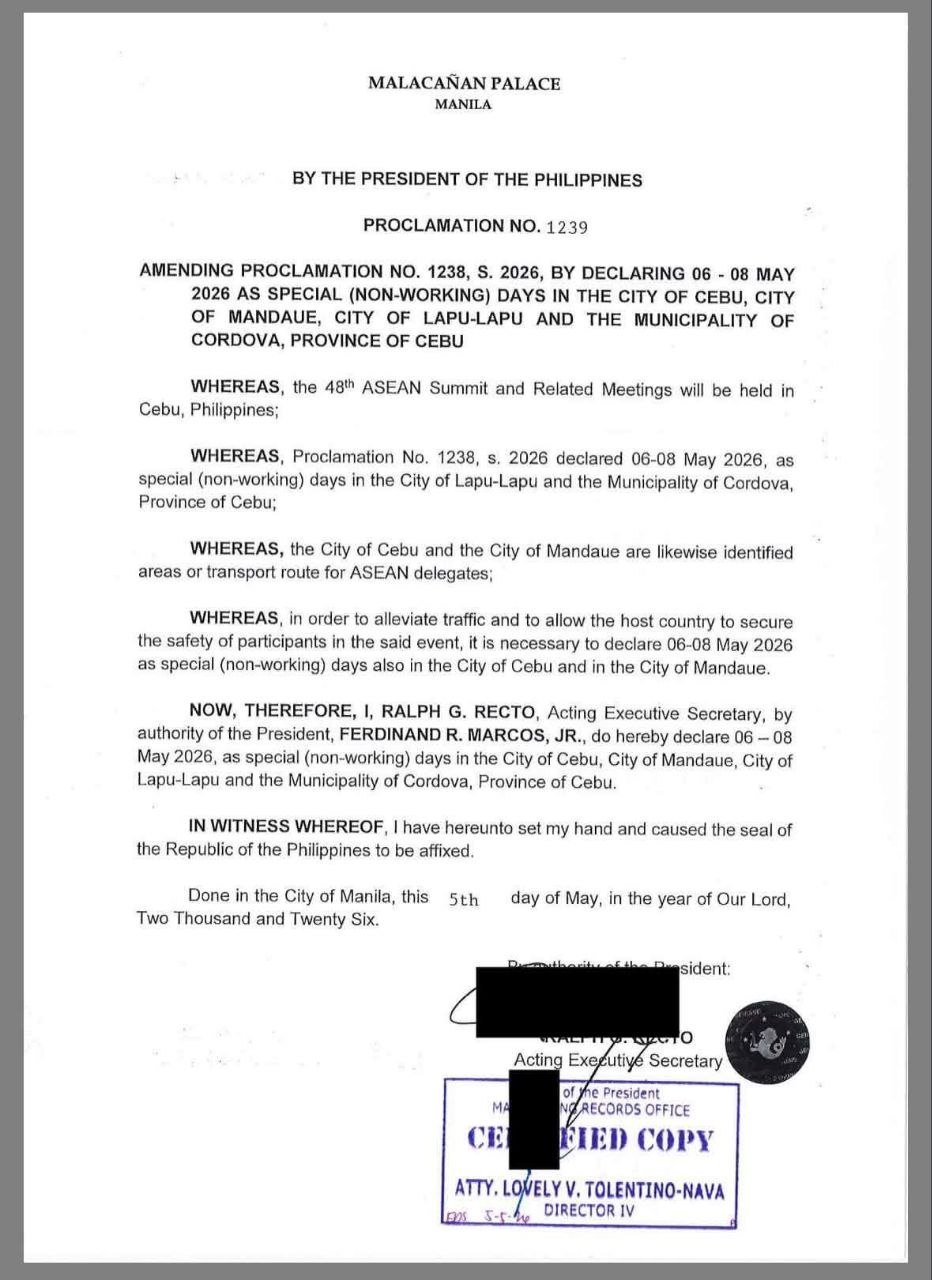
MANILA, Philippines — The special non-working day declaration tied to the 48th ASEAN Summit has been broadened to cover Cebu City and Mandaue City, following an amended proclamation signed on May 5, 2026, by Acting Executive Secretary Ralph G. Recto on behalf of President Ferdinand R. Marcos Jr.
The move comes just one day after the initial Proclamation No. 1238 was issued, which had originally limited the holiday designation to Lapu-Lapu City and the Municipality of Cordova. The updated directive, formally recorded as Proclamation No. 1239, significantly widens the geographic reach of the work suspension across the Cebu metropolitan area.
Expanded Coverage Across Four Cebu-Area Local Government Units
With the new amendment in effect, May 6 to 8, 2026, are now recognized as special non-working days in four local government units within Cebu Province: the City of Cebu, the City of Mandaue, the City of Lapu-Lapu, and the Municipality of Cordova.
The original proclamation, signed on May 4, had confined the holiday coverage to Lapu-Lapu City and Cordova — both situated on Mactan Island, which serves as the primary accommodation hub for visiting ASEAN delegations. The rapid amendment underscores the fast-moving logistical demands of organizing a summit of this scale.
The expansion reflects the Philippine government’s recognition that hosting a major multilateral diplomatic event requires coordinating resources and mobility across multiple interconnected urban centers, not just the immediate venue locations.
Traffic Alleviation and Delegate Security Behind the Decision
Malacañang explained that Cebu City and Mandaue City were added to the holiday coverage because both serve as critical transit corridors for ASEAN delegates traveling between venues, airports, and accommodation facilities.
The proclamation itself stated the rationale clearly: “In order to alleviate traffic and to allow the host country to secure the safety of participants in the said event, it is necessary to declare 06-08 May 2026 as special (non-working) days also in the City of Cebu and in the City of Mandaue.”
By reducing civilian vehicle traffic along these key routes during summit days, authorities aim to ensure the smooth and safe movement of high-level delegations throughout the host region. Security and logistics officials identified these urban corridors as essential to the overall summit operations plan.
Cebu’s Premier Resort Venues Take Center Stage
The 48th ASEAN Summit and Related Meetings is being hosted by the Philippines, with the majority of events concentrated in the Cebu area. Preparatory meetings at the Senior Officials’ and Ministerial levels are set to take place on May 6 and 7 at two internationally recognized resort venues: Dusit Thani Mactan and Shangri-La Mactan.
The formal opening of the summit is scheduled for May 8 at the Mactan Expo facility within Mactan Newtown. A full program of leaders’ meetings, a working lunch, and a retreat session will also be held at Shangri-La Mactan, making it one of the most active venues throughout the event.
The selection of these world-class tourism facilities highlights the Philippines’ deliberate strategy of using the summit to promote its hospitality and infrastructure capabilities to Southeast Asia’s most senior diplomats and heads of government.
Eleven Heads of State Expected at the Gathering
At least 11 heads of state from ASEAN member nations are expected to attend the summit. The 10-member bloc comprises Brunei, Cambodia, Indonesia, Laos, Malaysia, Myanmar, the Philippines, Singapore, Thailand, and Vietnam. Agenda items are expected to span regional economic cooperation frameworks, maritime and security challenges, and bilateral and multilateral strategic partnerships among member states.
The summit represents one of Southeast Asia’s most significant annual diplomatic gatherings, carrying considerable weight in shaping the region’s political and economic direction for the year ahead.
Over 7,000 Security Personnel Mobilized
Ensuring the safety of the summit has required a massive security mobilization. The Philippine government has deployed more than 7,300 personnel drawn from multiple government security and emergency response agencies to provide comprehensive protection throughout the event.
The security coverage extends well beyond the immediate summit venues to include transportation networks, major thoroughfares, airports, and the lodging facilities being used by visiting delegations. The effort involves coordinated operations between the Armed Forces of the Philippines, the Philippine National Police, and various specialized units.
The scale of the deployment is consistent with protocols applied to previous ASEAN summits, where the simultaneous presence of multiple heads of state and senior government officials necessitates rigorous and layered security arrangements across an entire host region.
Pay Rules During the Special Non-Working Days
Workers in the four covered local government units should be aware of the applicable compensation rules during the declared special non-working days. Under Department of Labor and Employment guidelines, the “no work, no pay” principle governs employees who opt not to report during May 6 to 8 in the affected areas.
On the other hand, employees who do report for work on these dates are entitled to receive an additional 30 percent of their daily wage on top of their regular pay for the first eight hours worked. This incentive structure is designed to encourage essential services to remain operational even while broader economic activity is reduced.
Establishments in the covered cities are given the flexibility to determine their own operational status during these dates, with some expected to temporarily close while others maintain reduced or full services depending on the nature of their business.
Legal Basis and Documentation of the Proclamation
The amended proclamation was certified as a true copy by Atty. Lovely V. Tolentino-Nava, Director IV of the Malacañang Records Office, fulfilling the standard legal documentation requirements for presidential directives of this nature.
The fact that Proclamation No. 1239 followed Proclamation No. 1238 by only a single day reflects both the dynamic nature of summit-level event planning and the government’s capacity to respond swiftly to evolving operational requirements on the ground.
The use of presidential proclamations to declare special non-working days for major events is well-established practice in the Philippines, serving as a flexible legal mechanism to manage public movement, safeguard security, and ensure the orderly conduct of nationally and internationally significant gatherings.