Hours after a powerful magnitude 7.8 earthquake shook Southern Mindanao on June 11, 2026, the Philippine Air Force mobilized a fleet of fixed-wing aircraft and helicopters to rush relief supplies and evacuate injured residents, demonstrating the military’s rapid-response capacity in the face of large-scale natural disasters. The operations were detailed in an official statement released by the Air Force Public Affairs Office on June 12, 2026, authorized by Colonel Ma. Christina O. Basco PAF (GSC), Chief of the Air Force Public Affairs Office.
Airlift Operations Launched from Villamor Air Base
All missions departed from Colonel Jesus Villamor Air Base (CJVAB) in Pasay City, which served as the primary staging area for the disaster response effort. According to the Philippine Air Force statement, the operations involved multiple aircraft types working in tandem to cover the wide geographic area affected by the earthquake across Southern Mindanao.
The scale of the relief airlift underscored the importance of CJVAB as a logistics hub during national emergencies, given its proximity to key government agencies and its capacity to handle simultaneous fixed-wing and rotary-wing operations.
Over 1,000 PCSO Relief Packs Flown to General Santos City
Among the first priorities was the delivery of 1,000 ChariTimba relief packs — pail-type containers packed with essential goods for affected families — which were provided by the Philippine Charity Sweepstakes Office (PCSO) as part of the national relief effort, the PAF statement said.
A C-295 aircraft handled the initial batch, transporting 270 ChariTimba packs to General Santos City. A C-130 Hercules followed with the remaining 730 packs in a separate flight. General Santos City, situated in the Soccsksargen region of Mindanao, functions as a critical distribution hub for relief goods destined for communities spread across Southern Mindanao and neighboring areas impacted by the disaster.
The combined use of the C-295 and the larger C-130 Hercules reflected the PAF’s strategy of deploying different fixed-wing assets based on cargo volume and runway availability at destination airfields, according to the Air Force Public Affairs Office.
Black Hawk Helicopters Bring Food and Water to Three Provinces
While fixed-wing planes handled bulk cargo delivery to major airports, rotary-wing assets were tasked with reaching communities in more dispersed locations. An S-70i Black Hawk helicopter from the PAF’s 205th Tactical Helicopter Wing carried 480 family food packs sourced from the Department of Social Welfare and Development (DSWD) and 450 packs of bottled water provided by the Office of Civil Defense (OCD).
The DSWD food packs and OCD water supplies were distributed across three provinces: Davao Occidental, Davao Oriental, and Sorsogon. The broad coverage of the helicopter mission reflected the wide footprint of destruction caused by the 7.8-magnitude earthquake, which displaced and affected populations across a significant stretch of Mindanao and nearby areas.
The 205th Tactical Helicopter Wing is one of the PAF’s primary rotary-wing formations, regularly deployed for humanitarian assistance and disaster response (HADR) missions, search and rescue operations, and troop transport throughout the country.
Medical Evacuation Brings Sarangani Residents to Cotabato
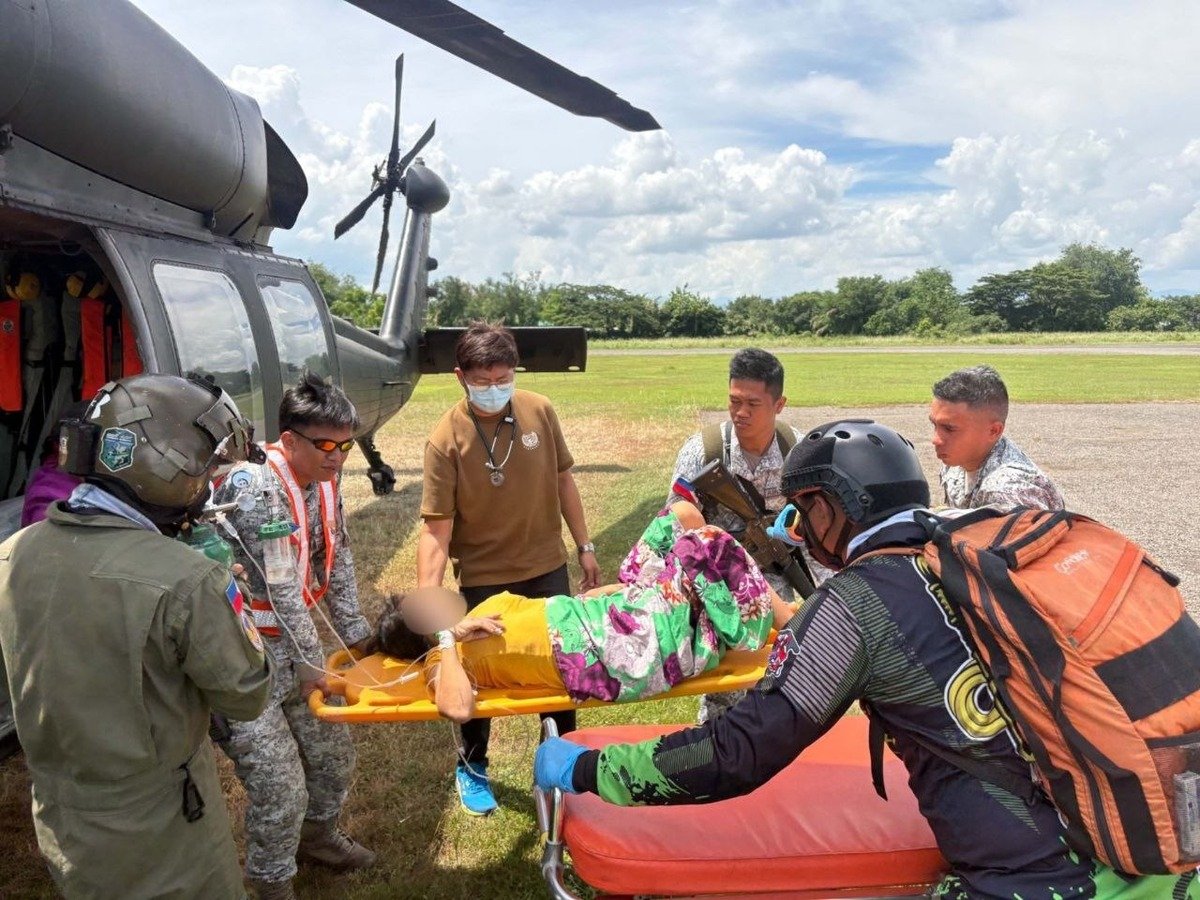
A second S-70i Black Hawk helicopter conducted a medical evacuation (MEDEVAC) mission on June 11, transporting residents from Sarangani Province to Cotabato for urgent medical treatment, according to the PAF statement. Sarangani Province lies along the southern coast of Mindanao and sits near seismic zones associated with high-magnitude earthquake activity in the region.
MEDEVAC operations are considered an essential component of post-disaster response, particularly in the immediate aftermath of major earthquakes when local hospitals and health centers may be overwhelmed, structurally compromised, or otherwise unable to handle a surge of seriously injured patients. The Air Force did not specify the exact number of individuals evacuated or detail the nature of their injuries in its statement.
Multi-Agency Coordination Drives Relief Effort
The June 11 HADR operations were carried out in close coordination with several national government bodies. The PCSO supplied the ChariTimba relief packs, the DSWD provided family food packs, and the OCD contributed bottled water supplies, with the PAF providing the airlift capability to move these goods rapidly to affected areas, the Air Force Public Affairs Office confirmed.
This inter-agency model is consistent with standard Philippine disaster response protocols, where the National Disaster Risk Reduction and Management Council (NDRRMC) acts as the central coordinating authority. The PAF’s role within this framework centers on providing strategic and tactical airlift capacity, enabling relief to reach remote, mountainous, or road-inaccessible communities far more quickly than ground transport would allow.
Civilian volunteers also participated in the relief effort alongside government agencies, the PAF statement noted, reflecting the whole-of-society approach typically employed in large-scale Philippine disaster operations.
Southern Mindanao’s Seismic Risk and the Scale of the Disaster
A magnitude 7.8 earthquake is classified as a major seismic event capable of inflicting severe structural damage, triggering landslides, and displacing large numbers of people — particularly in areas with aging infrastructure or communities situated near active fault lines. Southern Mindanao, which encompasses the Davao Region, Soccsksargen, and the Bangsamoro Autonomous Region in Muslim Mindanao (BARMM), is recognized as one of the more seismically active parts of the Philippines due to its location near the Philippine Fault System and related geological structures.
As of the PAF statement dated June 12, 2026, no comprehensive casualty or damage assessment had yet been released. The Air Force’s report focused specifically on the airlift and MEDEVAC missions conducted on June 11, without addressing the full scope of damage or the total number of individuals displaced or injured by the earthquake.
PAF Commits to Continued Operations Until Relief Needs Are Met
In its official statement, the Philippine Air Force emphasized that the June 11 missions reflect its “continued commitment to rapid response, lifesaving airlift capability, and coordinated disaster relief efforts in support of national humanitarian operations.”
The Air Force indicated that HADR operations were ongoing as of June 12, 2026, with no sign that the relief effort was approaching completion. Given the magnitude of the earthquake and the number of provinces affected, sustained relief operations involving multiple government agencies and military assets are expected to continue in the days and weeks ahead, the PAF statement suggested.
As ground assessments progress and additional affected communities are identified, the scope of relief missions is expected to expand further. The PAF, working alongside the NDRRMC, DSWD, OCD, and other national agencies, is expected to continue deploying both fixed-wing aircraft and helicopters to ensure that assistance reaches the most vulnerable populations in the earthquake-affected zones of Southern Mindanao.
The C-130 Hercules, C-295, and S-70i Black Hawk helicopters collectively form the backbone of the PAF’s airlift capability — assets that have proven indispensable across successive major disaster response operations in recent Philippine history.
Photo credit: Photo courtesy of the Philippine Air Force Public Affairs Office
Originally reported by: Philippine Air Force Public Affairs Office / BNNO wire reports
Related stories