
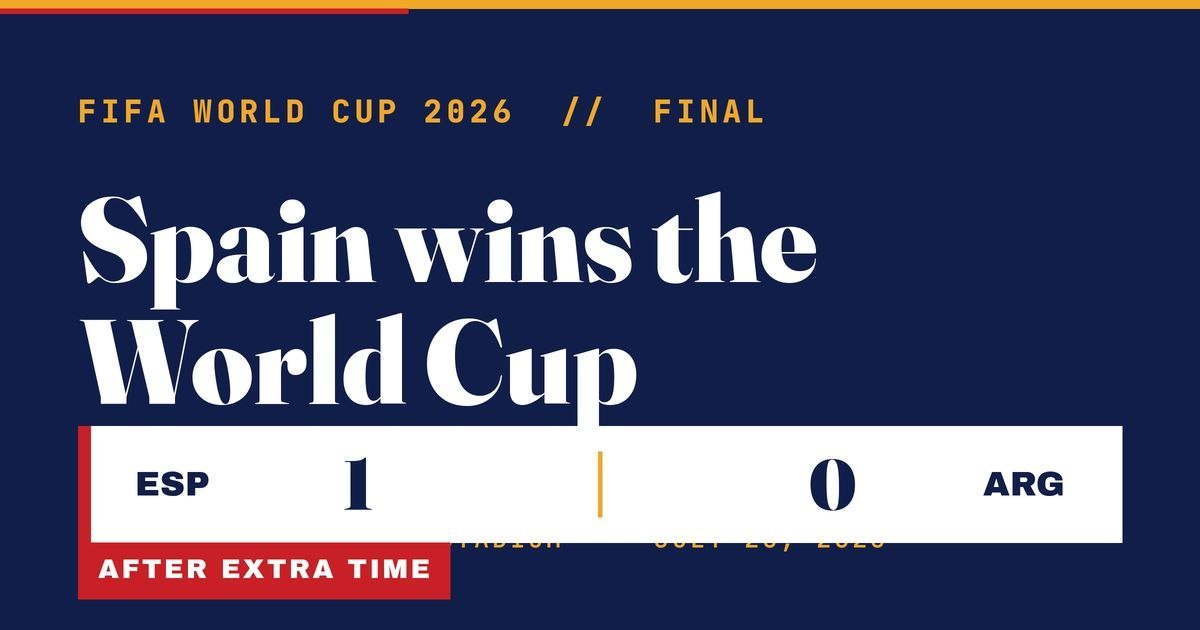
Sixteen years after lifting the trophy in Johannesburg, Spain are FIFA World Cup champions once more. La Roja edged out defending title-holders Argentina 1-0 in extra time at New York New Jersey Stadium in East Rutherford on Monday, July 20, 2026 — a hard-fought victory that ended the South American giants’ four-year hold on the sport’s most coveted prize.
The Deciding Moment
For all of Spain’s dominance throughout the 90 minutes, the breakthrough proved elusive until well into extra time. The lone goal arrived in the 106th minute — just six minutes after the additional period began — finally rewarding a Spanish side that had controlled virtually every phase of the contest without managing to convert their chances during regulation.
Argentina’s discipline eroded under the relentless Spanish pressure in the closing stages. According to match records, La Albiceleste accumulated five yellow cards across the 120 minutes, and a second booking in the second period of extra time left them playing with 10 men — a reduction that came moments before Spain struck the decisive blow.
Statistical Dominance on the Night
The numbers painted an unmistakable picture of Spanish control. Match statistics showed Spain finishing with 68 percent of possession, registering 20 shots in total with 11 hitting the target. Argentina, by stark contrast, managed only three attempts across the full duration of the match — none of which troubled the Spanish goalkeeper.
Much of the credit for keeping Argentina in the contest belonged to goalkeeper Emiliano Martínez, a central figure in the country’s 2022 World Cup triumph. FIFA match records showed Martínez making 10 saves over the course of the evening — a heroic individual display that single-handedly prevented the final from becoming a lopsided affair long before extra time arrived.
Spain’s Dominant Tournament Run
Spain’s path to the final was among the most impressive in recent World Cup history. They conceded just one goal across the entire tournament — a remarkable defensive record that underlined their collective solidity throughout the competition.
In the group stage, Spain drew 0-0 with Cape Verde before comfortably dispatching Saudi Arabia 4-0 and edging Uruguay 1-0. Their knockout run was equally authoritative: Austria fell 3-0, Portugal 1-0, and Belgium 2-1, before Spain shut out France 2-0 in the semifinal to book their place in the title match.
Argentina’s Rougher Route to New Jersey
The defending champions had a considerably more demanding journey to the final. Argentina scraped past Egypt 3-2 and Switzerland 3-1 in the group stage, before surviving a late scare to beat England 2-1 in the semifinal and reach the title decider.
The final also carried powerful symbolic weight as a generational passing of the torch. Lamine Yamal, born 19 years after Lionel Messi, led Spain’s attack against the man broadly regarded as the greatest player the sport has ever produced. The New Jersey final is widely expected to mark Messi’s last appearance at a FIFA World Cup, drawing the curtain on a career that has defined an entire era of the game.
England and France Serve Up a Thriller in the Third-Place Match
The day before the final, the third-place playoff between England and France delivered the most spectacular scoreline of the entire tournament. England ran out 6-4 winners after leading an astonishing 4-0 at the interval, with Bukayo Saka completing a hat-trick in the process.
France’s Kylian Mbappé scored twice in the defeat — but in doing so, he surpassed Lionel Messi to become the all-time leading scorer in World Cup history, according to FIFA records. The match also brought down the curtain on Didier Deschamps’ tenure as France head coach.
How Filipino Fans Watched the Final
Filipino football supporters set their alarms early, with the final kicking off at 3 a.m. Manila time. According to confirmed broadcast arrangements ahead of the tournament, Aleph — FIFA’s exclusive commercialisation and multimedia partner in the Philippines for the 2026 edition — made 40 selected matches available free of charge through its Aleph Arena YouTube channel.
Fans seeking full tournament access, including all 104 matches with Filipino-language commentary, could subscribe to a P1,999 pay-per-view package through BlastTV and Pilipinas Live, the latter holding broadcast rights across the entire competition.
A Tournament for the Record Books
The 2026 FIFA World Cup was historic on multiple fronts. It became the first edition ever co-hosted across three nations — the United States, Mexico, and Canada — and the first to operate under an expanded 48-team format. Matches were spread across 16 host cities from June 11 through July 19, 2026, with the final played on July 20 local time in New Jersey.
For Spain, the triumph completes a remarkable return to the top of world football — their first global title since a Andrés Iniesta header settled another tense final in Johannesburg back in 2010. For Argentina and their supporters, the defeat ends a four-year reign that began with their penalty shootout victory over France in Qatar.
By the Numbers
- 1-0 — Final scoreline after 120 minutes
- 106th minute — When Spain scored the match-winning goal
- 68% — Spain’s share of ball possession during the final
- 20 — Shots attempted by Spain; 11 on target
- 3 — Total shots managed by Argentina across 120 minutes
- 10 — Saves recorded by Emiliano Martínez
- 5 — Yellow cards received by Argentina
- 1 — Goals conceded by Spain throughout the entire tournament
- 6-4 — England’s victory over France in the third-place playoff
- 48 — Number of teams in the expanded 2026 World Cup
- 104 — Total matches played across the tournament
- 16 — Host cities across the United States, Mexico, and Canada
- P1,999 — Price of the full pay-per-view package via BlastTV and Pilipinas Live
- 3 a.m. — Manila kickoff time for Filipino viewers
Why This Matters
Spain’s triumph is only their second FIFA World Cup title and their first in 16 years, cementing a new generation of Spanish players — led by teenage star Lamine Yamal — as genuine world-beaters. Argentina’s defeat ends a four-year reign as champions and almost certainly closes the international chapter on Lionel Messi’s storied career, making this final a defining moment in the history of the sport. The 2026 edition also set new benchmarks as the first three-nation, 48-team World Cup, with its expanded format and broad broadcast reach — including free streaming options and pay-per-view packages in the Philippines — bringing the tournament to record audiences across the globe.
Source: Breaking News Negros Oriental / wire reports
Related stories