
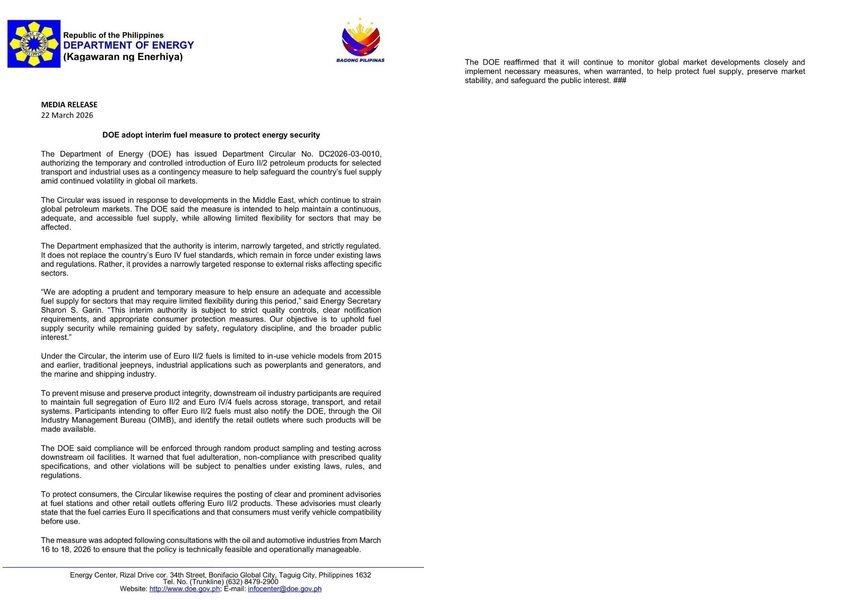
The Department of Energy (DOE) has issued a circular allowing the temporary and controlled use of Euro II petroleum products for selected transport and industrial sectors. This measure serves as a contingency to help secure the country’s fuel supply amidst ongoing volatility in global oil markets.
According to the DOE, Department Circular No. DC2026-03-0010 was issued on March 22, 2026, in response to developments in the Middle East that continue to strain global petroleum markets. The circular aims to maintain a continuous, adequate, and accessible fuel supply while allowing limited flexibility for sectors that may be affected by the global situation.
Interim Measure Designed for Targeted Sectors
The DOE clarified that this authorization is interim, narrowly targeted, and strictly regulated. It does not replace the existing Euro IV fuel standards in the Philippines, which remain in force under current laws and regulations. This measure is a targeted response to external risks impacting specific sectors, according to the DOE.
Energy Secretary Sharon S. Garin emphasized the temporary nature of the measure. “We are adopting a prudent and temporary measure to help ensure an adequate and accessible fuel supply for sectors that may require limited flexibility during this period,” she said in a statement. She also assured that the interim authority is subject to strict quality controls, clear notification requirements, and appropriate consumer protection measures.
Specific Sectors Permitted to Use Euro II Fuel
Under the circular, the interim use of Euro II fuels is limited to specific sectors. These include in-use vehicle models from 2015 and earlier, traditional jeepneys, industrial applications such as power plants and generators, and the marine and shipping industry.
The DOE has outlined specific restrictions to prevent misuse and maintain product integrity. Downstream oil industry participants are required to fully segregate Euro II and Euro IV fuels across storage, transport, and retail systems. Furthermore, participants planning to offer Euro II fuels must notify the DOE through the Oil Industry Management Bureau (OIMB), identifying the retail outlets where the products will be available.
Strict Compliance and Enforcement Measures
To ensure compliance, the DOE will conduct random product sampling and testing across downstream oil facilities. Fuel adulteration, non-compliance with quality specifications, and other violations will be subject to penalties under existing laws, rules, and regulations.
The circular mandates clear and prominent advisories at fuel stations and other retail outlets offering Euro II products to protect consumers. These advisories must clearly state that the fuel carries Euro II specifications and that consumers must verify vehicle compatibility before use.
Consultations with Industry Stakeholders Preceded Implementation
Before implementing the measure, the DOE conducted consultations with the oil and automotive industries from March 16 to 18, 2026. These consultations aimed to ensure that the policy is technically feasible and operationally manageable for all parties involved.
Impact on Transportation and Potential Cost Savings
The temporary allowance of Euro II fuel could offer potential cost savings for owners of older vehicles and traditional jeepneys, particularly in areas where fuel prices are higher. However, it also raises concerns about potential environmental impact due to the higher sulfur content in Euro II fuel compared to Euro IV.
For industrial users like power plants and generators, the shift to Euro II fuel could provide a more affordable option during periods of high fuel costs. However, these industries will need to ensure their equipment is compatible with the lower fuel grade to avoid operational issues or damage.
Marine and Shipping Industry Considerations
The inclusion of the marine and shipping industry recognizes the challenges faced by this sector due to fluctuating fuel prices. Allowing Euro II fuel could potentially lower operational costs for shipping companies, impacting prices of goods transported by sea. Stricter monitoring will be needed to ensure this is implemented safely.
Potential Environmental and Health Concerns Addressed
While the DOE emphasizes that this is a temporary measure, the use of Euro II fuel does raise environmental and health concerns. Euro II fuel generally has a higher sulfur content compared to Euro IV, leading to increased emissions of sulfur dioxide and particulate matter, both of which can contribute to respiratory problems and air pollution.
The DOE’s requirement for clear labeling and consumer awareness campaigns is crucial in mitigating these risks. Vehicle owners and operators must be informed about the potential environmental and health impacts of using Euro II fuel and encouraged to maintain their vehicles properly to minimize emissions.
DOE to Monitor Global Markets and Implement Further Measures
The DOE has reaffirmed its commitment to closely monitor global market developments. The agency will implement necessary measures, when warranted, to protect fuel supply, preserve market stability, and safeguard the public interest. This includes ongoing assessments of the effectiveness of the Euro II fuel measure and adjustments as needed.
The department’s proactive stance underscores the government’s dedication to addressing the ongoing challenges in the global energy landscape and ensuring that the Philippines remains resilient in the face of external pressures.
Photo credit: Photo from DOE.gov.ph