Military and immigration authorities have detained a Chinese citizen who allegedly used forged Filipino documentation to establish multiple business enterprises across the Philippines, following a coordinated enforcement action in Davao City on April 21, 2026.
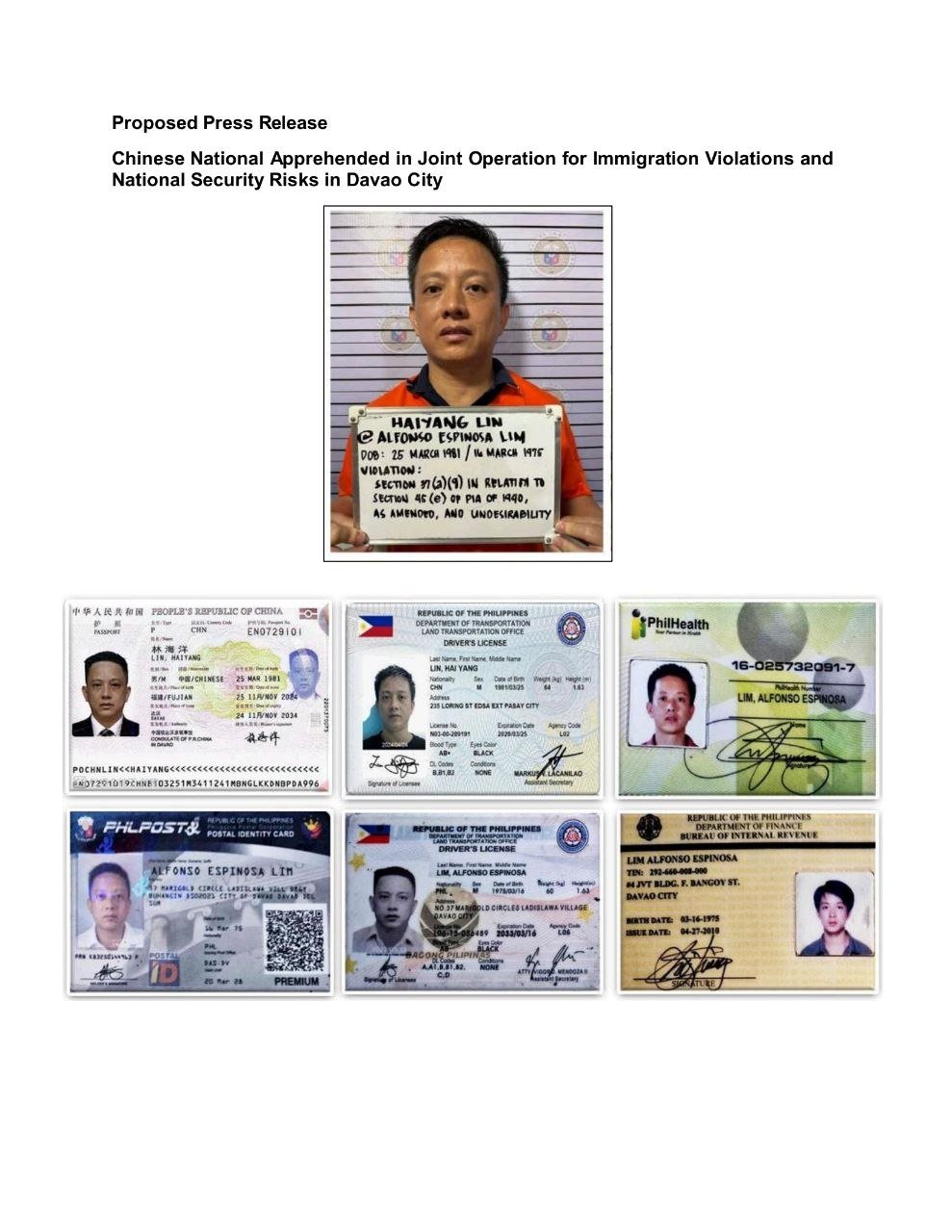
The suspect, identified as Lin Haiyang, had been conducting commercial operations under the fabricated Filipino name Alfonso Espinosa Lim when he was taken into custody at his residence on Quezon Boulevard, Barangay 26-C (Poblacion), Davao City. The operation involved personnel from the 1003rd Infantry “Raptor” Brigade of the 10th Infantry Division working alongside Bureau of Immigration officers.
Authorities executed the arrest under Bureau of Immigration Mission Order No. 2026-100, leading to the filing of numerous criminal charges against Lin. The charges encompass violations of the Philippine Immigration Act of 1940, Anti-Dummy Law infractions, falsification of government documents, and breaches of the National Internal Revenue Code of 1997.
Elaborate Document Falsification Exposed
Military officials revealed that extensive verification procedures confirmed Lin Haiyang had illegally obtained the identity of Alfonso Espinosa Lim using fraudulent civil registry documentation. Investigations established that the individual possesses a People’s Republic of China passport bearing number EN0729101, showing his birth date as March 25, 1981, in Fujian Province, China.
Despite maintaining Chinese citizenship, Lin successfully secured numerous Philippine government identification credentials under his false Filipino persona. The fraudulent documents encompassed a Certificate of Live Birth, driver’s license from the Land Transportation Office, PhilHealth membership card, Tax Identification Number documentation, and Postal identification.
Law enforcement officials characterized the situation as representing unlawful assumption of Philippine citizenship through fabricated documentation, highlighting vulnerabilities in the nation’s civil registry verification systems.
Strategic Sector Business Infiltration
Utilizing his counterfeit Filipino credentials, Lin Haiyang established and managed multiple corporate entities within sectors authorities classify as critical national infrastructure. His business portfolio encompassed telecommunications, construction, and food service industries—areas where foreign ownership faces significant legal restrictions under Philippine legislation.
The Foreign Investments Act, commonly referred to as the Anti-Dummy Law, specifically prohibits non-Filipino nationals from engaging in particular commercial activities designated for citizens only, or mandates specific ownership arrangements limiting foreign control over strategic economic sectors.
Government officials voiced alarm that such business activities conducted under falsified Filipino documentation create substantial concerns regarding potential territorial exploitation for influence campaigns, economic destabilization, sabotage operations, and initiatives serving foreign geopolitical objectives.
Security Concerns Highlighted
Joint statements from the Bureau of Immigration and Armed Forces of the Philippines described Lin Haiyang’s situation as transcending conventional immigration law violations. Officials characterized the detained individual as “more than a standard immigration violator but rather a potential security threat whose ongoing presence and commercial activities represent considerable dangers to public welfare, economic stability, and national defense.”
The incident underscores persistent concerns regarding foreign nationals potentially bypassing Philippine regulations established to safeguard strategic economic sectors and preserve national control over critical infrastructure systems.
Lin Haiyang’s success in acquiring legitimate Philippine government credentials using false identity documentation also exposes potential weaknesses in security and authentication procedures across various government departments responsible for credential issuance.
Criminal Charges Filed
The detained Chinese national confronts multiple severe charges under Philippine jurisprudence. These encompass violations of Section 37(a)(9) connected to Section 45(e) of the Philippine Immigration Act of 1940, as amended, addressing prohibited conduct and penalties for immigration infractions.
Supplementary charges include designation as an undesirable alien under immigration statutes, Anti-Dummy Law violations restricting foreign business ownership, falsification of government documents, and National Internal Revenue Code of 1997 breaches.
Bureau of Immigration arrest teams secured Lin Haiyang for proper judicial proceedings, with officials confirming the case will advance through Philippine court channels.
Continued Investigation Efforts
The Bureau of Immigration announced ongoing enforcement activities coordinated with the Armed Forces of the Philippines and additional partner law enforcement organizations. Investigation efforts include verification of individuals potentially connected to the apprehended Chinese national.
Officials indicated active efforts to prevent additional illegal operations that might threaten national security and sovereignty, suggesting this case could represent part of broader investigations into similar fraudulent schemes.
Armed Forces of the Philippines leadership stressed their dedication to sustained cooperation with partner organizations in Philippine law enforcement, particularly involving cases requiring protection of national integrity and security priorities.
Immigration Enforcement Landscape
This detention occurs during increased examination of foreign nationals conducting business in the Philippines, especially those engaged in activities potentially affecting national security or economic independence. The case illustrates continuing difficulties Philippine authorities encounter maintaining citizenship and identification system integrity.
The effective joint military-civilian law enforcement operation demonstrates the government’s integrated approach to addressing complex situations spanning immigration regulation, commercial oversight, and national security considerations.
The Bureau of Immigration continues emphasizing its responsibility for immigration law enforcement and maintaining Philippine border and territorial security against potential threats from individuals attempting to exploit legal vulnerabilities or fraudulent documentation for illegal domestic operations.
Photo credit: Photo courtesy of Armed Forces of the Philippines
Related stories