
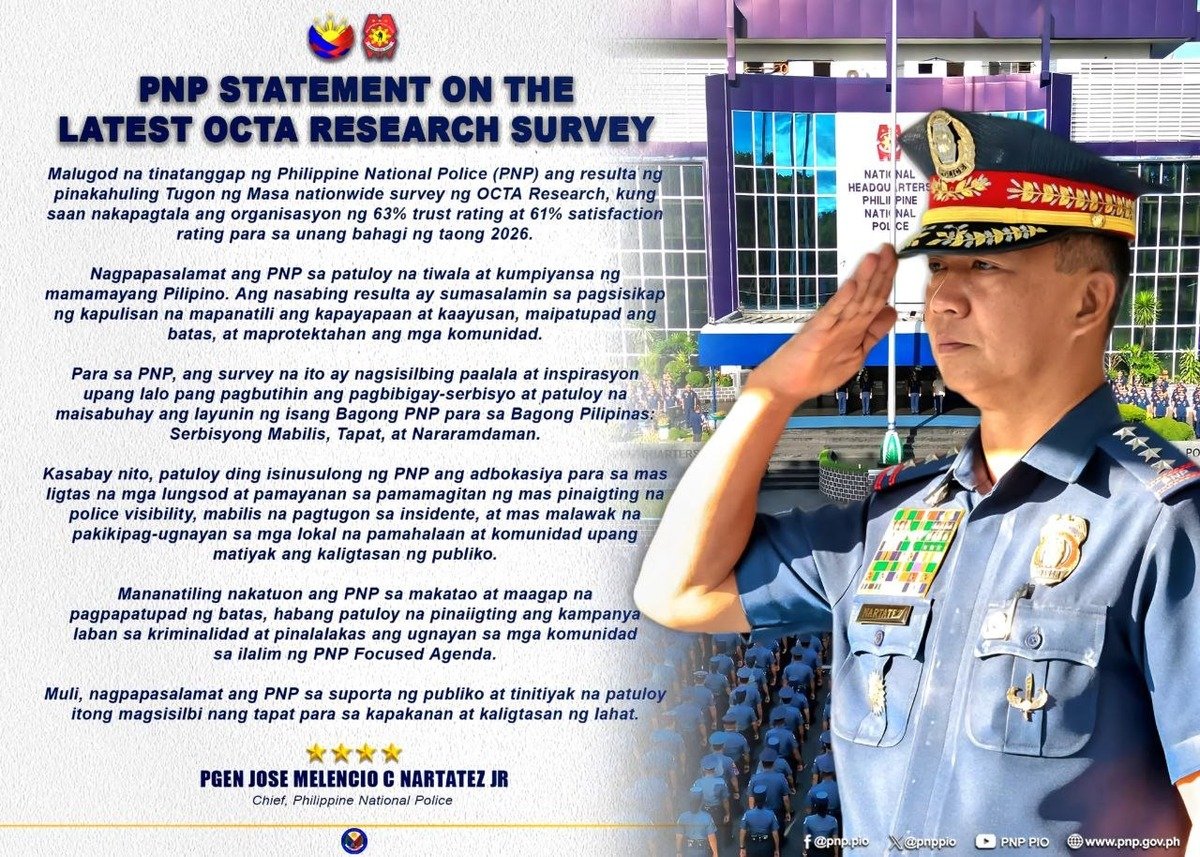
Public confidence in the Philippine National Police remains relatively strong heading into mid-2026, with a fresh nationwide survey placing the institution’s trust rating at 63 percent and its satisfaction rating at 61 percent. The findings, released by OCTA Research through its Tugon ng Masa survey series, were gathered between March 19 and 25, 2026, using face-to-face interviews conducted among 1,200 adult respondents drawn from across the country.
The PNP officially acknowledged the results on May 6, 2026, with Police General Jose Melencio C. Nartatez Jr. issuing a formal statement expressing appreciation for the public’s continued confidence in the national police force. Nartatez leads the institution at a time when policing reform and community engagement have become central priorities in the organization’s operational agenda.
Top Official Acknowledges Public’s Continued Support
In his official remarks, Nartatez framed the OCTA survey results as an encouraging signal from the Filipino public — one that validates the police force’s day-to-day commitment to law enforcement and public safety.
“The Philippine National Police gladly accepts the results of the latest Tugon ng Masa nationwide survey by OCTA Research, where the organization recorded a 63% trust rating and 61% satisfaction rating for the first part of 2026,” the PNP chief said in the statement.
Nartatez was careful to credit not just institutional leadership but the thousands of police officers stationed in communities throughout the Philippines who carry out the daily work of keeping peace and enforcing the law. He described the ratings as a collective reflection of these front-line efforts.
“The PNP thanks the Filipino people for their continued trust and confidence. The said result reflects the efforts of the police force to maintain peace and order, enforce the law, and protect communities,” he added.
Survey Design and How the Numbers Break Down
The OCTA Research Tugon ng Masa survey for the first quarter of 2026 followed a structured methodology, conducting face-to-face interviews nationwide with a margin of error set at plus or minus 3 percentage points at the national level. The 1,200-respondent sample was designed to represent a broad cross-section of the adult Filipino population.
When broken down by region, the data revealed notable differences in how various parts of the country view the PNP. Mindanao emerged as the region with the strongest showing for the police, recording a trust rating of 74 percent and a performance rating of 69 percent — both the highest among the major regional clusters surveyed.
The Visayas region ranked second in terms of public confidence in police performance, suggesting that community policing programs have had measurable impact in island areas outside Luzon. These regional variations point to the uneven but generally positive reception of PNP initiatives across different geographic and cultural contexts.
Survey Serves as Both Validation and a Call to Do More
Rather than treating the survey results purely as a pat on the back, Nartatez publicly framed them as a dual mandate — confirmation that the PNP is moving in the right direction, but also a reminder that the work of building public trust is never finished.
“For the PNP, this survey serves as a reminder and inspiration to further improve service delivery and continue to live by the goal of a New PNP for a New Philippines: Fast, Honest, and Compassionate Service,” the police chief explained.
The “New PNP for a New Philippines” framework represents a sweeping reform agenda within the organization, one that emphasizes professionalism, accountability, and compassion as the three pillars guiding every aspect of police service delivery. The initiative directly addresses historical criticisms of the institution and seeks to reposition the PNP in the eyes of the public as a modern, people-centered law enforcement body.
Visibility, Rapid Response, and LGU Cooperation at the Core
As part of its ongoing strategy to sustain and improve these ratings, the PNP outlined several operational priorities it intends to pursue in the coming months. Chief among these is increased police visibility in communities — a measure widely regarded as both a deterrence tool and a trust-building mechanism.
The organization also pointed to swift incident response and closer coordination with local government units (LGUs) as key components of its public safety approach. By partnering more closely with local officials, the PNP aims to tailor law enforcement strategies to the specific needs and conditions of individual communities rather than applying a one-size-fits-all national template.
This collaborative model recognizes that effective policing is as much about relationships as it is about enforcement. Local government officials often have a clearer understanding of community dynamics, enabling more nuanced and targeted interventions when safety concerns arise.
Anti-Criminality Campaigns Remain a Priority Focus
The PNP’s intensified campaign against criminality continues to anchor its broader service strategy. The institution maintains that public trust is most directly influenced by people’s perception of personal safety in their neighborhoods — making crime prevention and response a linchpin of any effort to improve satisfaction ratings.
“The PNP will remain focused on humane and prompt enforcement of the law, while continuously intensifying the campaign against criminality and strengthening relations with communities under the PNP Focused Agenda,” Nartatez stated.
The phrase “humane enforcement” is significant, reflecting an awareness within the institution that how the law is applied matters as much as whether it is applied. The PNP Focused Agenda framework guides these operational priorities, providing structure to what might otherwise be disparate regional policing approaches.
The dual strategy of proactive crime prevention and responsive law enforcement is designed to address both immediate public safety threats and the longer-term goal of building community resilience. By investing in community relationships now, the PNP hopes to create conditions in which crimes are less likely to occur in the first place.
Pledge to Continue Serving All Filipinos
Closing his statement on a note of institutional commitment, Nartatez reaffirmed the PNP’s core obligation to every Filipino citizen, regardless of their location, economic status, or background.
“Once again, the PNP thanks the public for their support and ensures that it will continue to serve faithfully for the welfare and safety of all,” the police chief concluded.
The release of these survey results comes amid a period of heightened global attention on policing practices, accountability, and community relations. Against that backdrop, the PNP’s relatively solid numbers indicate that its reform programs and community engagement efforts are gaining traction among the broader Filipino public. Still, with meaningful portions of the population yet to express full confidence in the institution, police leadership appears to understand that the bar for public trust must continue to be raised — not merely met.
Photo credit: Photo courtesy of PNP