TAGUIG CITY — Soldiers from the Philippine Army and the United States Army are pressing through an intensive series of combined field exercises under the 41st iteration of Exercise Balikatan, with training activities spread across several installations and provinces nationwide. The drills span a broad range of military disciplines — from responding to chemical and explosive threats to conducting pier assessments along Luzon’s Pacific coastline — and are set to wrap up on May 8, 2026.
Exercise Balikatan, whose name comes from the Filipino expression meaning “shoulder to shoulder,” is an annual bilateral military exercise between the Armed Forces of the Philippines and the United States Armed Forces. Now in its 41st year, the exercise has expanded considerably in scale, now encompassing ground, naval, and air force components operating simultaneously across multiple domains.
CBRN and EOD Response Drills at Camp Aquino, Tarlac
At Camp Aquino in Tarlac City, Philippine Army Chemical, Biological, Radiological, and Nuclear specialists joined their U.S. Army counterparts for mock chemical incident drills designed to test how quickly and effectively combined teams can respond to CBRN and Explosive Ordnance Disposal threats within simulated complex battlefield conditions.
Colonel Louie G. Dema-ala, Chief Public Affairs of the Philippine Army, said in an official statement that these exercises are intended to reinforce the interoperability and combined operational readiness of the two allied forces. The scenarios are crafted to reflect realistic situations that joint Philippine-U.S. units might encounter during actual operations involving chemical or explosive hazards.
CBRN threats represent some of the most technically demanding challenges in modern warfare. Countering them requires not only specialized equipment and individual training, but also seamless coordination across allied units — precisely the kind of proficiency that exercises like Balikatan are designed to develop and sustain over time.
The Camp Aquino drills form a core part of the broader Balikatan framework, which is structured around building warfighting readiness across the full spectrum of battlefield conditions. The inclusion of EOD scenarios alongside CBRN response reflects the recognition that explosive hazards and chemical threats often occur together or in close proximity in real-world conflict environments.
Combat Engineers Practice Fortification and Obstacle Work in Joint Drills
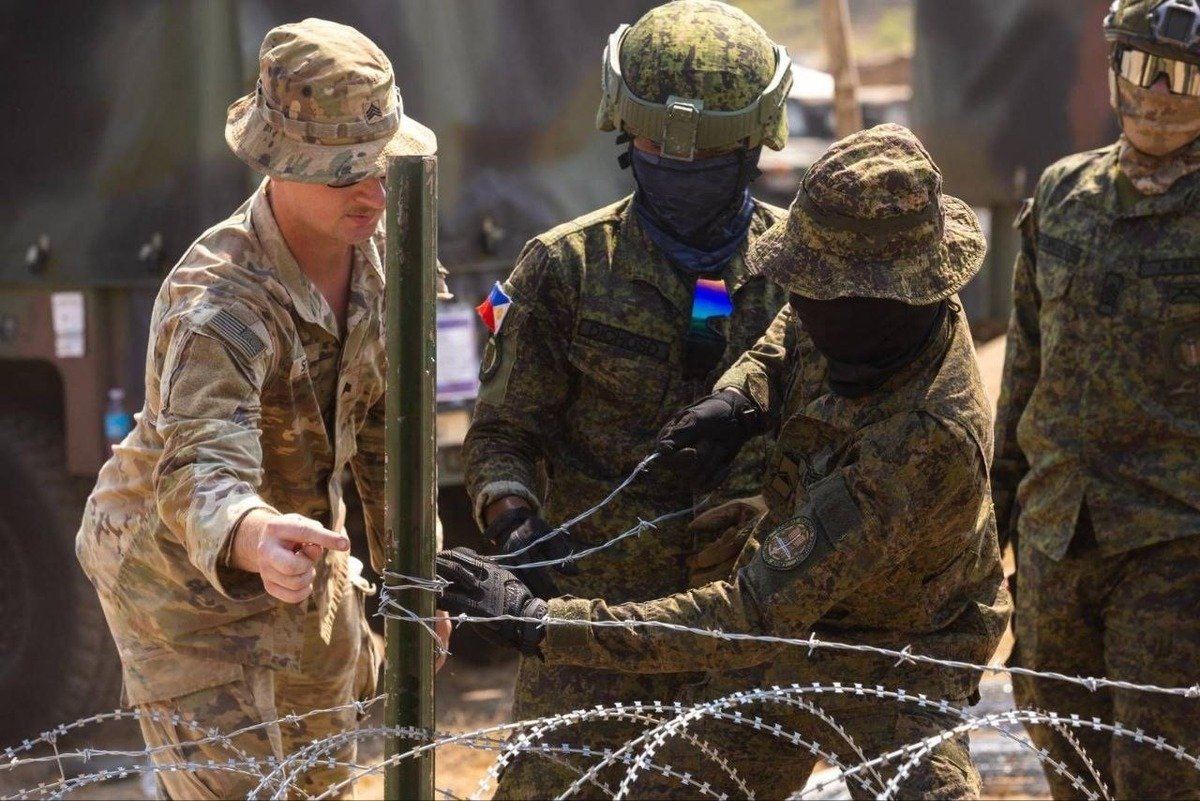
Separate from the CBRN activities, combat engineers from both the Philippine Army and the U.S. Army Pacific participated in bilateral engineering drills that involved constructing field fortifications and carrying out rapid obstacle emplacement exercises.
Colonel Dema-ala stated that the engineering activities “directly supported shared defense capabilities,” with the training aimed at improving the allied forces’ collective ability to “secure key terrain, protect formations, and enable follow-on operations anywhere across the region.”
Field fortification and obstacle emplacement are among the most essential tasks in defensive ground operations. Properly positioned obstacles slow enemy movement, force opposing forces into pre-planned engagement areas, and create protected corridors for friendly troops and supply lines. Practicing these tasks in a combined setting ensures that Philippine and U.S. engineers can operate fluidly alongside each other when it matters most.
The inclusion of combat engineering drills in Balikatan 2026 highlights the exercise’s emphasis on practical, soldier-level skills rather than restricting training purely to command-and-control or high-level coordination exercises. Both armies benefit from working through tactical tasks together at the field level.
Philippine Special Forces Guide U.S. Troops Through Jungle Survival at Fort Magsaysay
Over in Nueva Ecija, Philippine Army Special Forces soldiers took on an instructional role, facilitating jungle survival training for their U.S. Army counterparts at Fort Magsaysay — one of the largest military training reservations in all of Southeast Asia.
The training covered core survival competencies required for operations in dense tropical terrain, including navigation without modern aids, constructing field shelters, sourcing food and water from the environment, and evasion techniques. The Philippines’ combination of geographic setting, ecological diversity, and institutional military experience in jungle environments makes it uniquely suited as a training ground for this type of instruction.
This arrangement reflects a key feature of the Balikatan model: the exercise is not a one-directional transfer of knowledge from a larger force to a smaller one. Both sides bring specific areas of expertise, and instruction flows in both directions depending on the domain. When it comes to jungle warfare and tropical survival, Philippine forces hold a genuine instructional edge.
Fort Magsaysay has long served as one of the principal training sites in the Balikatan series, offering expansive terrain suited to field operations, live-fire exercises, and the kind of immersive environmental conditions that make jungle survival training meaningful rather than theoretical.
Pier Survey Operations Conducted Along Dingalan, Aurora Coastline
In a distinct but strategically significant component of the exercise, Philippine Army and U.S. Army teams carried out pier survey operations in Dingalan, Aurora, situated along the eastern coast of Luzon facing the Pacific Ocean.
The objective of the pier survey drills was to evaluate underwater structures and identify any obstructions or hazards that could compromise the safe offloading of cargo and military equipment directly onto a beach or pier facility. These assessments are a foundational step in amphibious logistics planning — before any large-scale coastal landing or maritime supply operation can proceed, trained survey teams must clear the seabed and coastal approaches.
The selection of Dingalan as a drill site carries strategic relevance. The municipality’s location along the Pacific-facing coast provides coastal conditions that closely mirror environments where real-world amphibious logistics operations may be required across the broader Indo-Pacific region.
Pier and beach survey capabilities are gaining prominence within Philippine-U.S. alliance exercises, reflecting a wider strategic shift toward sea-based logistics, coastal access planning, and maritime domain awareness as central pillars of regional security cooperation.
A Multi-Domain Exercise Across the Philippine Archipelago
The 2026 edition of Balikatan stands out for the breadth of its training activities. Beyond the CBRN, EOD, engineering, jungle survival, and pier survey components covered in the Philippine Army’s latest update, the full exercise also encompasses activities conducted by naval and air force components of both countries.
All Philippine Army and U.S. Army ground component activities are being coordinated within the larger joint and combined exercise structure that governs the entire Balikatan program, according to the Philippine Army’s public affairs office.
The exercises are conducted under the framework of the Mutual Defense Treaty between the Philippines and the United States, a security agreement in force since 1951 that obliges both nations to support each other in the event of an armed attack. Balikatan functions as one of the primary instruments through which both militaries keep their combined readiness current and their interoperability sharp.
Photos documenting the latest training activities were furnished by the U.S. Army Pacific, with Colonel Dema-ala serving as the official spokesperson for the Philippine Army’s ground component participation.
Final Days of Balikatan 41 Approach
As the May 8, 2026 closing date draws near, the 41st Exercise Balikatan is on track to stand as one of the more comprehensive iterations of the annual drill in recent memory. Training has touched on an unusually wide range of warfighting domains — from highly technical CBRN response and combat engineering to jungle fieldcraft and amphibious coastal survey — demonstrating the depth and versatility that both the Philippine and U.S. armies bring to their enduring alliance.
The Philippine Army has served as the ground component lead on the Philippine side throughout the exercise period, coordinating activities across Luzon and other parts of the country as part of a sustained commitment to combined military readiness with its long-standing American ally.