Law enforcement teams from the Philippine National Police and the Philippine Drug Enforcement Agency dismantled two large-scale illegal cannabis cultivation sites in a remote mountain area of Kalinga province on May 18, 2026 — an operation that authorities say ranks among the most significant marijuana eradication efforts carried out in the Cordillera Administrative Region in recent memory.
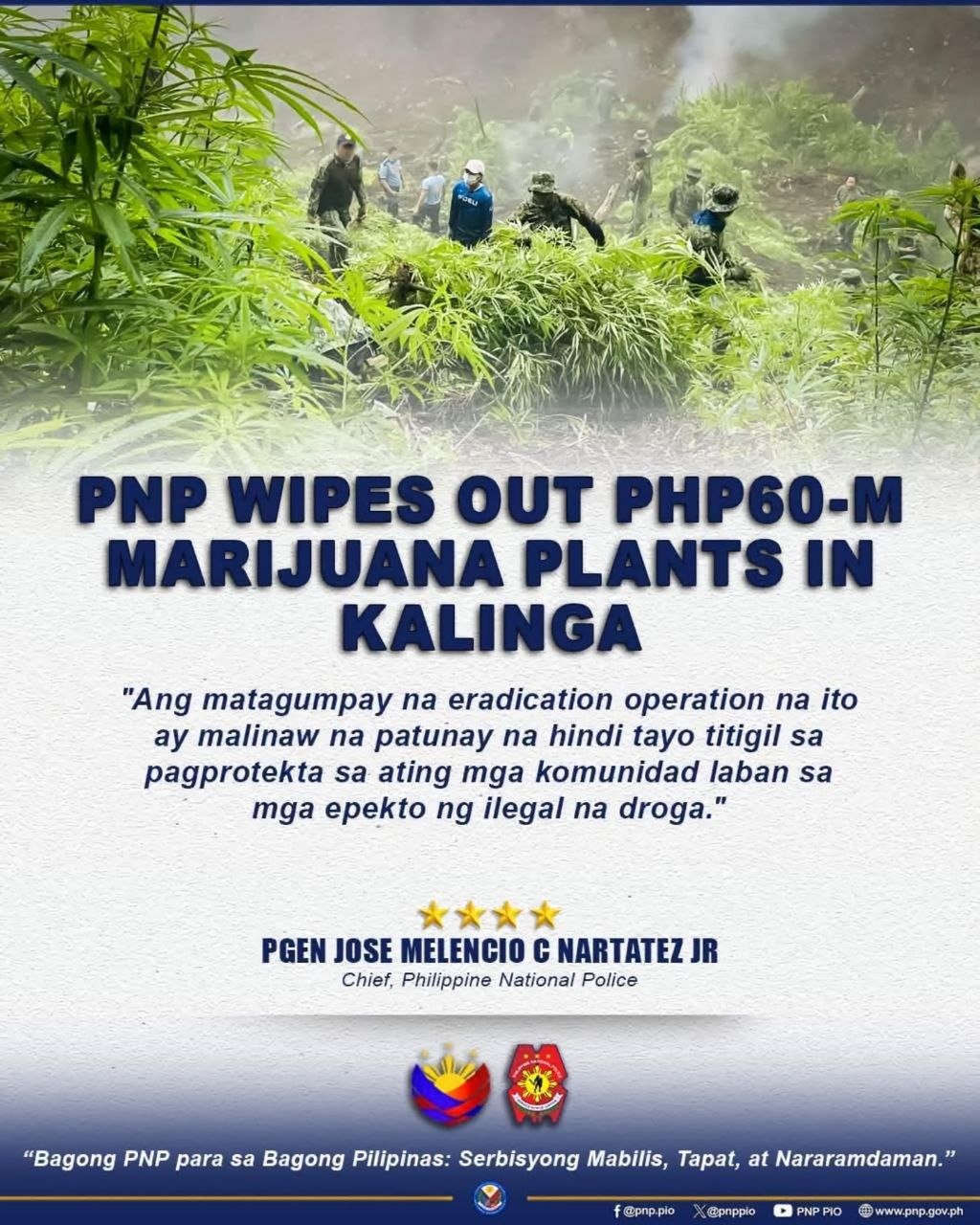
The joint operation targeted plantation sites inside a communal forest at Mt. Chumanchil, Barangay Loccong, in the municipality of Tinglayan, Kalinga. Combined teams uprooted and destroyed an estimated 300,000 fully grown marijuana plants spread across approximately 25,000 square meters of cultivated land, with the total haul valued at roughly PHP60 million based on prevailing street market prices.
Remote Mountain Terrain Concealed Two Distinct Plantation Sites
Operatives uncovered not one but two separate marijuana plantation sites during the raid, both situated within geographically isolated sections of the communal forest at Mt. Chumanchil. According to the PNP Public Information Office, which released a formal report on the operation, both sites were nestled in rugged, difficult-to-access terrain — a deliberate choice by illegal cultivators seeking to avoid detection by law enforcement patrols.
The combined cultivated area of 25,000 square meters housed all 300,000 plants in what authorities described as a fully grown and near-harvest condition at the time of discovery. The maturity of the plants indicates that the cultivation operation had been running for a sustained period prior to the raid, and that the illegal harvest was likely imminent when authorities moved in.
In accordance with standard anti-drug enforcement protocols, representative plant samples were collected and preserved for laboratory testing and evidentiary purposes. The remaining plants were systematically documented and destroyed on-site, consistent with the legal procedures governing the disposal of seized controlled substances under Philippine law.
Multi-Agency Teams Execute Operation With Full Protocol Compliance
The Tinglayan operation was conducted through the coordinated deployment of anti-illegal drug operatives drawn from PNP regional units and local police forces assigned within the Cordillera Administrative Region, working in close partnership with PDEA field units. The PNP Public Information Office confirmed that the operation was carried out in full compliance with established rules of engagement and documentation requirements mandated under Philippine anti-drug statutes.
The multi-agency structure of the operation reflects the government’s now-standard inter-agency approach to anti-drug enforcement, particularly in remote and mountainous communities where terrain, limited road access, and distance from urban centers have historically constrained the operational capacity of individual law enforcement units. The involvement of both the PNP and PDEA allowed for broader resource pooling and more effective ground coverage across the plantation areas.
PNP Chief Issues Commendation for Units Involved in Tinglayan Raid
PNP Chief Police General Jose Melencio C. Nartatez Jr. publicly recognized the performance of the units that executed the Tinglayan operation, citing their dedication and the quality of inter-agency coordination displayed throughout the mission. PGen Nartatez stated in remarks released alongside the official operation report that the force remains committed to strengthening anti-drug operations across all parts of the country.
“Patuloy nating pinapalakas ang ating operasyon laban sa ilegal na droga sa iba’t ibang bahagi ng bansa. Ang matagumpay na eradication operation na ito ay malinaw na patunay na hindi tayo titigil sa pagprotekta sa ating mga komunidad laban sa mga epekto ng ilegal na droga,” PGen Nartatez said, as quoted in the PNP Public Information Office report.
Translated, the PNP Chief expressed that the police will not cease operations in defense of communities against the harms of illegal drugs, and that the Mt. Chumanchil eradication serves as clear evidence of that institutional resolve. PGen Nartatez further stressed that community cooperation and sustained inter-agency collaboration are indispensable elements in sustaining long-term anti-drug enforcement, especially in isolated highland areas where local intelligence networks are critical to operational success.
Operation Supports Marcos Administration’s Drug Policy and PNP Focus Agenda
The Mt. Chumanchil eradication operation is part of the PNP’s intensified campaign under its Focus Agenda on Enhanced Managing Police Operations — the institutional framework guiding the agency’s anti-criminality and anti-illegal drug enforcement priorities. This agenda is aligned with the broader peace and order platform of the administration of President Ferdinand R. Marcos Jr., which has been in place since 2022.
The PNP has increasingly adopted intelligence-driven enforcement strategies in recent years, with a particular focus on identifying and dismantling large-scale drug supply networks operating in mountainous and geographically isolated provinces. Kalinga, located in the Cordillera Administrative Region in northern Luzon, has been flagged in past law enforcement assessments as one of several highland provinces where illegal marijuana cultivation has persisted, owing to the natural concealment provided by its rugged terrain and the historically limited accessibility of its more remote communities.
The successful Tinglayan operation is expected to feed into ongoing intelligence assessments of drug cultivation activity in the broader Kalinga area, according to information made available through the PNP Public Information Office.
PHP60-Million Valuation Signals Major Disruption to Drug Supply Chain
Anti-drug enforcement authorities place the estimated street value of the destroyed plants at PHP60 million — a figure calculated based on prevailing illegal market prices per gram or kilogram across local and downstream distribution channels. The scale of the seizure represents a substantial blow to whatever supply network had been cultivating and financing the Mt. Chumanchil plantations.
The fact that all 300,000 plants were described as fully grown at the time of the raid is particularly significant, as it means the operation intercepted the cultivation at peak value — effectively preventing a complete and ready harvest from entering the illegal drug distribution network. Had the plants reached the market, the volume destroyed would have represented considerable supply capacity within the regional and potentially national illegal cannabis trade.
Law enforcement analysts have noted that marijuana cultivation at the scale found at Mt. Chumanchil — spanning 25,000 square meters and requiring consistent labor, water access, and logistical management — cannot be attributed to isolated, small-scale actors. The PDEA and PNP have indicated that operations of this complexity typically point to structured cultivation networks involving multiple financiers and organized groups of farm laborers, though no formal suspect profiling information was released in connection with this specific operation.
No Arrests Recorded as of May 19; PNP Vows Continued Operations
As of May 19, 2026, the PNP Public Information Office had not reported any arrests made in connection with the Tinglayan marijuana plantation operation. No information has been publicly disclosed regarding whether specific persons of interest have been formally identified as part of an active investigation tied to the destroyed cultivation sites at Mt. Chumanchil.
The PNP has not confirmed whether follow-up operations are planned for other suspected sites in Tinglayan or the surrounding areas of Kalinga province. However, the agency reaffirmed its institutional commitment to continuing lawful, intelligence-driven enforcement operations nationwide under its organizational vision articulated as “Bagong PNP para sa Bagong Pilipinas: Serbisyong Mabilis, Tapat at Nararamdaman” — a reform-oriented framework positioning the PNP as a responsive and community-centered police service.
The PDEA and PNP have both indicated that similar operations targeting illegal marijuana plantations and other drug cultivation activities in geographically remote communities across the Philippines will continue as part of sustained, long-range enforcement efforts aimed at disrupting illegal drug supply at the source.
Originally reported by: PNP Public Information Office / wire reports