
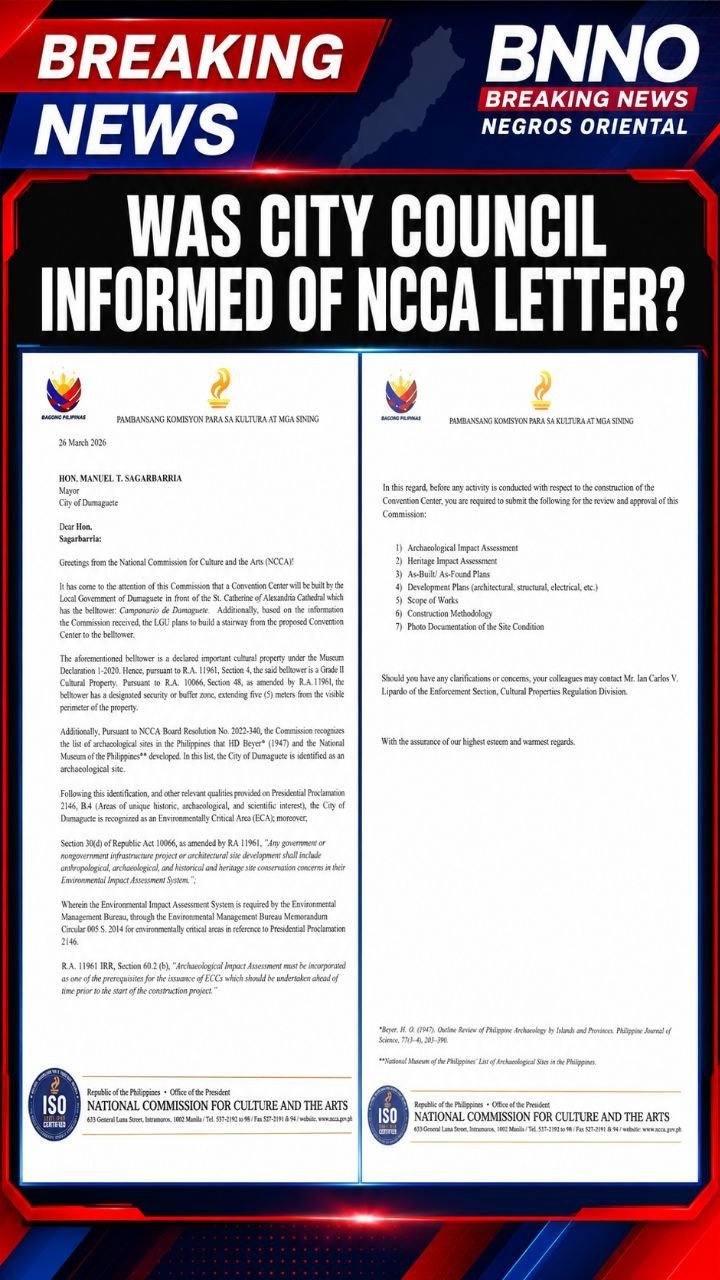
Questions over heritage compliance and legislative transparency are mounting in Dumaguete City after a letter from the National Commission for Culture and the Arts, dated March 26, 2026 and addressed to Mayor Manuel T. Sagarbarria, came to light — with civic observers and concerned parties now asking whether its contents were ever formally shared with the Sangguniang Panlungsod and the City Development Council before deliberations on two major infrastructure projects moved ahead.
The letter, originally issued in relation to a proposed convention center planned for construction near the St. Catherine of Alexandria Cathedral and the historic Campanario de Dumaguete, laid out a mandatory set of documentary and compliance requirements that must be met before any ground-disturbing activity could legally proceed at that location. The question that has since emerged is whether those same legal triggers apply — or should have been disclosed as applying — to the city’s planned new public market and City Hall extension projects.
What the NCCA Letter Actually Said
According to the March 26, 2026 NCCA letter, the Campanario de Dumaguete carries the formal designation of an Important Cultural Property and a Grade II Cultural Property under Philippine heritage law. A mandatory five-meter protected buffer zone extends from the visible perimeter of the Campanario, placing strict heritage and cultural compliance obligations on any construction activity within that radius.
The NCCA further stated in the letter that Dumaguete City itself holds a formal classification as an archaeological site, as well as recognition as an Environmentally Critical Area — a designation grounded in the city’s historic, scientific, and archaeological significance. These are not procedural labels. Under existing law, they impose binding obligations on both private and government project proponents operating within the city’s heritage core.
Heritage advocates have since pointed out that while the NCCA letter was specifically prompted by the convention center proposal, the legal conditions that gave rise to its requirements — proximity to a declared cultural property, location within an archaeological zone, and the Environmentally Critical Area classification — are geographic and statutory in nature, meaning they apply equally to any major infrastructure project situated in the same area of the city.
The Legal Basis: Republic Act 10066
The legal framework underpinning the NCCA’s authority in this matter is Republic Act No. 10066, known as the National Cultural Heritage Act of 2009. As cited in the Supreme Court E-Library, the law requires that all government and non-government infrastructure projects or architectural site developments incorporate archaeological, anthropological, historical, and heritage conservation concerns into the Environmental Impact Assessment System before proceeding.
RA 10066 also grants cultural agencies the authority to inspect declared cultural properties and national historical landmarks to verify that their physical integrity and heritage value are being protected throughout any nearby development process, according to the statute’s provisions.
The practical implication, as observers have noted, is that the proposed public market and City Hall extension — both expected to be located within or adjacent to Dumaguete’s historically and archaeologically sensitive urban core — may be legally subject to the same documentation requirements that the NCCA outlined for the convention center project.
Those requirements, as specified in the NCCA letter, include an Archaeological Impact Assessment, a Heritage Impact Assessment, an As-Built or As-Found Plan, detailed development plans, scope of works, construction methodology documentation, and photo documentation of the existing site condition. These must be submitted and reviewed before any excavation or construction work may legally commence at a site within or beside a declared cultural property.
Did the Council and CDC Receive the Letter?
The core accountability question being raised by civic observers is pointed and specific: were members of the Sangguniang Panlungsod and the City Development Council formally provided with a copy of the NCCA’s March 26, 2026 letter before the first reading, endorsement, or planning deliberations on the public market and City Hall extension projects took place?
If they were not informed, observers say this constitutes a transparency gap that the Executive Department must address. If the letter was disclosed and deliberations proceeded nonetheless, then concerned parties and the public have a right to know what documented steps were taken to ensure compliance with applicable heritage laws and NCCA regulatory guidelines.
Some civic observers have suggested the Sangguniang Panlungsod, as the legislative body responsible for approving public infrastructure and appropriating city funds, may consider requiring the Executive Department to produce a written certification confirming that both the public market and City Hall extension projects have either already secured or will secure — prior to any ground-breaking activity — the necessary NCCA opinion, heritage clearance, archaeological assessment, environmental compliance certificates, and all other required approvals from relevant cultural agencies.
Location, Not Project Label, Is What Triggers Compliance
A key point raised in the ongoing discussion is that the NCCA’s compliance requirements for the convention center were not triggered by what the project was called or what function it would serve. They were triggered purely by where it was planned to be built — in proximity to a declared cultural property, within an archaeologically classified zone, and inside the historic center of a city formally recognized as an Environmentally Critical Area.
This distinction has direct relevance to the market and City Hall extension projects. If those projects are sited within the same heritage-sensitive perimeter — which available information suggests is the case — then the NCCA’s compliance threshold is met by geography alone, regardless of whether the project in question is labeled a convention center, a public market, or a government office building.
The NCCA’s mandate under RA 10066, as the agency has articulated, is to preserve the physical integrity of declared cultural properties and protect the archaeological landscape of formally classified heritage zones. Dumaguete City’s dual classification as an archaeological site and an Environmentally Critical Area is a standing, permanent designation — not a project-specific or case-by-case ruling — which means all major construction within that zone is theoretically subject to the same level of review and documentation.
Transparency and Public Accountability
Beyond the legal compliance dimension, the situation has surfaced parallel concerns about transparency and due process in how Dumaguete City’s development projects are being presented to the public and to the legislative body tasked with approving them.
The Sangguniang Panlungsod, as the legislative arm of the local government, holds both the authority and the institutional responsibility to require the Executive Department to furnish documentary proof that major public infrastructure projects meet all applicable legal standards — including those governing heritage properties and cultural zones — before those projects receive final legislative endorsement or funding authorization.
Observers have also noted the broader civic dimension: Dumaguete City actively positions itself as a historic, cultural, and heritage destination. That identity comes with a corresponding institutional obligation to ensure that publicly funded construction in the city’s historic center undergoes the same rigorous review that would be expected of any private developer operating in a similarly designated area.
No Official Response From City Hall as of Publication
As of June 7, 2026, no official statement had been issued by the Office of Mayor Manuel T. Sagarbarria, the Sangguniang Panlungsod, or the City Development Council, according to available records at the time of publication. No confirmation has been made public regarding whether the March 26, 2026 NCCA letter was formally disclosed to the city’s legislative and planning bodies before deliberations on the public market and City Hall extension projects commenced.
No public documentation has surfaced confirming that either project has undergone or initiated the archaeological, heritage, and environmental compliance processes required under RA 10066 and the NCCA’s regulatory framework. The matter remains unresolved as of the date of this report, with concerned parties continuing to call for formal disclosure and accountability from the city government.
Originally reported by: breakingnewsnegrosoriental.com
Related stories