
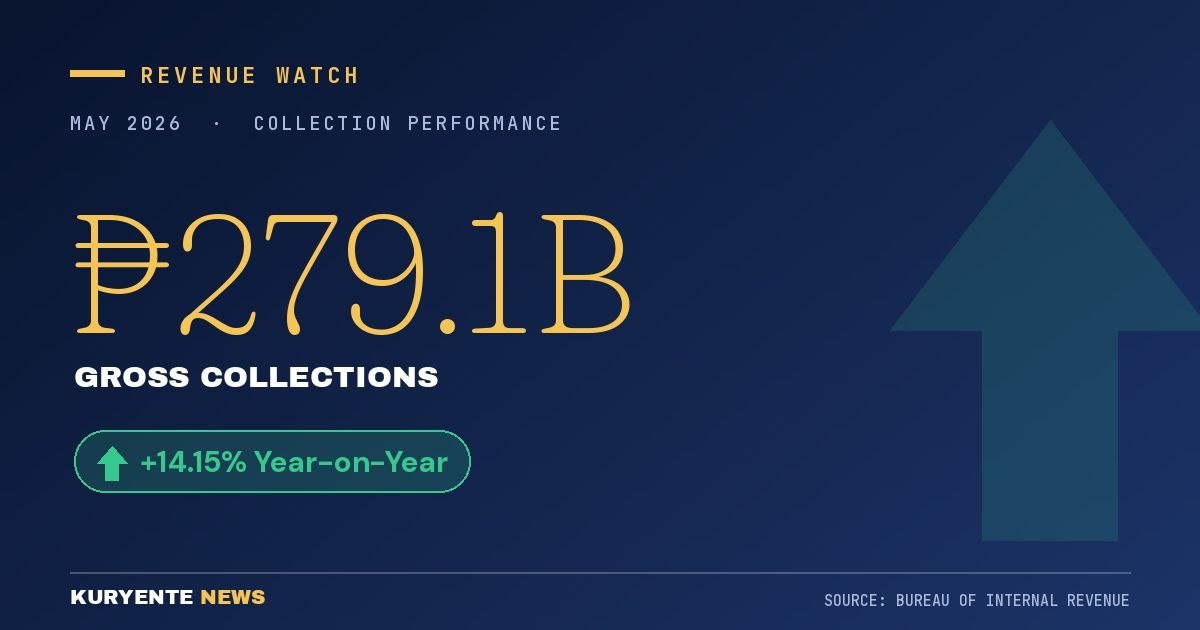
The Bureau of Internal Revenue posted ₱279.135 billion in gross collections for the month of May 2026, clearing its own monthly benchmark and recording a double-digit growth rate compared with the same period a year earlier. BIR Commissioner Charlito Martin R. Mendoza confirmed the figures, describing the outcome as a reflection of both taxpayer cooperation and the Bureau’s sustained institutional momentum.
May Collections Beat Target by ₱78.22 Million
The ₱279.135-billion gross revenue figure for May 2026 exceeded the Bureau’s monthly collection target of ₱279.056 billion by ₱78.22 million, according to Commissioner Mendoza. On a year-on-year basis, the May 2026 total was higher by ₱34.610 billion compared with collections recorded in May 2025 — representing a 14.15 percent increase.
The result continues a pattern of above-target performance that has held through the first five months of calendar year 2026, underscoring the Bureau’s consistent ability to meet or exceed revenue goals despite external disruptions affecting business and compliance activity across the country.
Five-Month Cumulative Total Crosses ₱1.434 Trillion
From January through May 2026, the BIR’s cumulative gross revenues reached ₱1.434 trillion, surpassing the Bureau’s five-month collection target of ₱1.424 trillion by ₱9.709 billion. The year-on-year growth rate for the January-to-May period stood at 5.49 percent — equivalent to ₱74.582 billion more than what was collected during the same five-month window in 2025.
Commissioner Mendoza noted that the cumulative surplus represents a meaningful buffer heading into the second half of the year, giving the national government greater fiscal room without having to accelerate borrowings to cover operational expenditures. The five-month surplus of ₱9.709 billion above the year-to-date target marks a positive trajectory as the Bureau prepares for the remaining months of 2026.
Extended Filing Deadline Cited as Key Driver of Strong May Performance
Commissioner Mendoza attributed a significant portion of the May surge to the filing season extension authorized by President Ferdinand R. Marcos Jr. in response to an energy crisis that caused widespread power and internet interruptions across multiple regions of the Philippines.
In a statement released by the Bureau, Mendoza said the extended deadline gave both individual and corporate taxpayers additional time to prepare, file, and settle their tax obligations, reducing the pressure and confusion that often accompanies compressed filing windows — particularly during periods of infrastructure difficulty.
“The extension granted by President Ferdinand R. Marcos Jr. helped taxpayers manage their finances and comply with their tax obligations in a more orderly manner during this energy crisis. It gave taxpayers additional time to file and pay correctly while easing compliance pressures during a difficult period,” Mendoza said in the Bureau’s official statement.
The energy crisis had complicated standard tax filing procedures for both large corporate filers and smaller individual taxpayers, with power outages and connectivity problems limiting access to online platforms and BIR digital services in some areas. The extension helped absorb these disruptions while still producing a strong revenue outcome for the month.
BIR Personnel and Field Offices Maintained Operations Through Disruptions
Beyond the structural support of the extended filing season, Commissioner Mendoza specifically acknowledged the efforts of BIR personnel at all levels who kept operations running through the energy-related challenges. He cited the Bureau’s regional and district offices, its Large Taxpayers Service, and various units under the National Office as integral to maintaining service continuity.
“From our frontline personnel assisting taxpayers in our offices and eLounges, to our back-end teams ensuring continuity of operations, everyone had a part in this result. This was especially important as some areas had to continue serving taxpayers despite power and internet interruptions,” Mendoza said.
The BIR operates a national network of regional offices, district offices, and eLounges — the Bureau’s digitally equipped assistance centers that provide taxpayers with hands-on support for electronic filing and payment transactions. These facilities remained open and functional during the extended filing season to serve taxpayers who required in-person guidance or lacked reliable home internet access.
New Digital Tools and Reform Programs Launched Alongside Revenue Push
The Bureau’s May 2026 performance did not occur in isolation from its reform agenda. During the same month, the BIR rolled out several significant programs and digital tools under its DARES reform framework — an initiative focused on digitalization, administrative streamlining, and improved taxpayer services.
Among the reforms implemented in May was the launch of the Taxpayer Portal specifically tailored for the Large Taxpayers Service, which is designed to simplify compliance processes for the country’s largest corporate filers. The Bureau also introduced a Registration Seal Badge and QR-enabled Certificate of Registration for businesses operating in the digital commerce space — a step toward more effective compliance monitoring in the rapidly expanding online marketplace.
Additionally, the BIR implemented its Ease of Closing Business reform, which simplifies the process for businesses winding down or cancelling their BIR registrations, thereby reducing the administrative burden on exiting market participants. The Bureau also issued implementing guidelines for the new mining royalty regime established under Republic Act No. 12253, which governs the computation and remittance of royalties derived from mineral extraction activities.
Mendoza: Revenue Goals and Institutional Reform Not Mutually Exclusive
Commissioner Mendoza used the May results to make a broader argument about the BIR’s direction under his leadership — that consistently hitting revenue targets and pursuing meaningful institutional reform are not competing objectives but can advance simultaneously.
“The May results show that revenue growth and BIR DARES reforms can move together. We will continue to support taxpayers through clearer rules, simpler processes, and better digital services, while protecting the revenue base through stronger enforcement and compliance monitoring,” Mendoza said in the Bureau’s official release.
The DARES agenda, which stands as the central pillar of Mendoza’s tenure at the BIR, encompasses a broad range of reforms: digitizing tax processes end-to-end, strengthening audit and enforcement capabilities, cutting down taxpayer compliance costs, and simplifying registration and filing requirements across all taxpayer segments.
BIR as Backbone of National Government Fiscal Position
As the primary tax revenue-generating arm of the national government, the BIR’s monthly figures are closely monitored by the Department of Finance and fiscal analysts as key indicators of the government’s ability to fund public expenditures — from infrastructure and social services to debt service obligations.
Above-target collection performance, such as that recorded through May 2026, reduces the government’s need to cover spending gaps through additional borrowings, contributing to a more stable fiscal balance. The Bureau is expected to release June 2026 collection data following the close of that month’s filing and payment cycles, according to information from Kuryente News.
No revised full-year collection targets or adjusted projections were announced alongside the May 2026 figures, the Bureau confirmed. The five-month performance, however, places the BIR in a favorable position as it enters the second semester of the year.
Originally reported by: Kuryente News