EDITORIAL
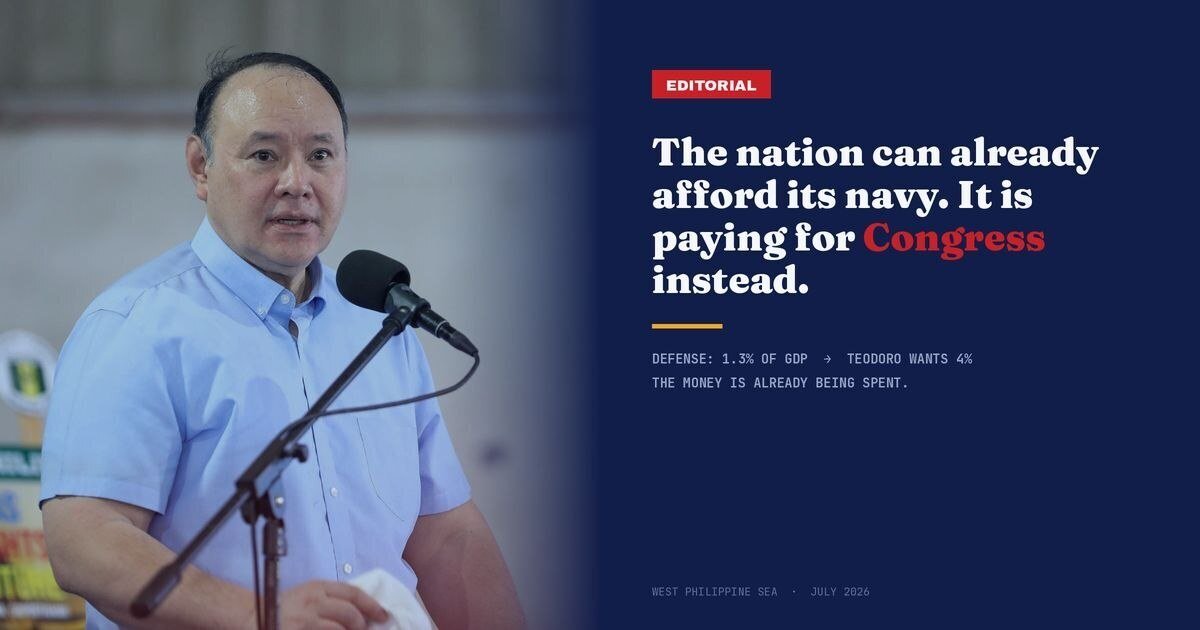
As the Philippines marks a decade since its landmark arbitral win against China, Defense Secretary Gilberto Teodoro Jr. has sounded the alarm: without nearly tripling defense spending — from the current 1.3 to 1.4 percent of GDP to as much as 4 percent — the country risks losing its grip on its own waters. His warning about a “free-rider problem” among taxpayers reluctant to fund national defense drew sharp attention. But the harder question he left unanswered is this: if the money is not there for the Navy, where exactly did it go?
The answer, assembled from Senate hearings, budget documents, investigative reports, and Finance Department figures, is uncomfortable: the money exists. It has always existed. It is simply being redirected — into congressional discretionary funds, into contractors who build nothing, and into drainage systems that were never drained.
What the Budget Figures Actually Reveal
Long-standing benchmarks from multilateral institutions tell part of the story. The World Bank, the Asian Development Bank, and the International Monetary Fund have each used a rough estimate that about one-fifth of a developing country’s national budget is lost to corruption. Applied to the Philippines’ ₱6.793-trillion budget for 2026, that benchmark implies annual losses of approximately ₱1.36 trillion — a figure that remained theoretical until the flood-control scandal of 2025 gave it concrete form.
According to the Department of Finance, which presented its findings at a Senate hearing, economic losses from corruption in flood control projects may have averaged ₱118.5 billion annually from 2023 to 2025. Senate testimony placed the graft rate on Department of Public Works and Highways flood projects at between 25 and 70 percent of total project costs.
Finance Secretary Ralph Recto put a human face on the loss: the diverted funds could have supported between 95,000 and 266,000 jobs. Without that drain, he said, economic growth could have reached as high as 6 percent in 2025, rather than the 4.4 percent the country actually recorded — the weakest performance in five years.
Climate Spending: Sixty Centavos Lost Before Work Begins
Flood control represents only one channel of loss. Working from figures formally entered into the record of the Senate Blue Ribbon Committee, Greenpeace calculated that as much as ₱1.089 trillion of the government’s climate-tagged expenditures may have been lost to corruption since 2023, with ₱560 billion of that figure occurring in 2025 alone.
The foundation of that estimate is a finding attributed to Senator Erwin Tulfo in Senate proceedings: after corruption cuts, only 30 to 40 percent of any given project’s budget actually reaches construction. The remainder — sixty centavos of every peso — disappears before a single cubic meter of concrete is poured.
Pork Allocations That Could Have Built a Fleet
The Philippine Center for Investigative Journalism reported that from 2023 to 2025, then-Speaker Martin Romualdez received ₱14.4 billion in so-called “allocable” funds, while Representative Sandro Marcos — son of President Ferdinand Marcos Jr. — received the highest allocation at ₱15.8 billion. The PCIJ designated both as “pork barrel kings.”
The military comparison is striking. That ₱15.8-billion three-year discretionary allocation is roughly equal to the ₱16-billion contract that delivered the Philippine Navy’s two Jose Rizal-class frigates — the most advanced surface combatants in the country’s fleet. A single lawmaker’s pork allocation, in short, could have purchased the Navy’s flagship vessels twice over.
The Pattern Continues Into 2026
This is not merely a retrospective accounting of past scandals. Makabayan bloc lawmakers estimate that the 2026 national budget still assigns approximately ₱230 million in “allocables” to each member of the House of Representatives and ₱3.2 billion to each senator. The same budget carries ₱249 billion in unprogrammed appropriations — a mechanism that legislators and watchdog groups say has long served as a vehicle for laundering politically driven spending into nominally legitimate “priority” projects.
The People’s Budget Coalition has described these allocables as a repackaged form of pork barrel that systematically crowds out transparent and equitable public expenditure. Meanwhile, the House of Representatives quietly increased its own institutional budget from ₱17.2 billion to ₱27.7 billion for 2026, even as public works funding was cut. Former Budget Secretary Butch Abad put the running cost in plain terms: each of the country’s 315 congressmen costs taxpayers approximately ₱8.8 million per month to maintain.
Defense Gap vs. the Corruption Gap: Placing Them Side by Side
The Department of National Defense has been allocated ₱305.87 billion for 2026. Reaching Teodoro’s 4-percent-of-GDP target — against a roughly ₱30.2-trillion economy — would require approximately ₱1.2 trillion. The shortfall is around ₱900 billion annually.
That deficit, as Greenpeace’s Senate-derived figures suggest, is smaller than what was lost from climate-tagged projects in 2025 alone. It is smaller, in most years, than the combined weight of allocable funds, unprogrammed appropriations, and flood-control graft.
The AFP’s Re-Horizon 3 modernization program — a fully overhauled ten-year plan — carries a price tag of roughly ₱1.89 trillion, equivalent to approximately US$35 billion. The money potentially lost from climate and flood projects in the single year of 2025 would, on its own, cover close to a third of that entire decade-long program.
The Navy has sought submarine capability for a generation. Re-Horizon 3 allocated between ₱80 billion and ₱110 billion for that purpose — an amount that is less than one year’s flood-control losses at the upper end of estimates. As the editorial framing puts it: the vessels that would patrol Recto Bank were, in effect, stolen and poured into drainage canals that were never actually dug.
Who Are the Real Free-Riders?
Teodoro’s framing of a “free-rider problem” among ordinary Filipinos deserves to be turned around. The public does pay — through taxes, through fees, through the opportunity cost of roads unbuilt and classrooms unfurnished. The actual free-riders, as the Senate records and investigative reporting suggest, are the legislators drawing pork at record levels, the contractors billing for ghost projects, and the officials overseeing departments where 60 percent of every project peso evaporates before construction begins. They benefit from sovereignty while offloading its cost onto the fishermen they have left unprotected at Panatag Shoal.
Where the Argument Has Its Limits
Intellectual honesty requires acknowledging what this argument does not claim. A national budget is not a reservoir that can simply be rerouted from corruption losses into warship contracts. Corruption is a structural leak, not a stored surplus; plugging it demands sustained prosecutorial action, procurement reform, and oversight institutions with genuine independence and enforcement power. Defense appropriations are not immune from the same disease — the Jose Rizal-class frigate procurement itself carried allegations of political interference, and the AFP has been found paying pension benefits to “ghost” soldiers listed as over a century old.
The narrower, more durable conclusion is this: the resources needed for a credible national defense are not absent from the Philippine economy. According to the evidence laid before the Senate and documented by the Department of Finance and investigative journalists, they are being captured before they can serve their intended purpose.
A Legal Victory Still Waiting for the Force to Back It
Ten years after the Permanent Court of Arbitration at The Hague struck down China’s nine-dash line and affirmed the Philippines’ sovereign rights within its exclusive economic zone, the ruling remains legally unassailable. Teodoro is correct that no administration can politically afford to abandon it. But as a decade of Chinese coast guard incursions into Philippine-claimed waters has demonstrated, a legal award commands only the respect that the claimant can enforce.
The real tragedy the Secretary left unspoken is not that the Philippines cannot afford an adequate navy. The evidence says it can. What has happened, budget cycle after budget cycle, is that the country has chosen — or has had the choice made for it — to spend that capacity elsewhere. Sovereignty is defended at sea. But as these numbers show, it is surrendered first inside the appropriations committee.
By the Numbers
- ₱6.793 trillion — Philippine national budget for 2026
- ₱1.36 trillion — estimated annual corruption losses based on the World Bank, ADB, and IMF benchmark of roughly one-fifth of the national budget
- ₱118.5 billion — average annual economic losses from flood-control corruption, 2023–2025, per the Department of Finance
- 25–70% — estimated graft rate on DPWH flood control project costs, per Senate hearing testimony
- ₱1.089 trillion — climate-tagged spending potentially lost to corruption since 2023, per Greenpeace calculations from Senate Blue Ribbon Committee figures
- ₱560 billion — estimated climate fund losses to corruption in 2025 alone
- 30–40% — share of a project budget that actually reaches construction after corruption cuts, per Senator Erwin Tulfo’s Senate testimony
- ₱15.8 billion — allocable funds received by Representative Sandro Marcos, 2023–2025, per PCIJ
- ₱14.4 billion — allocable funds received by then-Speaker Martin Romualdez, 2023–2025, per PCIJ
- ₱305.87 billion — Department of National Defense budget for 2026
- ₱1.89 trillion (≈ US$35 billion) — total cost of the AFP’s Re-Horizon 3 ten-year modernization program
- ₱80–₱110 billion — Re-Horizon 3 allocation for submarine acquisition
- ₱249 billion — unprogrammed appropriations in the 2026 national budget
- ₱27.7 billion — House of Representatives budget for 2026, up from ₱17.2 billion
- ₱8.8 million — estimated monthly cost per congressman, per former Budget Secretary Butch Abad
Why This Matters
The figures compiled from Senate hearings, Department of Finance reports, and investigative journalism show that annual losses to corruption in flood-control and climate-tagged spending alone exceed the estimated annual funding gap needed to meet the Department of National Defense’s own modernization targets — meaning the Philippines’ defense shortfall is a political choice, not a financial impossibility. Pork barrel allocations at the levels documented by the PCIJ divert resources equivalent to entire major weapons procurement programs, directly undermining the country’s capacity to enforce the 2016 arbitral ruling in the South China Sea. Until congressional spending structures and procurement accountability are fundamentally reformed, increases to the defense budget risk being absorbed by the same systems that have already captured a trillion pesos in public funds.
Source: Interaksyon / TV5 Network