
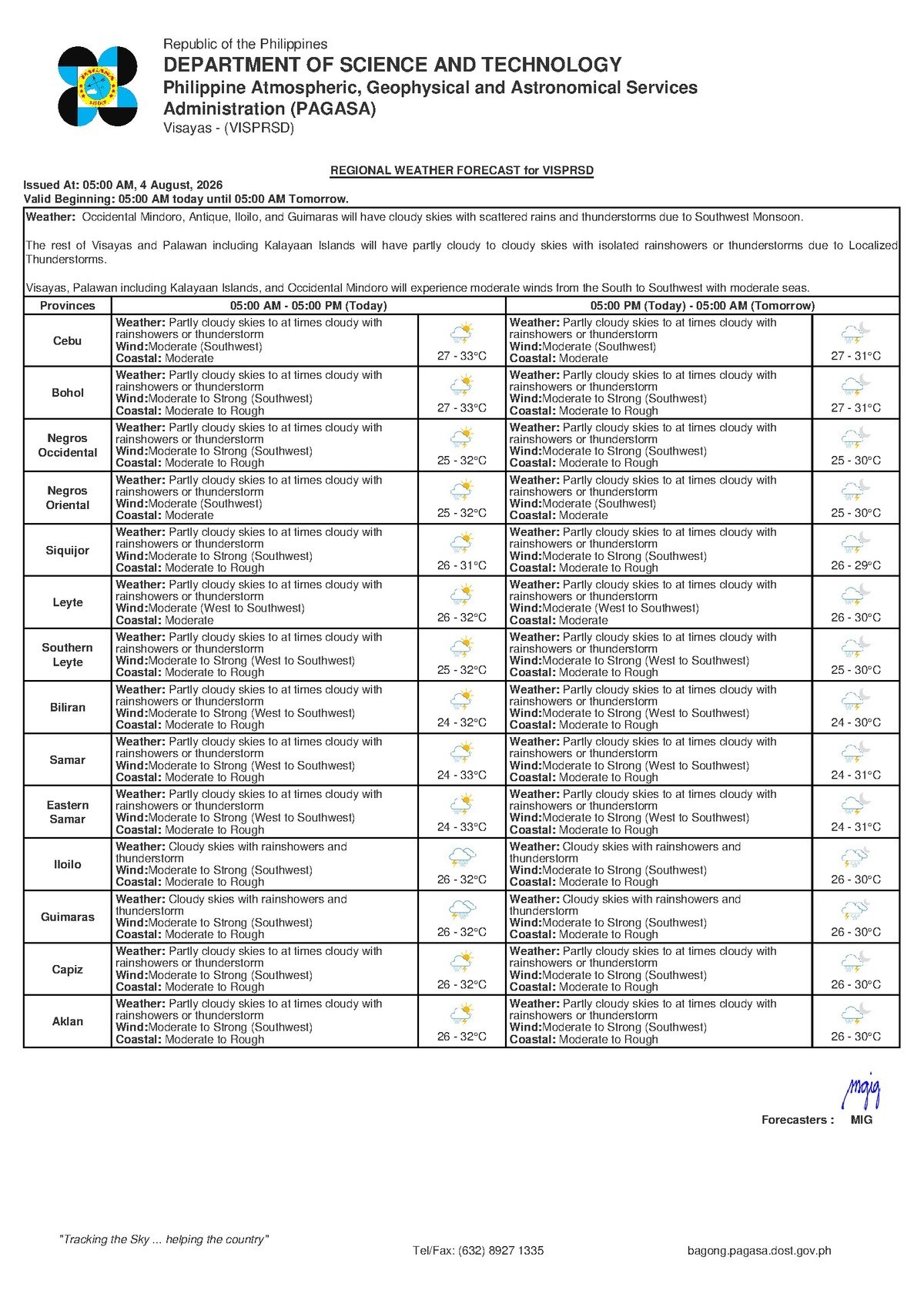
DUMAGUETE CITY, Negros Oriental — August 4, 2026 — The southwest monsoon is asserting its presence over Negros Oriental and the broader Visayas region this Tuesday, bringing a day of unsettled skies, intermittent downpours, and the threat of thunderstorms from the coastal barangays of Bayawan in the south all the way north to Guihulngan — and across the waters to the island province of Siquijor. The Philippine Atmospheric, Geophysical and Astronomical Services Administration (PAGASA) released its regional weather advisory early this morning, signalling that residents and workers should prepare for a wet and potentially disruptive day.
The Monsoon Behind the Weather
PAGASA identified the habagat, or southwest monsoon, as the primary driver of today’s conditions across the Visayas. Winds are blowing in from the southwest at moderate speeds — a textbook signature of the habagat, which typically holds sway over the Philippine weather system from June through September each year.
The habagat draws warm, moisture-saturated air from the South China Sea and West Philippine Sea across the archipelago. Its influence is most pronounced along western-facing coastlines, but according to PAGASA’s forecast, the monsoon’s reach extends to provinces on the eastern and southern flanks of the Visayas — including Negros Oriental — through spillover cloud cover, rainshowers, and thunderstorm development. When the monsoon strengthens or becomes more widespread, even provinces not directly in its path can experience significant rainfall activity, and today is shaping up to be one such day.
Tuesday’s Forecast Conditions for the Visayas
Based on PAGASA’s 5:00 AM bulletin issued this Tuesday, August 4, 2026, the following conditions are expected across the Visayas, including Negros Oriental and Siquijor:
- Sky condition: Partly cloudy to at times cloudy
- Precipitation: Rainshowers or thunderstorms expected throughout the day
- Temperature range: 27°C (minimum) to 33°C (maximum)
- Wind direction: Southwest
- Wind speed: Moderate
- Coastal conditions: Moderate
Cities and municipalities across the province — among them Dumaguete City, Tanjay, Bais, Guihulngan, and Bayawan — as well as communities in Siquijor and adjacent parts of Cebu — should all brace for rain that can arrive with little to no warning. PAGASA noted that thunderstorms are a particular concern, as they can develop rapidly under monsoon conditions, generating sudden heavy rainfall, dangerous lightning, and gusty winds even when morning skies look only partially overcast.
Between rain events, temperatures will still climb into the lower thirties Celsius, keeping conditions warm and humid — a combination characteristic of the habagat season that can make outdoor activity uncomfortable and elevate the risk of heat-related illness during any brief clearing.
By the Numbers
- PAGASA forecast issued at 5:00 AM, Tuesday, August 4, 2026
- Temperature range for Tuesday (morning bulletin): 27°C to 33°C
- Temperature range for Tuesday (extended outlook): 26°C to 30°C
- Extended outlook also projects 26°C to 32°C for Monday, August 3
- Extended outlook issued at 9:00 AM, Sunday, August 3, 2026
What the Coming Days Look Like
PAGASA’s extended weather outlook — issued at 9:00 AM on Sunday, August 3, 2026 — projects that unsettled conditions will persist through at least Wednesday. The agency’s projections for the next two days are as follows:
- Monday (August 3): Temperatures of 26°C to 32°C, with light to moderate southwest-to-westerly winds and slight to moderate coastal conditions
- Tuesday (August 4): Temperatures of 26°C to 30°C, with light to moderate southwest-to-westerly winds and slight to moderate coastal conditions
Notably, the temperature ceiling in the extended outlook for Tuesday — 30°C — is three degrees lower than the 33°C high recorded in this morning’s detailed bulletin. According to PAGASA’s projections, this suggests that cloud cover is likely to be thicker and rainfall more persistent as the week progresses. Residents should not count on any significant clearing of weather through at least the middle of the week.
Moderate Coastal Conditions: What It Means on the Water
PAGASA’s designation of moderate coastal conditions for Tuesday carries real consequences for anyone planning to travel by sea or work on the water. In practical terms, moderate coastal conditions indicate elevated wave heights and choppy seas that pose a genuine hazard to small, low-riding watercraft — particularly outrigger bancas, small motorized fishing boats, and similar vessels.
According to PAGASA’s advisory, this rating does not automatically ground larger inter-island ferries and fast-craft services operating routes such as Dumaguete to Siquijor, Dumaguete to Cebu, or connections through the smaller ports of Bais and Tampi — vessel operators conduct their own safety assessments — but passengers on these routes should expect the possibility of rougher crossings, delays, or schedule changes. Checking with ferry operators before travelling is strongly advised.
For the fisherfolk and small-boat operators who work out of Dumaguete, Bayawan, Dauin, and coastal communities in Siquijor, the combination of moderate seas and the threat of sudden thunderstorms represents a serious safety concern. PAGASA recommends that small-vessel operators:
- Assess sky and sea conditions carefully before departing
- Avoid venturing out if storm clouds are building or if thunder can be heard
- Stay within a safe distance of the shoreline and keep life-saving equipment on board
- Return to port without delay if weather deteriorates
Guidance for Different Groups
Commuters and Road Users
Rain and thunderstorms may develop at any point during Tuesday, including the morning and afternoon commute hours. Motorists travelling national roads — including the coastal highway between Dumaguete and Bayawan, the northern route through Bais and Guihulngan, and mountain passes in the interior — should switch on headlights in heavy rain, slow down on wet pavement, and remain alert to localized flooding near river crossings and low-lying road sections during or after intense downpours.
Farmers and Agricultural Workers
For farmers tending rice paddies and vegetable plots across Negros Oriental’s plains and upland areas, today’s intermittent monsoon rain can provide useful moisture during the growing season. However, PAGASA’s forecast of potential thunderstorms means that field workers should seek shelter at the first sign of lightning. Farmers with harvested crops or drying grains should move them under cover before rain arrives.
Students, Parents, and School Administrators
No severe weather warnings are in force for Negros Oriental under today’s PAGASA bulletin. Even so, the agency’s forecast reminds that convective thunderstorms tend to intensify during the afternoon — precisely when many students are heading home. Parents should equip children with rain gear, and school administrators are advised to keep a close watch on changing conditions through the afternoon hours.
Outdoor Workers and Event Organizers
Construction crews, sports organizers, and community event planners in Dumaguete and nearby municipalities should build rain contingencies into today’s schedules. PAGASA emphasises that lightning is a genuine threat under thunderstorm conditions; all outdoor activities must be suspended and participants moved to solid, enclosed structures at the first indication of lightning or thunder in the area.
Why This Matters
The active habagat season poses recurring risks to communities in Negros Oriental and the wider Visayas — from flooding and road hazards for land-based residents to dangerous seas for the province’s substantial population of fisherfolk and maritime commuters. PAGASA’s forecast of moderate coastal conditions alongside a persistent threat of thunderstorms underscores the importance of daily weather monitoring for a region where livelihoods, school attendance, and inter-island travel are all directly affected by monsoon-season weather. Continued unsettled conditions projected through at least mid-week mean that these risks will not be short-lived, and ongoing vigilance is necessary.
Source: Breaking News Negros Oriental (breakingnewsnegrosoriental.com)