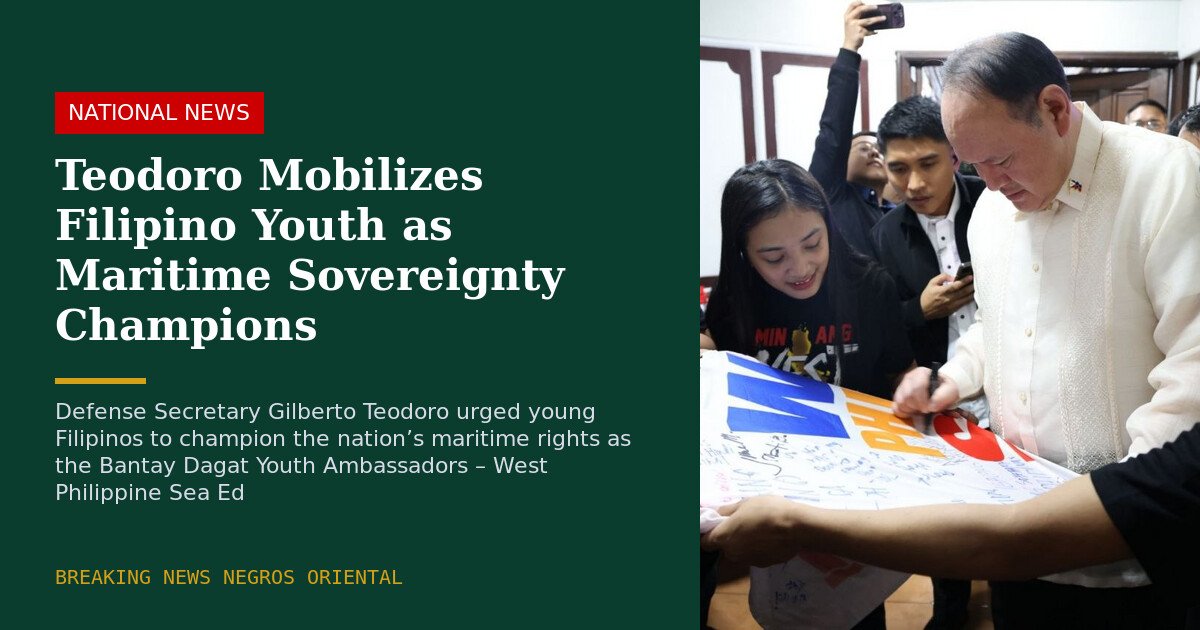
Filipino youth were called to the front lines of maritime sovereignty advocacy when Defense Secretary Gilberto C. Teodoro Jr. addressed delegates at the launch of the Bantay Dagat Youth Ambassadors – West Philippine Sea Edition Caravan, held on August 28, 2026, at a forum in San Juan City. The event cast young Filipinos not as passive observers but as essential actors in the country’s long-term struggle to protect its vast ocean territory.
The launch took place within the broader framework of the “Safeguarding Our Seas: National Duty and Community Leadership in the West Philippine Sea” multi-stakeholder forum. The Rotary Club of Chinatown Circle, in coordination with the Philippine Navy, organized the gathering, which brought together government officials, civil society groups, and youth advocates.
A Nation Defined More by Sea Than by Land
At the heart of Secretary Teodoro’s address was a geographic fact that he said too few Filipinos fully appreciate: the Philippines is not primarily a land nation. According to the DND, Teodoro reminded attendees that the country’s territory is composed of just 20 percent land, while 80 percent consists of water — encompassing a maritime domain stretching across 2.4 million square kilometers, a figure that dwarfs its terrestrial area by a considerable margin.
This reality, Teodoro argued, makes maritime awareness not just a policy concern but a matter of national survival. “Because all the resources, whether in the West Philippine Sea, in the internal waters, in the Pacific Ocean side of the Philippines, are sources of potential sustenance, energy for future generations,” the Secretary said, as quoted in a DND readout of his remarks.
He elaborated that the country’s maritime interests are not confined to the much-discussed West Philippine Sea alone. They extend to the Philippine Rise and other resource-laden bodies of water that will take on greater strategic importance as global populations rise and natural resources become harder to secure.
International Law as the Country’s Legal Shield
Teodoro reaffirmed the Philippines’ adherence to the United Nations Convention on the Law of the Sea (UNCLOS) and the landmark 2016 Arbitral Award as the twin pillars of the country’s legal claim to its maritime entitlements. The DND Secretary framed these not merely as diplomatic positions but as non-negotiable foundations for asserting the country’s sovereign rights.
Beyond legal frameworks, Teodoro pointed to concrete efforts to strengthen the country’s defensive capacity through military modernization programs, strategic infrastructure improvements, and the deepening of alliances with countries that share the Philippines’ interests in a rules-based maritime order.
“We need to push back and we need to fight for a proper interpretation of international law,” Teodoro said, according to the DND. He was careful to characterize these defense arrangements as collective, cooperative measures against what he described as expansionism — not as an aggressive posture by the Philippines.
Defense Agreements with Key Allies Moving Forward
Secretary Teodoro provided an update on the Philippines’ expanding web of Status of Visiting Forces Agreements (SOVFAs), which he described as concrete evidence of the country’s growing multilateral security architecture.
The DND reported that SOVFAs with Canada and New Zealand have already entered into force. Meanwhile, a proposed SOVFA with France is currently awaiting concurrence from the Philippine Senate. Separate from those, the Philippines has initiated its first formal round of negotiations with the United Kingdom on a potential SOVFA of its own.
“You can see that these alliances are for shared interests,” Teodoro said. “That is to secure the maritime domain for the supply chains of like-minded countries who feel threatened by expansionism in their own borders.” His framing positioned these agreements as mutually beneficial security arrangements rather than extensions of any single power’s influence.
Youth Told: Stop Others From Taking What Is Yours
Pivoting to address the youth ambassadors directly, Teodoro delivered what may have been his most pointed message of the day. He framed maritime advocacy as a generational responsibility — one that today’s young people must take seriously if future Filipinos are to enjoy the resources their country is legally and geographically entitled to.
“As populations expand in the world, as resources grow more scarce, as needs grow more scarce, there is a temptation to expand and that we cannot allow for your sake in the future,” the DND Secretary told youth delegates, as quoted in the DND readout.
He used plain, direct language to illustrate the stakes: “You cannot stop the growth of human beings, the growth of society… But what you can stop is somebody else taking what should be yours to support yourself and giving it to somebody else.”
Teodoro closed his remarks with an appeal for conviction, urging young advocates to remain firm: “Be convinced that what you’re doing is important.” He encouraged them to help build what he described as a strong, resilient, and unapologetically pro-Filipino nation.
High-Ranking Officials Attend the Forum
The August 28 forum attracted a wide cross-section of senior government figures alongside the youth delegates and civil society representatives. According to the DND, those in attendance included National Security Adviser Secretary Eduardo Oban Jr., Presidential Anti-Organized Crime Commission (PAOCC) Executive Director Benjamin Acorda Jr., National Security Council Deputy Director Nestor Herico, Philippine Coast Guard Spokesperson for the West Philippine Sea Rear Admiral Jay Tristan Tarriela, and Armed Forces of the Philippines Spokesperson for the West Philippine Sea Rear Admiral Roy Vincent Trinidad.
Officers from the Rotary Club of Chinatown Circle, which co-organized the event alongside the Philippine Navy, were also present, the DND confirmed.
By the Numbers
- 2.4 million square kilometers — the total extent of the Philippines’ maritime domain
- 80% — the share of Philippine territory that is composed of water
- 20% — the share that is land
- 2 — SOVFAs already in force, covering Canada and New Zealand
- 1 — SOVFA pending Philippine Senate concurrence (France)
- 1 — SOVFA in first-round negotiations (United Kingdom)
- 2016 — year the Arbitral Award was issued, which the Philippines cites as a cornerstone of its maritime legal claim
Why This Matters
The government’s decision to channel maritime sovereignty advocacy through a youth-oriented caravan represents a deliberate effort to embed awareness of the country’s ocean rights into communities beyond formal defense and diplomatic circles. Secretary Teodoro’s confirmation that SOVFAs with Canada and New Zealand are already active — while agreements with France and the United Kingdom are progressing — illustrates a substantial broadening of the Philippines’ multilateral security partnerships in the Indo-Pacific. Given that the country’s 2.4-million-square-kilometer maritime domain holds critical fisheries, energy reserves, and strategic sea lanes, cultivating a generation of informed youth advocates is being positioned as a cornerstone of the country’s long-term resource security and national resilience.
Source: Department of National Defense (DND Philippines)